
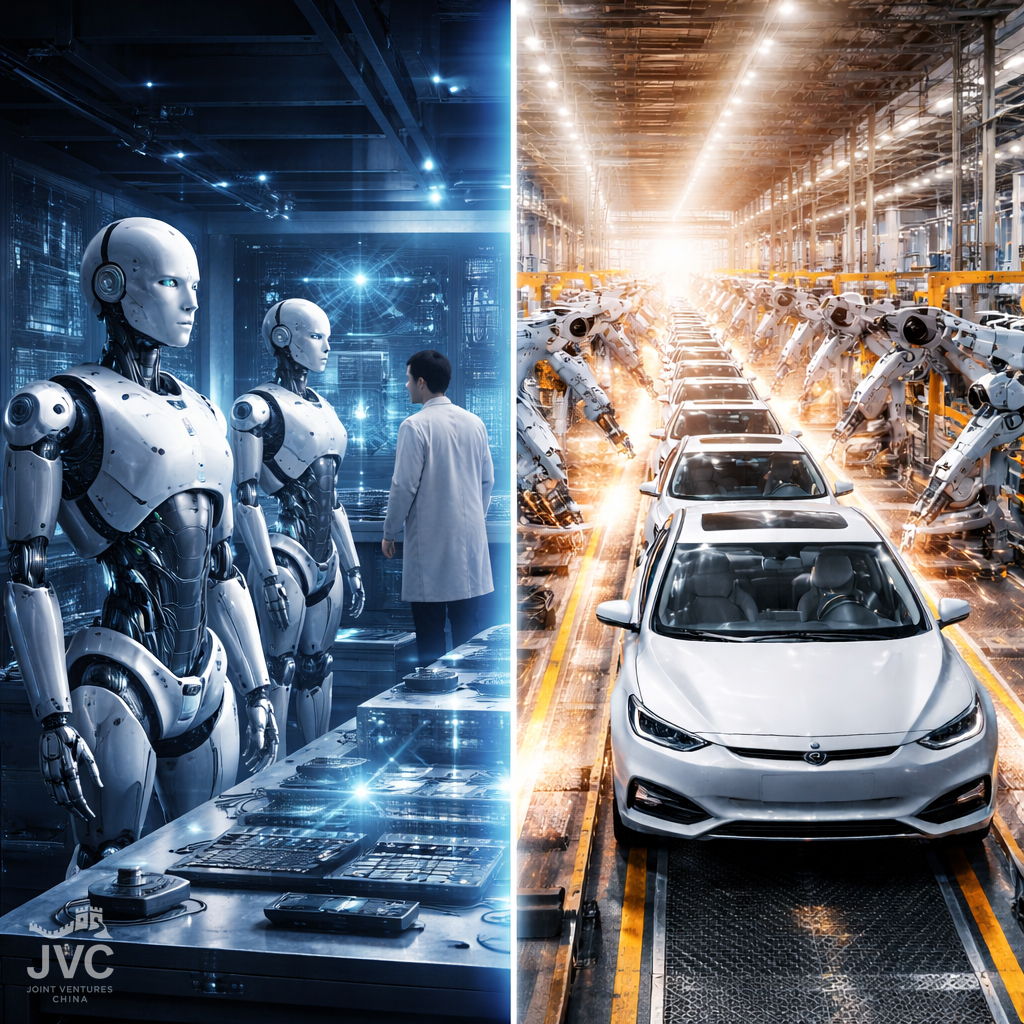
For decades, global business leaders operated under a comfortable assumption.
China scales.
The West innovates.
That distinction shaped investment decisions, trade policy, corporate strategy, and competitive confidence. Western firms focused on research and early-stage technology. Chinese firms were seen as masters of execution, cost control, and rapid industrial deployment.
It was a clean mental model.
It is no longer accurate.
The conversation is no longer about manufacturing efficiency alone. It is about China innovation and scale operating together in a single system. The convergence of China innovation and scale is reshaping global competitive dynamics.
Why China Became Exceptional at Scale
Before understanding what is changing, it is important to understand what was always true.
Chinese companies scaled rapidly because the system around them was designed for coordinated expansion.
Infrastructure was built for industrial velocity.
Supply chains clustered geographically.
Capital deployment aligned with national priorities.
Mandates moved through hierarchical structures quickly once decisions were finalized.
Scaling in China has rarely been improvisational. It has been orchestrated.
This structural pattern is explored in Why Chinese Companies Move Faster — And Why It Matters More Than Ever and reinforced in Speed in China Doesn’t Look Fast — Until It Does. Speed in China is rarely chaotic. It is the product of alignment before motion.
It also reflects the disciplined sequencing discussed in Why Sequence Beats Speed in China’s Factories. Scale was not about rushing. It was about structured progression.
This system advantage explains how companies like BYD vertically integrated battery production, vehicle manufacturing, and component sourcing at remarkable speed. It explains how Huawei deployed telecom infrastructure across multiple continents with operational consistency.
For years, scale was China’s defining competitive advantage.
Innovation was seen as secondary.
Why the West Believed Innovation Was Its Domain
The Western assumption of innovation superiority was not baseless.
The United States led semiconductor design.
Silicon Valley shaped the internet.
American venture capital funded platform ecosystems.
European engineering dominated precision manufacturing and automotive performance.
Meanwhile, China built infrastructure.
Factories multiplied. Industrial clusters deepened. Export capacity surged.
From the outside, it appeared that China’s role was implementation rather than invention.
But this interpretation missed something fundamental.
China was building the physical, financial, and talent architecture that would eventually support innovation at scale.
Scale was not the destination.
It was the foundation.
That foundation now supports the rise of China innovation and scale as a combined strategic force.
The Convergence of China Innovation and Scale
The real shift is not that China learned how to scale. It always knew how to scale.
The shift is that innovation capacity is now embedded inside the same system that drives expansion.
Several forces accelerated this convergence.
First, talent density. China produces one of the world’s largest pools of STEM graduates annually. That creates depth across engineering, manufacturing, and applied research. Innovation capacity is no longer concentrated in isolated labs. It is distributed across ecosystems.
Second, domestic competition. Chinese companies compete intensely inside their own market. Speed pressure and technology pressure create rapid iteration cycles. Innovation becomes survival.
Third, hardware and software integration. In sectors like electric vehicles, robotics, battery technology, and AI-enabled manufacturing, product development is tightly integrated with production capability. This shortens the distance between prototype and mass deployment.
Fourth, capital alignment. Strategic industries receive sustained investment that allows experimentation without constant short-term earnings pressure dominating every decision. Even external pressure, as explored in How China Responds to Pressure, often accelerates system adaptation rather than slowing it.
Evidence of this shift is visible in global data. According to the Global Innovation Index published by the World Intellectual Property Organization, China has risen steadily in global innovation rankings over the past decade and now ranks among the world’s leading innovation economies. The trajectory reflects sustained R&D investment, patent growth, advanced manufacturing integration, and ecosystem development across multiple sectors.
This expanding China innovation ecosystem strengthens the structural integration between research, capital, and industrial deployment.
The result is a system where China innovation and scale operate simultaneously.
Not sequentially.
The Competitive Shift
For years, China’s advantage was scale.
Now scale is becoming the platform for innovation.
When innovation and expansion operate inside the same system, the competitive equation changes.
This is no longer about manufacturing capacity.
It is about ecosystem capability.
Sector Signals: Where the Shift Is Visible
The electric vehicle ecosystem offers a clear example.
BYD is no longer simply scaling battery output. It is designing proprietary battery architectures, refining software integration, and vertically integrating components. Scale accelerates innovation feedback loops.
In telecommunications and advanced computing infrastructure, Huawei continues investing heavily in semiconductor design and AI development despite external constraints.
In consumer technology hardware, DJI did not dominate global drone markets through cost advantages alone. It combined software, stabilization algorithms, hardware miniaturization, and manufacturing efficiency into a unified competitive engine.
For comparison, Tesla demonstrated how innovation-driven firms can reshape industries. But what is increasingly clear is that Chinese firms are not merely following. They are competing directly in advanced battery systems, AI integration, and platform ecosystems.
The distinction between innovation-first and scale-first companies is blurring.
This blurring reflects the growing maturity of China innovation and scale across multiple sectors.
Why This Changes the Competitive Landscape
For Western leaders, the strategic risk is underestimating this convergence.
If China only scaled, the competitive response was clear: protect intellectual property, maintain R&D leadership, and accept manufacturing migration.
If China combines innovation with scale, the response becomes more complex.
Innovation embedded inside a scaling ecosystem creates compounding advantages:
Faster commercialization.
Lower production ramp friction.
Integrated supply chain iteration.
Shorter feedback loops between engineering and deployment.
When innovation and scaling reinforce each other, competitive moats widen. This shift elevates Chinese manufacturing competitiveness beyond cost efficiency toward system capability.
This is not about ideology.
It is about understanding how China innovation and scale alter competitive strategy.
It is about system design.
The Structural Advantage of Innovating at Scale
Innovation in the West has historically followed a familiar pattern.
Research begins in universities or private labs. Venture capital funds early development. A product is commercialized. Manufacturing is optimized later, often in a separate geography.
Innovation and scale occur in sequence.
In China, those stages are increasingly collapsing into one another.
Engineering teams sit closer to manufacturing lines. Suppliers sit closer to product designers. Iteration cycles are compressed because the distance between prototype and production is smaller, both geographically and organizationally.
This structural proximity changes how innovation behaves.
In many Western systems, scaling introduces friction. Production ramp adds cost. Supply chain constraints slow iteration. Manufacturing complexity increases risk.
In the Chinese model, scaling often reduces friction.
Once infrastructure and supplier density are established, adding volume can reduce cost per experiment. Product improvements can be tested across large customer bases quickly. Digital feedback loops feed directly into hardware refinement.
Innovation becomes iterative at scale, not isolated from it.
This is innovation at scale, embedded directly inside production ecosystems.
This creates a compounding advantage.
When product development, capital deployment, and industrial capacity operate inside the same ecosystem, the cost of experimentation drops. The speed of commercialization rises. Competitive positioning strengthens.
This is where China innovation and scale become more than parallel capabilities.
They become mutually reinforcing forces.
That reinforcement is the core advantage of China innovation and scale.
Capital, Competition, and Compression
Another underappreciated dimension of this shift is capital structure.
Western public markets often reward short-term earnings performance. R&D investment must be justified quarterly. Manufacturing build-out competes with shareholder return expectations.
In China, strategic sectors often benefit from longer investment horizons. Government policy, private capital, and industrial objectives align more closely around multi-year development goals.
This does not eliminate market pressure. It redistributes it.
Domestic competition inside China is intense. Technology cycles move quickly. But the ecosystem supports reinvestment in process improvement and product iteration at a pace that surprises many foreign observers.
When innovation is not isolated inside a small R&D unit but embedded across engineering, production, and supplier networks, the system evolves continuously.
The time between idea and deployment compresses.
That compression is one of the defining characteristics of the new competitive environment.
What This Means for Joint Ventures and Global Partnerships
This convergence has direct implications for joint ventures and foreign partnerships operating in China.
Western firms entering the market expecting to contribute innovation while relying on Chinese partners for scale may find the balance shifting.
Chinese partners increasingly bring engineering capability, applied R&D depth, process innovation, and digital manufacturing integration.
The relationship is becoming more symmetrical.
As China innovation and scale strengthen internally, partnership dynamics evolve externally.
For joint venture leaders, this changes governance dynamics. Decision-making authority, intellectual property sharing, and product development roles must reflect a more equal innovation contribution.
The old model of “Western design, Chinese execution” is less durable than it once was.
Competition shifts from labor cost comparison to ecosystem comparison.
The relevant question becomes:
Which system integrates talent, capital, manufacturing, and digital capability more effectively?
That is a higher level of competition.
The Emerging Reality
China was built to scale.
That strength remains.
But scale is no longer the ceiling.
It is the platform.
And that platform is defined by China innovation and scale working in tandem.
And when a system built for expansion begins innovating at scale, the competitive equation shifts in ways that ripple far beyond manufacturing.
Executives who recognize that shift early will adjust strategy accordingly.
Those who do not may find themselves competing against a model they misunderstood.
Enjoying this?
Get weekly, real-world insights on China joint ventures and China manufacturing.