

Western executives often misunderstand Chinese business decision making.
They leave meetings confused.
The proposal seemed reasonable.
The numbers made sense.
No one openly disagreed.
And yet no one said yes.
Understanding how Chinese business decision making actually works requires looking beyond the meeting itself and into the internal risk structure of the organization.
The assumption is usually that the Chinese side is hesitant, slow, or overly cautious.
That interpretation is wrong.
In many cases, what you are seeing is not hesitation.
It is career protection.
To understand why decisions in China often move quietly before they move visibly, you have to understand the internal risk equation inside Chinese organizations.
Saying yes too early can be dangerous.
And in some companies, it can be career-limiting.
The Western Bias Toward Visible Commitment
In Western firms, leadership is often demonstrated through decisiveness.
The person who says:
“Let’s do it.”
“Lock it in.”
“I’ll own this.”
Is seen as confident and capable.
Visibility creates advancement.
Individual accountability is rewarded.
Even when the decision fails, boldness is often respected.
So Western leaders assume that early commitment signals strength.
They also assume hesitation signals weakness.
But that assumption does not translate cleanly into Chinese business decision making structures.
The Risk Equation Inside Chinese Business Decision Making
In many Chinese companies, incentives are structured differently.
Career advancement is tied less to bold individual positioning and more to stability, predictability, and alignment within the hierarchy.
When someone says yes too early, they create three immediate risks:
- They expose themselves if the decision later fails.
- They bypass colleagues who may not yet be aligned.
- They increase political visibility before protection exists.
That visibility is not always rewarded.
Sometimes it creates vulnerability.
In this context, silence is not incompetence.
It is insulation.
Western Incentives vs Chinese Incentives
To understand the pause, you must understand incentives.
In many Western organizations:
- Performance reviews emphasize initiative.
- Leadership potential is tied to decisiveness.
- Ownership of outcomes is visible and rewarded.
- Failure is often tolerated if initiative was shown.
In many Chinese organizations:
- Stability is valued over disruption.
- Protection of superiors and subordinates matters.
- Risk distribution is collective, not individual.
- Avoiding visible error can be more important than visible boldness.
These structural differences are central to understanding Chinese business decision making at both operational and board levels.
They also align with established cross-cultural research, including Hofstede’s work on power distance, which highlights how hierarchical societies manage authority and accountability differently than individualist systems (Hofstede Insights: https://www.hofstede-insights.com/).
This does not mean Chinese firms avoid risk.
They simply sequence it differently.
Before risk becomes visible externally, it must be stabilized internally.
That stabilization process is what Western executives often misinterpret as delay.
Why Silence Comes Before Commitment in Chinese Business Decision Making
Western executives often misread the pause.
They assume:
No enthusiasm equals no interest.
No commitment equals resistance.
But what is often happening internally is alignment building.
Before someone publicly supports a decision, they need:
- Confirmation from their direct superior
- Informal buy-in from key peers
- Assurance that risk will be shared
- Confidence that the decision aligns with broader mandates
This sequencing logic is central to Why Sequence Beats Speed in China’s Factories, where alignment precedes acceleration.
This is not inefficiency.
It is sequencing.
Without sequence, execution fragments.
Without alignment, urgency creates instability.
A Real Example: When Alignment Had to Move Upward
I experienced a recent board-level decision inside our joint venture that illustrates how Chinese business decision making functions when risk concentration exceeds the comfort of the current authority layer.
The issue was relocation of operations.
There was broad recognition that the current site was needed for other project deployments. There were strategic arguments for moving. There were cost analyses and timing considerations. Structurally, it made sense for one party but was divisive.
The board was split.
Some directors supported it conceptually.
Others were cautious.
Although there was pushback, a path forward was outlined.
Yet formal approval stalled.
Structured attempts to draft a Memorandum of Understanding went nowhere. Revisions were proposed. Language was adjusted. Meetings were held. But no visible commitment materialized.
From a Western perspective, this looked like indecision and lack of cooperation.
It was not.
At that level, an MOU agreement carried concentrated risk:
- Expense spending exposure
- Employee protection
- Political sensitivity
- Operational continuity risk
No director wanted to visibly own the decision before top-level alignment existed across the parent stakeholders.
The risk could not be fully absorbed at the board layer.
So the process stalled.
The turning point did not come from refining the language of the MOU.
It came from moving the alignment conversation upward.
Once senior leadership signaled clear support, the internal risk equation changed.
The same MOU language that previously lingered suddenly moved.
Execution accelerated.
Timelines compressed.
What had looked like hesitation converted into motion.
The system did not become more logical.
It became safer.
And once it was safe, it became fast.
This is why Western leaders often misdiagnose Chinese governance systems. They believe the debate is about data. Often, it is about risk absorption. Once the risk has a home, the decision has momentum.
Hierarchy’s role in this dynamic is explored further in Chinese Business Hierarchy: The System Behind China’s Speed.
Once the risk has a home,
the decision has momentum.
Why Structured Documentation Does Not Create Alignment
Western leaders often assume that Chinese business decision making improves with additional documentation.
They add:
- More detailed financial models
- More formal board papers
- More defined timelines
- More legal documentation
- More revisions to draft agreements
The assumption is simple.
Clarity produces agreement.
But documentation does not create alignment.
Alignment creates documentation.
In the relocation case, the MOU language was not the problem.
The draft was coherent.
The projections were solid.
The structure was clear.
But documentation could not solve the core issue because the core issue was not informational.
It was hierarchical.
Until senior leadership absorbed the political and strategic risk, no amount of drafting could produce visible commitment.
This distinction is reinforced by research published in MIT Sloan Management Review, which has shown that accountability systems shape decision velocity and risk behavior inside organizations (MIT Sloan Management Review: https://sloanreview.mit.edu/).
You cannot engineer alignment through paperwork if the risk does not yet have institutional protection.
When Western leaders mistake documentation for consensus, they often escalate pressure.
That pressure increases internal exposure.
And increased exposure produces more hesitation.
Only when hierarchy signaled safety did the documentation move effortlessly.
The paper did not change.
The risk structure did.
Why Chinese Business Decision Making Prioritizes Stability Before Momentum
One of the most misunderstood aspects of Chinese business decision making is the order in which stability and momentum are prioritized.
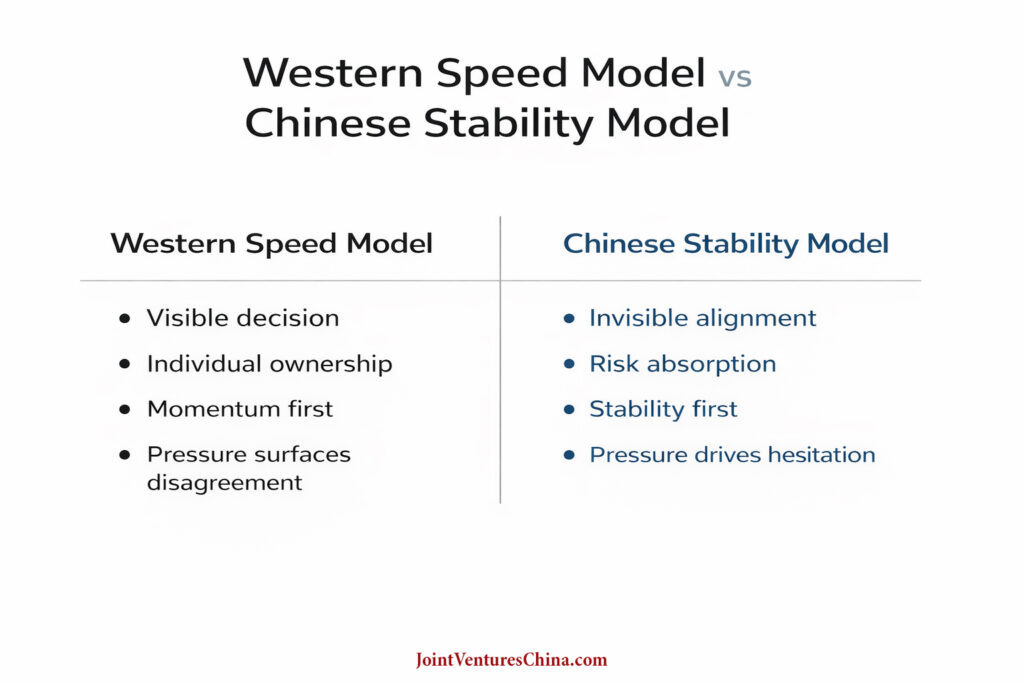
In many Western systems, momentum creates stability.
Leaders make a visible decision.
Action begins.
Energy builds alignment after movement starts.
In Chinese business decision making, the sequence often reverses.
Stability creates momentum.
Before public commitment is expressed, internal stakeholders assess:
- Whether the proposal aligns with long-term strategic direction
- Whether superiors will defend the outcome if it faces external criticism
- Whether the internal coalition supporting the decision is durable
- Whether political or regulatory exposure has been considered
This stabilizing phase can appear invisible to outsiders.
But it is highly active.
Informal discussions take place.
Signals are tested.
Authority boundaries are clarified.
Risk ownership is negotiated quietly.
Only when stability is sufficient does visible motion begin.
The result is not slower execution.
It is more synchronized execution.
At scale, this stabilizing pattern shapes Chinese business decision making across industries, from state-linked enterprises to privately held manufacturing groups.
Research from the McKinsey Global Institute has documented how Chinese enterprises often prioritize coordinated scaling and system stability before rapid execution phases (McKinsey Global Institute: https://www.mckinsey.com/mgi).
Momentum in Chinese business decision making is rarely spontaneous.
It is released.
What Western Leaders Get Wrong
There are three recurring misinterpretations.
First, they confuse speed with decisiveness.
Speed in Western systems often begins with a visible decision.
Speed in Chinese business decision making often begins with invisible alignment.
Second, they assume accountability structures are universal.
Western leaders often push for clear ownership.
In China, visible ownership without shared protection increases internal fear.
The result is not clarity.
It is concealment.
Third, they believe pressure produces transparency.
In Western firms, pressure can surface disagreement quickly.
In Chinese firms, pressure often drives disagreement underground.
This dynamic is examined further in How China Responds to Pressure, where urgency produces hesitation rather than acceleration.
When Western urgency meets Chinese risk protection, both sides misread each other.
Western leaders see avoidance.
Chinese managers see unnecessary exposure.
Hierarchy and Risk Absorption in Chinese Business Decision Making
To Western observers, hierarchy can appear rigid or layered.
But in Chinese business decision making, hierarchy is not simply about authority.
It is about risk absorption.
When a senior leader endorses a decision, the risk shifts upward.
That redistribution of risk creates safety below.
Once protection exists, speed follows.
This pattern is also connected to Speed in China Doesn’t Look Fast — Until It Does, where visible motion often follows invisible preparation.
The pause is not weakness.
It is stabilization.
Final Thought
If you want speed in China, do not demand faster decisions.
Design safer ones.
Chinese business decision making does not reward the first visible commitment. It rewards protected commitment.
When managers feel exposed, they hesitate.
When hierarchy absorbs risk, Chinese business decision making shifts from silence to coordinated action.
This is not cultural caution.
It is structural discipline.
Executives who succeed in China stop asking, “Why won’t they decide?”
They start asking, “Has the risk been absorbed within the Chinese business decision making structure?”
Once the answer is yes, execution does not inch forward.
It accelerates.
And by the time you hear the public commitment, the real decision has already been made.
Frequently Asked Questions About Chinese Business Decision Making
What is Chinese business decision making?
Chinese business decision making prioritizes alignment and risk absorption before visible commitment. Decisions are often stabilized internally through hierarchy and informal coordination before they are formally announced. What appears to be hesitation is frequently a deliberate process of ensuring shared accountability and protection within the organization.
Why do Chinese managers hesitate to say yes in meetings?
In many Chinese organizations, visible ownership of a decision carries personal and political exposure. Managers often wait until superiors signal support and internal stakeholders are aligned before publicly committing. This protects the system and reduces concentrated risk. Silence does not necessarily mean disagreement. It often means alignment is still forming.
How does hierarchy influence business decisions in China?
Hierarchy in Chinese business decision making functions as a risk absorption mechanism. When senior leadership endorses a decision, risk shifts upward and becomes institutional rather than personal. Once that protection exists, execution often accelerates quickly. Authority clarifies accountability, and clarity unlocks motion.
Enjoying this?
Get weekly, real-world insights on China joint ventures and China manufacturing.