

Most Western executives assume control in a China joint venture is defined by the contract.
Articles of Association.
Ownership percentages.
Board seats.
Voting rights.
On paper, it looks clear.
In reality, it rarely works that way.
Because who controls a china joint venture is not simply a legal construct.
It is an operational reality.
And that reality is shaped less by what is written in the agreement…
and more by who controls the system around it.
This is where many joint ventures begin to drift.
Not because the contract is weak.
But because the Western side is managing the structure while the Chinese side is operating the system.
This is where many leaders begin to question who controls a China joint venture in practice, not just in theory.
Why Contracts Don’t Decide Control
Contracts define governance.
But governance does not control execution.
This is one of the most important gaps Western leaders miss when they try to understand who controls a China joint venture.
The contract sets boundaries.
It defines rights, responsibilities, and escalation paths.
But it does not determine:
- Who drives daily decisions
- Who controls information flow
- Who shapes operational priorities
- Who influences timing and sequencing
In practice, control is determined by what happens between formal decisions.
This is why many Western teams feel they have control on paper…
but not in reality.
If you’ve seen decisions slow down, shift direction, or quietly evolve after meetings, this dynamic is already in play.
You can see how this shows up in practice in Decisions Don’t Happen in the Meeting – And That’s Normal in China.
The Four Real Sources of Control
To understand who controls a China joint venture, you have to look beyond governance and focus on how the business actually operates.
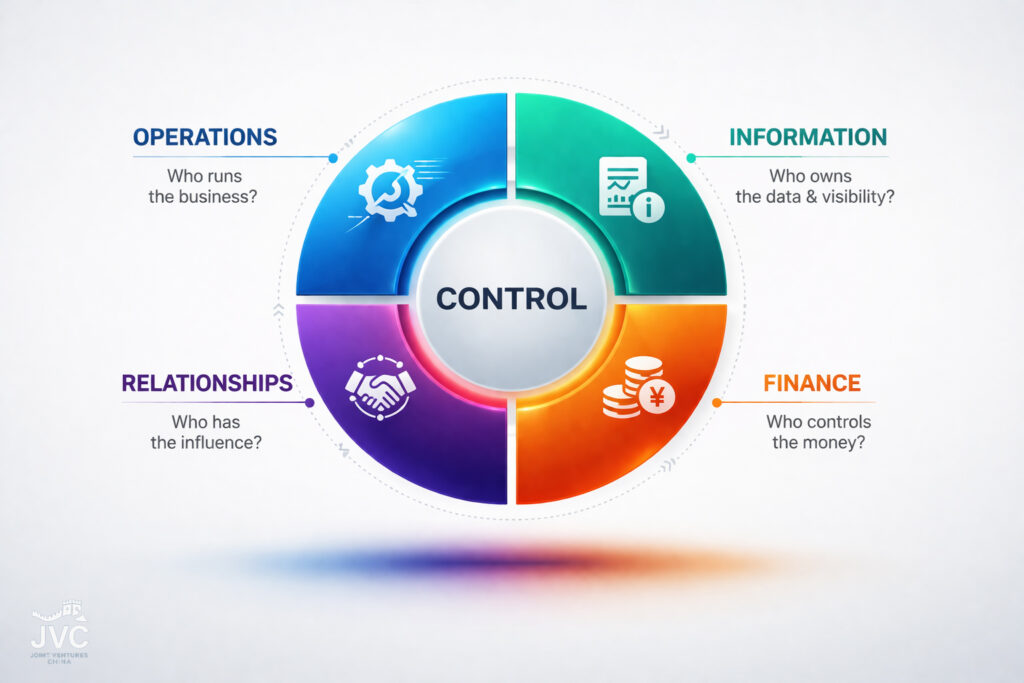
There are four primary sources of control.
1. Operational Control
The side that runs daily operations controls execution.
This includes:
- Production
- Staffing
- Supplier relationships
- Process flow
Even if strategic decisions are shared, the team managing operations determines how those decisions are implemented.
And small adjustments at the operational level compound into real control over time.
This is why execution often diverges from the original plan without triggering formal escalation.
2. Information Control
Control follows visibility.
The side that owns:
- Data
- Reporting
- Performance metrics
- Internal communication
has a significant advantage.
Because they shape how reality is understood.
If information is filtered, delayed, or selectively presented, decisions made at the board level are already constrained.
This is one of the most underestimated drivers of control.
It also connects directly to why Western leaders often feel misaligned with what is happening on the ground.
For deeper context, see Understanding Chinese Business Culture: The Signals Western Leaders Miss.
3. Relationship Control
In China, relationships are not separate from business operations.
They are part of the operating system.
Internal alignment, stakeholder trust, and informal influence networks all shape how decisions move.
This includes:
- Internal leadership alignment
- Government or local relationships
- Cross-department influence
Even when governance is equal, relationship strength is rarely equal.
And when pressure appears, decisions tend to follow alignment… not structure.
This dynamic is explored further in Chinese Business Hierarchy: The System Behind China’s Speed.
4. Financial Control
Even when operational decisions are made, financial control can reinforce or restrict execution.
Budgets, approvals, cost controls, and funding priorities all influence what is actually possible.
This includes:
- Capital allocation
- Cost approval thresholds
- Investment timing
- Expense controls
Financial rules can quietly override operational intent without appearing as a governance conflict. They can become procedures and even policies that control rather than protect.
This is why some initiatives stall, slow down, or never fully scale.
Because financial alignment was never fully established.
These four sources of control are rarely aligned in practice. When they are not, governance alone cannot determine outcomes.
Why Western Teams Misread Control
Most Western executives are trained to think in terms of structure.
Ownership equals control.
Board seats equal authority.
Contracts define outcomes.
But in China, structure is only part of the system.
Execution is shaped by alignment.
This is why who controls a China joint venture often appears ambiguous from the outside.
It is not because the system is unclear.
It is because the system is operating on a different layer.
If you focus only on governance, you will always feel one step behind.
If you focus on how alignment, information, and operations interact, control becomes much easier to understand.
You can see how this connects to execution speed in Why Sequence Beats Speed in China’s Factories.
What Actually Determines Who Controls a China Joint Venture
To clearly understand who controls a China joint venture, you have to look at how these factors interact in real operations. Control comes from the intersection of four factors:
- Who runs operations
- Who controls information
- Who owns key relationships
- Who governs financial decisions
These factors do not operate independently.
They reinforce each other.
Operational control shapes what actually gets done.
Information control shapes how decisions are understood.
Relationship control determines how alignment forms.
And financial control ultimately determines what is sustained and scaled.
When all four are aligned on one side, control becomes very clear.
When they are split, control becomes ambiguous and often unstable.
Governance still matters.
But it is only one layer.
The real question is not what the contract says.
It is how the system behaves.
This is why two joint ventures with identical ownership structures can operate completely differently.
Because control is not defined once.
It is built, reinforced, and sometimes shifted over time.
The Strategic Implication
If you want to understand who controls a China joint venture, you have to stop looking only at the contract.
And start looking at the system.
This does not mean governance is unimportant.
It means governance must be supported by:
- Operational visibility
- Information transparency
- Relationship alignment
- Financial clarity
Without those, control will naturally move toward the side that manages the system more effectively.
And this shift often happens gradually, without a clear moment where control changes hands.
In practice, this is where many Western teams struggle most.
They continue to reinforce governance
through meetings, reporting, and formal approvals
while the actual control of the business is shifting elsewhere.
For example, a board may approve a strategic initiative
but if the operational team does not prioritize it,
if the supporting data does not reinforce it,
or if internal alignment is not fully established,
execution will quietly slow down or redirect.
Nothing appears broken.
The structure remains intact.
The reporting still flows.
But the outcome changes.
This is not resistance in the traditional sense.
It is the system protecting alignment and reducing risk.
And unless leadership recognizes where control is actually being exercised,
they will continue to manage the structure
while losing influence over the outcome.
For a broader perspective on how institutions and governance systems influence business environments, see World Bank governance indicators.
Research from McKinsey on organizational decision-making also highlights how decision effectiveness depends less on formal structure and more on how information and alignment flow through an organization.
Final Thought
If you do not understand who controls a China joint venture, you are not managing it effectively.
Most joint venture challenges are not caused by bad contracts.
They are caused by misunderstood control.
Because what looks clear on paper…
often operates very differently in practice.
And until you understand that difference, you are not really managing the joint venture.
You are reacting to it.
Who controls a China joint venture? Understanding that changes everything.
Enjoying this Insight?
Get weekly real-world insights on Chinese business culture, joint ventures, and China manufacturing.

About the Author — Kevin Burton
Kevin Burton is the General Manager of a China joint venture company manufacturing advanced fiberglass materials for industrial thermal protection systems and EV safety applications. He writes about Chinese business culture, joint venture governance, and how Western leadership assumptions often collide with China’s execution-driven operating systems.