
Introduction
When foreign companies enter China through a joint venture, the first layer of trust often centers on ownership percentage. But in practice, control is exercised less through shareholding and more through China Joint Venture Governance — the structure, rhythm, and relationships that determine how decisions are actually made.
On paper, the board of directors holds ultimate authority. In reality, that authority depends heavily on how directors interact, how the general manager navigates both sides, and how decisions are prepared before meetings ever begin. Understanding how boards really work is one of the most overlooked skills foreign executives can develop — and it sits at the heart of effective China Joint Venture Governance. For broader context on building successful partnerships, see our earlier post, 5 Key Lessons from Running a China Joint Venture.
1. The Legal Framework vs. Reality
Chinese Company Law defines a joint venture board as the “highest decision-making body.” It sets strategy, approves budgets, and appoints the general manager. Typically, each shareholder nominates directors proportional to their equity stake — for example, a 60/40 JV might have three directors from the Chinese partner, two from the foreign partner, and one mutually agreed neutral.
However, formal structure rarely tells the full story. In practice, Chinese directors are deeply embedded in their parent organization’s hierarchy, while foreign directors often live abroad and rely heavily on the GM for visibility.
A detailed overview of board responsibilities and voting structures can be found in China Briefing’s guide to Board of Directors in Chinese Joint Ventures, which explains how control mechanisms differ between equity and cooperative JVs.
Effective China Joint Venture Governance recognizes these practical limitations and balances formal oversight with trust-based information flow.
2. The Role of the Chairman and the General Manager
In most Chinese joint ventures, the Chairman (董事长) represents the Chinese partner and formally holds authority over board proceedings. The General Manager (总经理) is responsible for daily operations and may come from either side, depending on negotiation and trust.
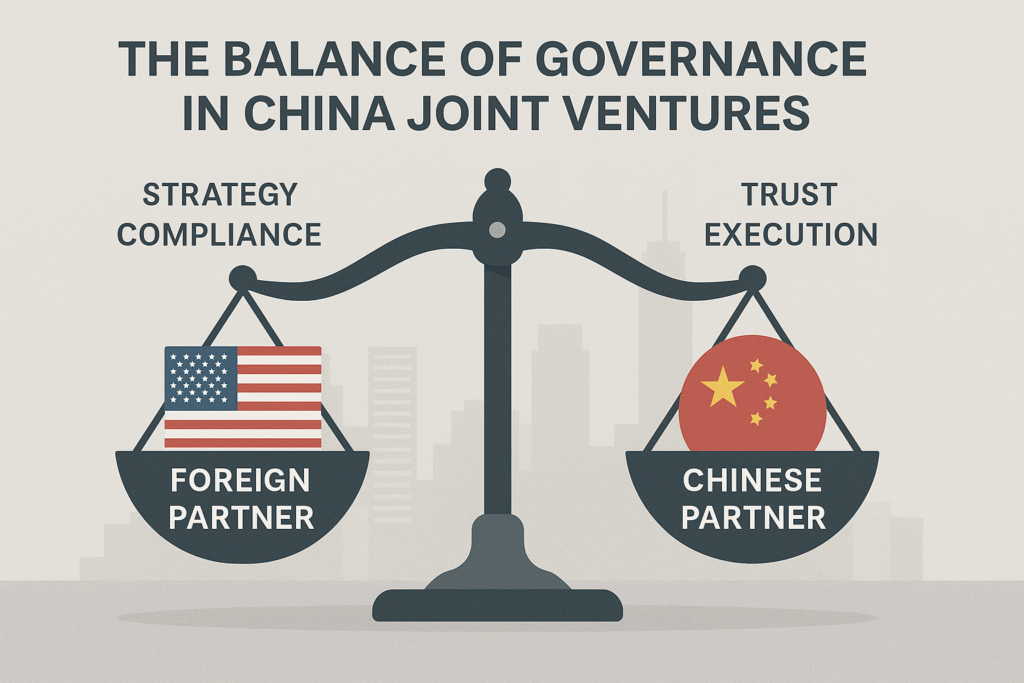
A healthy balance develops when both roles respect boundaries — the Chairman focusing on long-term strategy and compliance, the GM on execution. However, blurred lines are common.
As BCG’s analysis on managing China JVs points out, success often hinges on how well the GM can bridge cultural and operational gaps while maintaining alignment with both shareholder groups. In well-functioning China Joint Venture Governance, the GM serves as the cultural interpreter who translates corporate strategy into local action.
3. Decision-Making in Practice
Even the most carefully written JV contracts cannot predict every operational decision. In practice, Chinese joint venture boards make decisions through pre-alignment, not debate.
Key decisions typically flow through three layers:
- Pre-Board Alignment: Informal discussions between shareholders and GM well before the meeting.
- Board Approval: Formal ratification of decisions already agreed in principle.
- Implementation: Local execution shaped by the GM’s team and the Chinese partner’s influence.
Foreign directors expecting Western-style debate may feel the “decision has already been made.” In reality, this reflects the consensus-based nature of China Joint Venture Governance, designed to avoid public disagreement and preserve harmony.
The best-run JVs hold pre-meetings, clarify data privately, and present decisions as shared outcomes rather than contested votes — a hallmark of mature China Joint Venture Governance.
4. Cultural Governance: The Invisible Layer
Formal governance defines who should decide. Cultural governance defines how they actually decide.
Three cultural principles dominate most China JVs:
- Face (面子): Open confrontation is avoided; preserving dignity takes priority.
- Guanxi (关系): Personal trust networks sustain cooperation more than procedural control.
- Hierarchy (等级): Junior managers rarely contradict senior ones publicly.
A useful study, “Operating Autonomy in Chinese-Foreign Joint Ventures” (ScienceDirect), explains how cultural alignment influences autonomy and decision-speed inside JVs.
Effective China Joint Venture Governance recognizes these cultural realities. Trust precedes transparency, and relationships determine whether formal systems work smoothly or stall under hidden resistance.
5. Best Practices for Foreign Shareholders
1. Build Board-Level Relationships, Not Just Structures
Schedule informal dinners or WeChat exchanges with individual directors. Decisions are influenced long before the meeting starts.
2. Empower the General Manager — but Verify
Provide autonomy but set regular reporting routines: monthly P&L, quality metrics, and key project updates.
3. Prepare Board Materials with Clarity and Context
Chinese directors prefer concise, bilingual summaries rather than dense English reports.
4. Respect the Role of the Chairman
Even with majority equity, never bypass the Chairman. Collaboration preserves stability.
5. Document and Follow Up
Issue bilingual resolutions promptly to prevent later reinterpretation.
When these practices are followed, China Joint Venture Governance becomes less about control and more about coordination.
6. Case Reflection: When Governance Works
One successful Sino-foreign JV adopted a rhythm of quarterly board meetings, monthly GM reports, and semiannual joint strategy workshops.
Directors spent time aligning forecasts and visiting production sites rather than debating in the meeting room. Over time, both sides trusted the data and approvals accelerated. Similar success factors are highlighted in BCG’s study on managing China joint ventures, which notes that effective joint governance stems from shared transparency and aligned incentives.
Governance, once a friction point, became a source of stability and shared purpose.
This is the true outcome of strong China Joint Venture Governance — predictable cooperation and faster progress.
7. The Real Lesson of China Joint Venture Governance
The most effective JVs in China are not those with perfect legal safeguards, but those where both shareholders understand how the other side governs.
Boards that function well share three traits:
- Transparent but respectful communication
- Clearly defined roles between Chairman and GM
- A commitment to solve problems privately, not publicly
Good governance in China isn’t about enforcing control — it’s about creating a framework of mutual confidence that lets both sides focus on growth.
Conclusion
Foreign companies entering a Chinese joint venture often underestimate how much success depends on governance, not ownership. True control comes from preparation, relationship equity, and cultural awareness.
By understanding how China Joint Venture Governance really works — both legally and informally — you can protect your interests, strengthen partnerships, and build a more resilient joint venture. For additional guidance, explore our Resources for Building Trust in China Joint Ventures section.