
Why “Face” (Mianzi) Shapes Every Deal, Every Meeting, and Every Decision
If you do business in China long enough, you eventually discover that technical expertise and financial logic alone do not explain why business relationships move forward—or suddenly stall. A meeting that appeared successful may produce no follow-up. A direct question may receive an indirect answer. A correction that seems routine to a Western manager may quietly damage cooperation.
One reason is Face in Chinese business culture, or mianzi (面子). In Chinese business culture, Face refers broadly to a person’s social standing, reputation, dignity, and the respect they receive from others. Saving face in Chinese business means avoiding situations that publicly diminish that standing, while giving face means acting in ways that reinforce another person’s status and dignity.
This is not simply a matter of etiquette. Face can influence how Chinese colleagues communicate problems, disagree with senior managers, respond to criticism, negotiate difficult issues, and make commitments. Understanding Face in Chinese business culture therefore helps Western executives interpret behavior that might otherwise appear indirect, overly cautious, or difficult to explain.
In my own experience managing a China joint venture, Face becomes most important precisely when the business issue is difficult. When a project is late, a decision is disputed, or someone has made a mistake, how the issue is addressed can determine whether people become more open—or more guarded. The objective is not to avoid difficult conversations. It is to conduct them without unnecessarily forcing someone to lose standing in front of others.
1. What Face Actually Means (Beyond the Textbook Definition)
Understanding mianzi in Chinese business begins with recognizing that Face is more than personal reputation. It reflects a person’s perceived standing in the eyes of colleagues, customers, suppliers, government contacts, and others within their professional network.
Face can be influenced by:
- Reputation
- Professional competence
- Position and authority
- Social relationships
- Respect you give to others
- Respect others visibly give to you
What makes Face in Chinese business culture especially important is that this standing is partly social and public. A manager may be perfectly willing to acknowledge a problem privately but become much more defensive if asked to admit the same mistake in front of employees, peers, or senior leadership.
This distinction matters. The underlying business problem has not changed. What has changed is the social cost of acknowledging it.
In Western organizations, directness is often interpreted as transparency: identify the problem, challenge the assumption, correct the mistake, and move forward. In China, the same objective may be better achieved through a private conversation that allows the other person to address the problem without publicly diminishing their authority or competence.
This does not mean Chinese managers cannot accept criticism or that difficult issues should be avoided. It means the setting, timing, and manner in which those issues are raised can materially affect the response.
That is the practical meaning of mianzi for a Western executive: you can address the same business problem while either preserving someone’s standing or unnecessarily threatening it.
The practical rule:
Face does not require avoiding difficult conversations. It requires understanding when a public conversation creates a different response than the same conversation held privately.
2. Why Face Shapes Every Business Discussion in China
Face drives decisions in ways Western executives often overlook. To understand face in Chinese business culture, you must see it as a decision-making filter, not a cultural footnote. It guides how people communicate, what they reveal, and how quickly they move toward agreement.
A McKinsey & Company study reinforces this by explaining that leaders in high-context cultures often prioritize harmony, hierarchy, and reputation over speed or confrontation—especially during negotiations.
(Source: https://www.mckinsey.com/)

3. How Losing Face in Chinese Business Damages Relationships
Here are the classic mistakes Western managers make:
❌ Correcting someone publicly during a meeting
❌ Showing frustration or impatience
❌ Asking a junior employee to challenge their manager
❌ Pushing for a “yes/no” answer on the spot
❌ Treating hierarchy too casually
❌ Making the other party admit fault openly
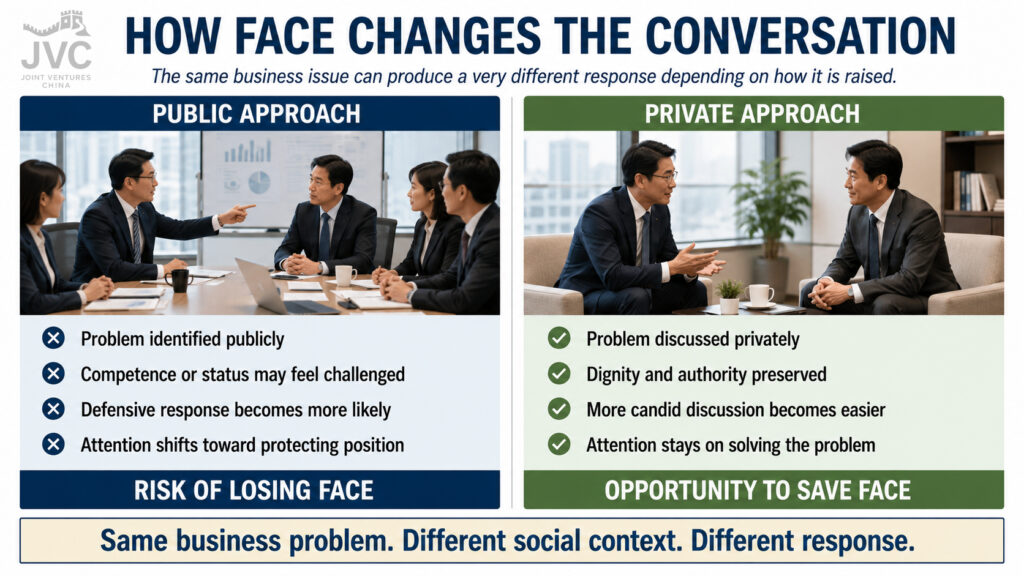
Even if the technical points are correct, the tone destroys cooperation.
Losing face in Chinese business can create long-term damage to working relationships, which is one of the key signals within Chinese business culture that Western leaders often misunderstand.
4. How to Give Face: The Most Valuable Skill in China
Saving face in Chinese business does not require avoiding difficult conversations. It means handling those conversations in ways that preserve dignity while still addressing the underlying business problem.
Here is what actually works:
1. Praise publicly, correct privately.
This is the golden rule. A private correction preserves harmony and allows people to re-engage confidently.
2. Let the other side “own” good ideas.
If you propose a solution, phrase it so that they are the champion of it.
3. Respect hierarchy intentionally.
Speak to the senior leader first, even if the technical expert is the true decision-maker. This is one of the most powerfully ingrained culture practices in China.
4. Provide exits that save dignity.
If a project, price, or plan cannot work, the explanation should protect reputations, not assign blame.
5. Create a path where both sides “win.”
Face is restored when both sides appear capable, respected, and competent.
This is how Chinese partners evaluate trust.
5. Real-World Examples of How Face Plays Out
These examples highlight how deeply face in Chinese business culture influences communication patterns. What seems confusing or indirect to Western executives often makes more sense once you recognize that how information is communicated can matter almost as much as the information itself.
Correcting a Problem in a Meeting
A Western manager notices an error in a project update and immediately challenges the person presenting it. The intention may simply be to correct the problem quickly.
But doing so in front of colleagues can turn a technical issue into a question of competence and status. Raising the same concern privately after the meeting may produce a much more open discussion—and often a faster solution.
Asking for an Immediate Yes or No
A Western executive asks whether a deadline can be met and expects a direct answer. The Chinese manager has concerns but does not want to publicly reject the request or appear incapable of delivering.
The result may be a vague or cautiously positive response that the Western executive interprets as agreement. Understanding Face helps explain why creating a private opportunity to discuss risks can produce much more useful information.
Giving Credit for a Successful Solution
A difficult problem is resolved through cooperation between Western and Chinese teams. Publicly recognizing the Chinese manager who helped drive the solution does more than acknowledge good performance.
It gives Face. That recognition reinforces the manager’s standing within the organization and can strengthen the working relationship well beyond the immediate project.
A MIT Sloan Management Review report on cross-cultural negotiation explains that indirect communication styles—such as silence, vague agreement, or soft disagreement—protect relationships and reduce conflict, especially in East Asian contexts.
(Source: https://sloanreview.mit.edu/)
6. How Face Connects to Long-Term Trust
Face is not manipulation. It is respect.
When you manage Face well:
- Meetings flow smoothly
- Negotiations stay collaborative
- Partners advocate for you internally
- Problems are communicated more honestly
- You become a preferred long-term partner
Face is the foundation of relationships in China. Many misunderstandings around Face show up as common mistakes. I break down those patterns here: Common Mistakes Foreign Executives Make in China.
Even Forbes notes that modern Chinese business culture still relies heavily on Guanxi, reputation, and face-saving behaviors, especially in long-term supplier and customer relationships.
(Source: https://www.forbes.com/)
7. The Face Strategy Toolkit (Use This Daily)
Here is a practical checklist you can apply immediately:
✔ Before Meetings
- Understand who the true decision-makers are
- Avoid putting anyone in a position where they may need to admit fault
✔ During Meetings
- Praise contributions publicly
- Keep difficult or corrective feedback for private follow-up
- Frame disagreements as “alternative perspectives”
✔ After Meetings
- Send a respectful summary
- Give credit to the other party in writing
- Provide options, not ultimatums
If you want to go deeper into how Chinese executives evaluate integrity and trustworthiness, see my article Building Lasting Trust in China — it expands on how trust is earned, protected, and grown through repeated positive interactions.
Mastering face in Chinese business culture is not about being overly cautious — it’s about being strategically respectful. When you adjust your approach even slightly, internal doors open, resistance falls away, and partnership momentum increases dramatically.
Final Thoughts
The most successful foreign executives in China are not the ones with the best PowerPoints, the best pricing models, or the best technology.
They are the ones who understand how to balance:
- Truth with tact
- Directness with diplomacy
- Results with relationships
- Transparency with Face
If you’d like additional tools or frameworks that support cross-cultural leadership, negotiation, or JV management, my Resources page includes guides that may be helpful.
Master Face—and the entire business environment becomes far more predictable, cooperative, and successful.
Enjoying this Insight?
Get weekly real-world insights on Chinese business culture, joint ventures, and China manufacturing.

About the Author — Kevin Burton
Kevin Burton is the General Manager of a China joint venture company manufacturing advanced fiberglass materials for industrial thermal protection systems and EV safety applications. He writes about Chinese business culture, joint venture governance, and how Western leadership assumptions often collide with China’s execution-driven operating systems.