
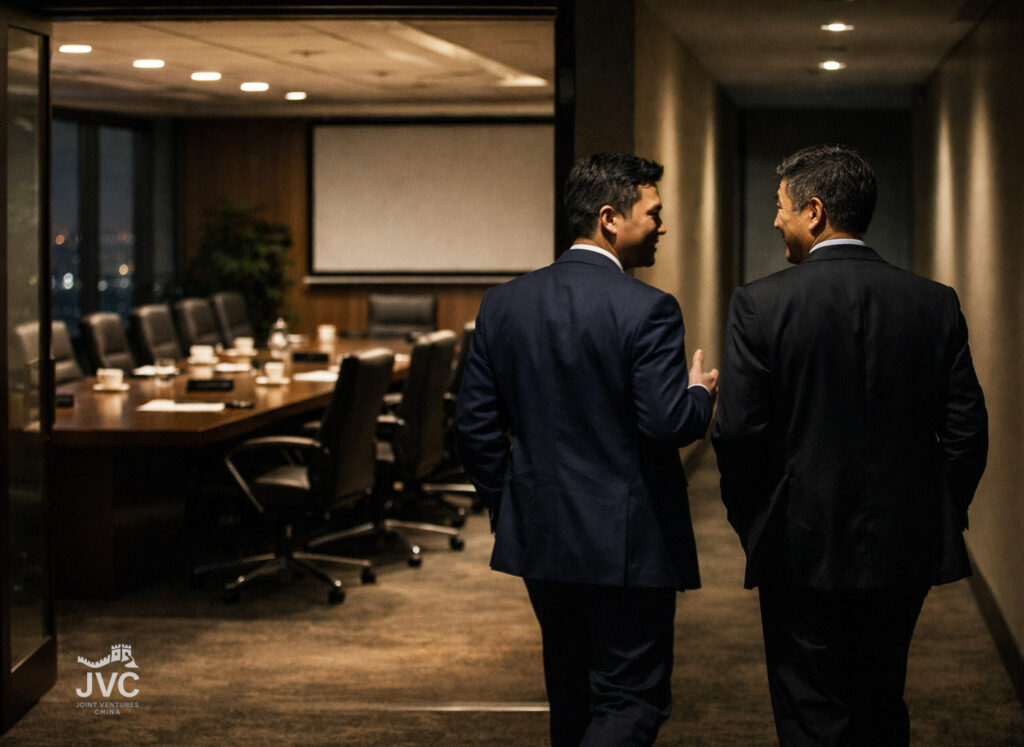
Most Western executives walk out of a meeting in China focused on what just happened in the room.
Who agreed.
Who nodded.
Who stayed quiet.
But the real determinant of progress is not the meeting itself. Follow-up in China is where outcomes are shaped, often long after the room empties.
That misunderstanding is where momentum quietly disappears.
The Meeting Is an Input, Not a Verdict
In Western business culture, meetings are designed to converge.
Clarify the issue
Debate options
Decide
Assign next steps
In China, meetings are designed to distribute context, not to finalize outcomes.
People in the room may:
- lack decision authority
- need to protect absent stakeholders
- be assessing political or operational risk
- be gathering information for internal discussion
A smooth meeting signals only that friction was avoided. It does not signal alignment.
This is why decisions rarely happen in the meeting itself.
That alignment is tested later, during follow-up in China.
What Actually Happens After the Meeting in China
Once the meeting ends, the visible process stops.
The real process begins.
Internally, teams start asking:
- Who owns the downside if this fails?
- Who needs to be consulted next?
- Does this affect other departments or partners?
- Is the timing safe inside the organization?
None of this happens in front of you.
And none of it will be explained directly.
This pattern is well documented in research on hierarchy and consensus building in Asian organizations, including work published by INSEAD Knowledge. That research shows how decisions often consolidate after meetings through internal alignment rather than public agreement.
From the outside, silence can feel like disengagement.
In reality, it is sequencing.
This is why many foreign teams misread post-meeting silence in China.
Why Follow-Up in China Signals More Than You Think
Your follow-up behavior is not neutral.
In China, follow-up is read as a signal of:
- how well you understand the internal process
- whether you respect sequencing
- whether you create pressure or reduce risk
- whether future cooperation feels predictable
A rushed or overly directive follow-up can quietly undo goodwill created in the meeting.
Not because it is rude.
Because it exposes people before alignment exists.
This same dynamic appears after social settings as well, including business dinners.
The Most Common Follow-Up Mistake
This line appears constantly in Western follow-ups:
“Just checking if we can confirm next steps.”
In Western contexts, it sounds reasonable.
In China, it often signals:
- you believe a decision has already been made
- you may not understand internal review
- you are accelerating before the system is ready
The safest response is delay.
Sometimes silence.
This is one of the most misunderstood moments in follow-up in China.
What Effective Follow-Up in China Looks Like
Strong follow-up in China does not push decisions forward.
It makes internal alignment easier.
Effective follow-up does three things.
1. Re-anchors shared understanding
Briefly restate what was discussed without reframing or escalating.
2. Leaves space for internal discussion
Acknowledge that review is ongoing.
3. Signals patience and predictability
You show that you will not force exposure.
For example:
“Thank you again for the discussion.
We appreciated the opportunity to walk through the background and constraints together.
Please let us know if additional clarification would be helpful as you review internally.”
Nothing is demanded.
Nothing is locked.
Trust increases.
This approach reflects how alignment actually forms inside Chinese organizations.
Momentum in China Is Behavioral, Not Verbal

Western teams look for momentum in words.
Chinese teams show momentum through actions:
- a new meeting is scheduled
- additional information is requested
- new stakeholders appear
- scope quietly evolves
If none of that is happening, more emails will not help.
Better follow-up in China will.
Western teams often keep pushing for verbal confirmation because silence feels risky. In China, that instinct is reversed. Verbal confirmation without internal protection creates risk, not certainty. Until actions start to appear, pressure feels premature, not productive.
The Real Question to Ask After the Meeting
After a meeting in China, do not ask:
“Did we get agreement?”
Ask instead:
“Did our follow-up in China make it easier for them to align internally without risk?”
If the answer is yes, progress is happening.
Even if you cannot see it yet.
The key in China is to keep making forward progress. It builds trust and momentum. And then things move quickly.
Enjoying this?
Get weekly, real-world insights on China joint ventures and China manufacturing.