
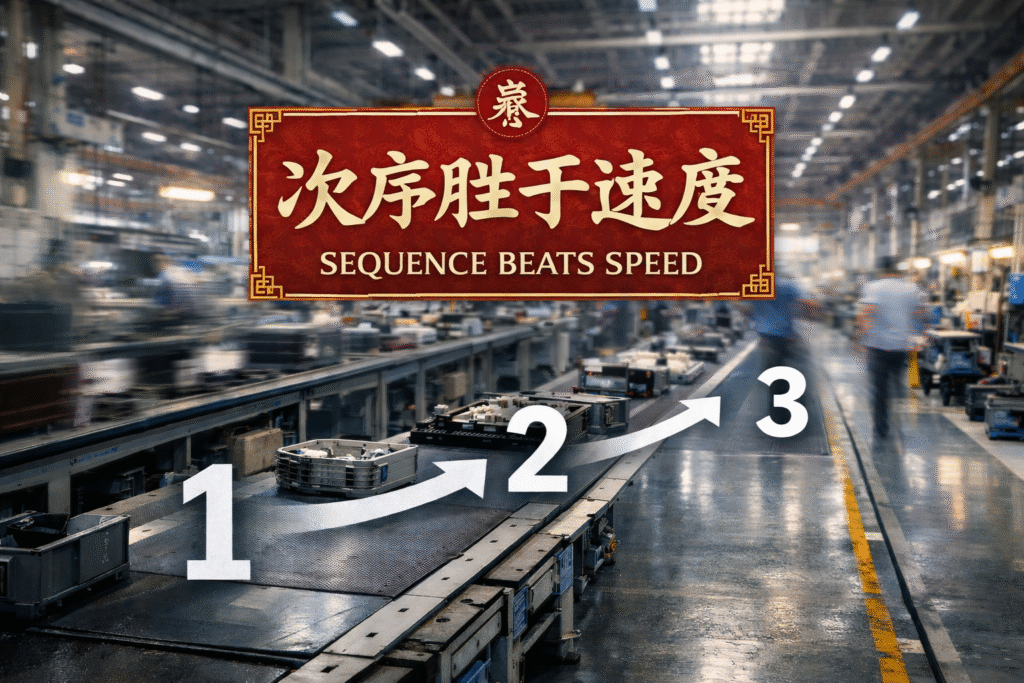
The mistake Western teams keep making
When Western teams evaluate factories in China, they usually ask one question first:
“How fast can you do this?”
It feels logical. Speed equals competitiveness. Urgency equals commitment.
But in Chinese manufacturing, this question is often backwards.
Because in China, sequence beats speed, especially when alignment before speed has not been established.
When sequence beats speed, friction disappears
Western teams often assume that if a factory has capacity, machines, and labor, then execution should be immediate.
So they push:
- Faster timelines
- Earlier commitments
- Parallel decisions
This is where sequence beats speed, because moving fast before the order is clear creates friction instead of momentum.
What they miss is that Chinese factories rarely move until the order of decisions is correct.
Materials.
Process routing.
Quality responsibility.
Change authority.
Commercial risk.
Internal sign-off.
If any of those are unclear, speed becomes dangerous, not impressive.
What factories are actually optimizing for – not speed
Chinese factories are not optimizing for speed in isolation.
In practice, this manufacturing mindset prioritizes execution order, risk control, and system stability over visible urgency.
They are optimizing for principles common in manufacturing process sequencing:
- Stability
- Predictability
- System protection
- Downstream risk avoidance
A rushed process that creates rework, internal blame, or customer disputes is worse than a slower start.
So when sequence is unclear, factories slow down on purpose.
Not because they cannot move.
Because they should not.
Sequence only works when hierarchy clarifies decision rights, a mechanism explored in detail in our article on Chinese business hierarchy.
Why Urgency backfires
Urgency forces people to act before they are protected.
That creates three common reactions:
- Silence
- Deflection
- Delay disguised as politeness
Western teams interpret this as resistance, without understanding what Chinese meetings are actually for.
In reality, it is risk management.
The hidden question factories are asking
When you push speed, Chinese teams are quietly asking something else:
“If this goes wrong, who absorbs the damage?”
Until that answer is clear, execution will not accelerate, which is why decisions don’t happen in the meeting.
Once it is clear, speed often appears suddenly and dramatically.
A factory example most Western teams recognize
Consider a Western customer placing a rush order for a specialized coated fabric.
The factory has the capacity.
The line is available.
Raw materials can be sourced quickly.
So the customer pushes for immediate production.
But inside the factory, several questions are still unresolved.
Which specification version is final?
Who approves deviations if the coating weight drifts?
What happens if upstream material arrives out of tolerance?
Is this treated as a development run or a commercial order?
Without clear answers, starting production creates exposure for multiple departments.
If the run fails, engineering is blamed for unclear specs.
If quality rejects material, production is blamed for moving too fast.
If the customer changes requirements mid-run, sales absorbs the conflict.
So the factory slows down.
Not because it lacks urgency.
Because the sequence is incomplete.
Once specifications are locked, authority is clear, and commercial terms are confirmed, production starts quickly.
From the outside, it looks like delay followed by sudden speed.
From the inside, it is controlled execution.
This is where management must understand the requirements needed prior to execution – where sequence beats speed.
What good sequencing looks like
Factories move fast when they know how Chinese manufacturing execution actually works:
- The technical path is locked
- Change authority is defined
- Commercial terms are stable
- Internal stakeholders are aligned
- Failure will not trigger internal punishment
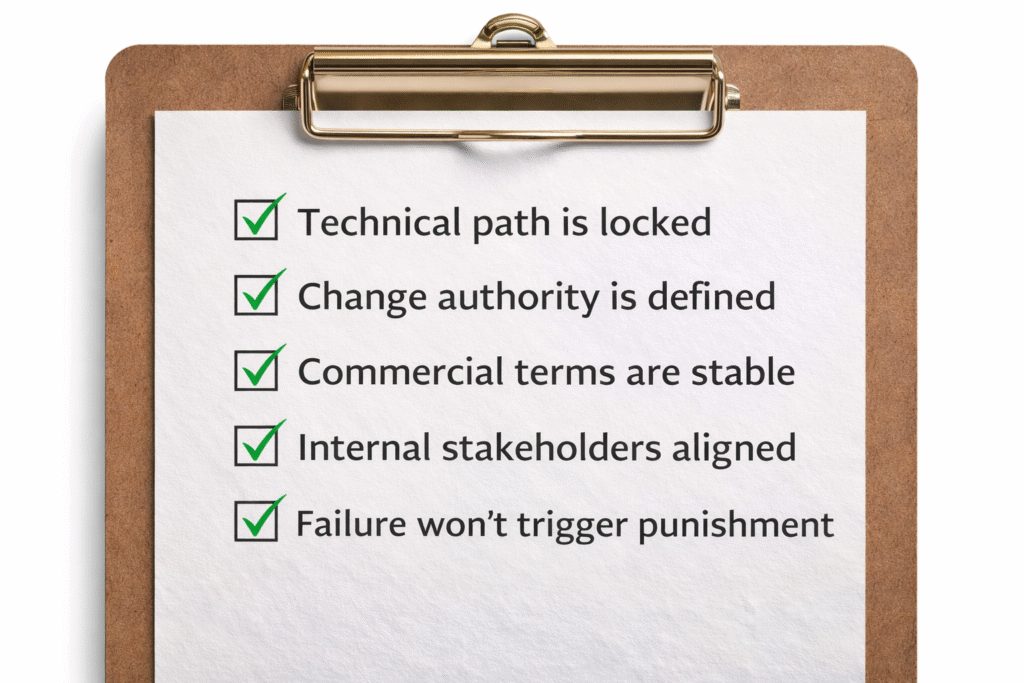
Sequence creates safety.
Safety creates speed.
This same sequencing logic also helps explain how China innovation and scale are increasingly operating inside the same integrated system. When innovation is embedded within structured industrial execution, speed becomes repeatable rather than accidental.
Why this feels uncomfortable to Western leaders
Western systems reward:
- Decisiveness
- Visible momentum
- Early clarity
Chinese systems reward:
- Correct order
- Internal consensus
- Low-risk execution
Neither is wrong.
But applying Western urgency before Chinese sequence almost always slows results.
The practical shift that changes outcomes
Instead of asking:
“How fast can you do this?”
Ask:
“What needs to be decided first for this to move cleanly?”
That single shift reframes you as a partner, not a pressure source.
And it unlocks real execution speed.
The paradox
China does not move fast because it rushes.
It moves fast because sequence beats speed.
When you respect that sequence, factories often outperform your expectations.
When you ignore it, even the best factories will stall.
Closing thought
Speed is visible.
Sequence is invisible.
Sequence beats speed.
In China, sequence is what makes speed possible.
Enjoying this?
Get weekly, real-world insights on China joint ventures and China manufacturing.