
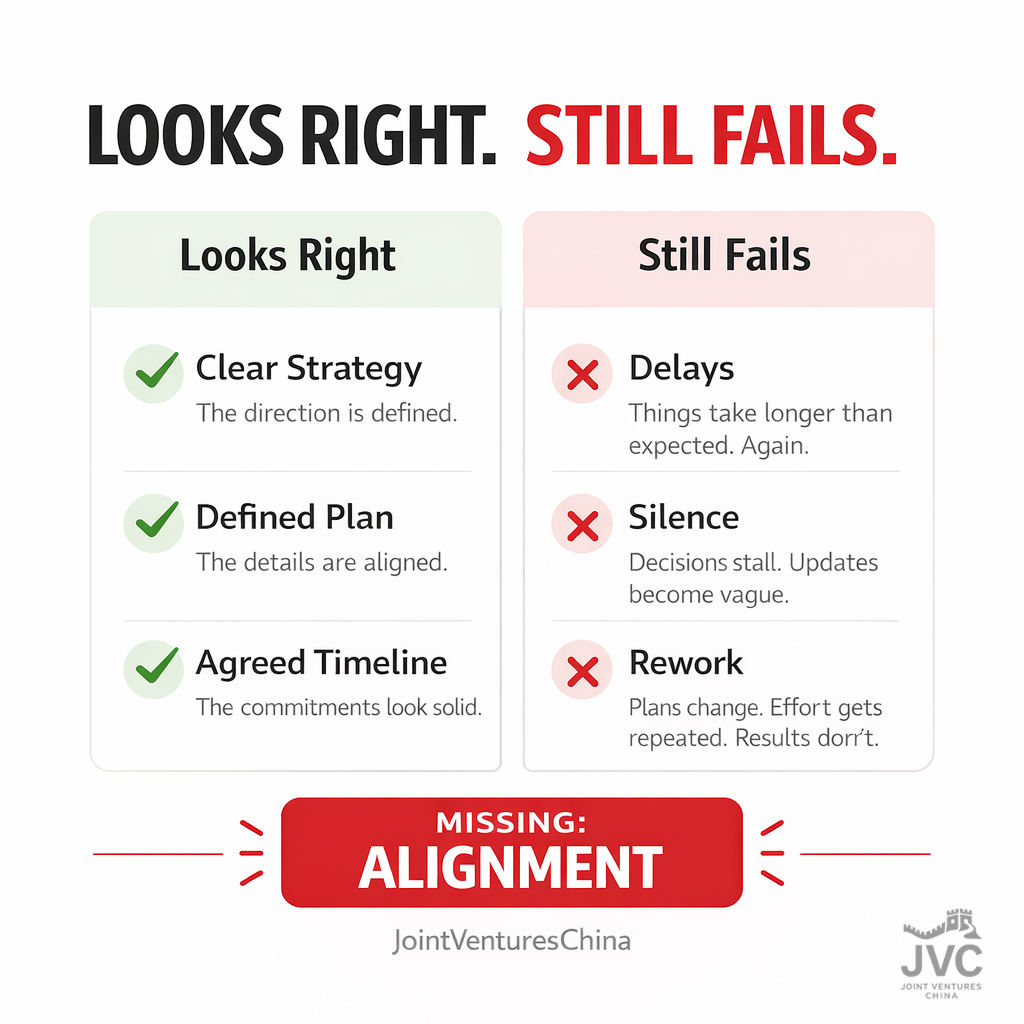
Strategy vs. Alignment
Most China strategies don’t fail because they’re wrong.
They fail because alignment never actually existed.
This is the core issue behind alignment in China, and why so many strategies break later.
That’s the part most Western leaders underestimate.
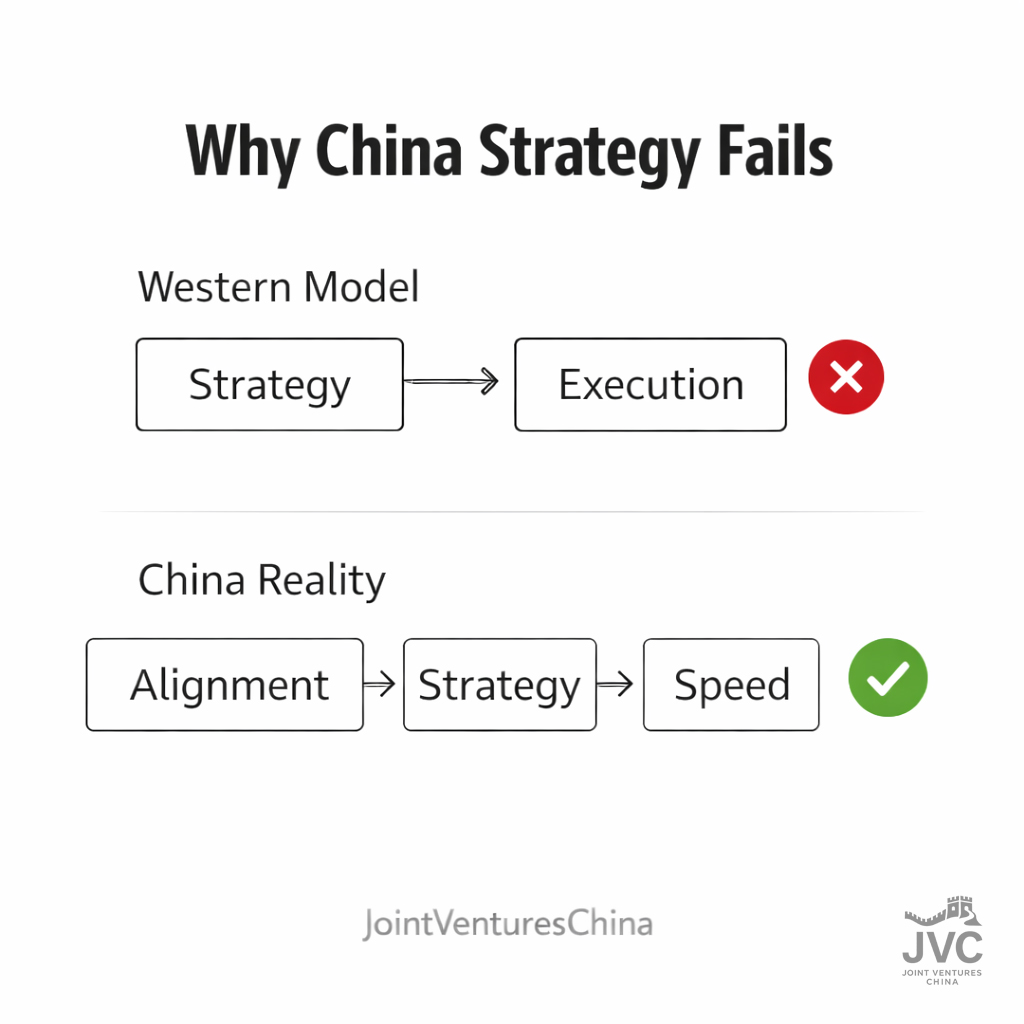
Because in Western business logic, strategy comes first.
Get the plan right, and execution follows.
In China, that sequence often breaks.
This reflects a deeper shift in how China business strategy actually works at a system level, where alignment and execution are inseparable. For a full breakdown, see China Business Strategy: Why Western Playbooks Fail and What Actually Works.
This is why many Western leaders misinterpret how decisions actually form. As explored in Decisions Don’t Happen in the Meeting — And That’s Normal in China, what looks like delay is often a different decision-making process entirely.
1. The Western Assumption
Western teams are trained to believe:
- Define the strategy
- Align resources to it
- Execute
It is a clean, logical sequence.
And in stable, transparent environments, it works.
But it depends on one hidden assumption:
That alignment naturally follows clarity.
If the plan is clear enough, people will align around it.
If expectations are defined, execution will follow.
If timelines are agreed, progress will happen.
In China, that assumption is dangerous.
Because alignment does not come from clarity alone.
Many Western leadership teams underestimate how deeply management systems are shaped by the operating environments they were designed to function within.
2. Why Alignment in China Business Works Differently
In China, alignment does not automatically follow strategy.
It must be built first.
Understanding alignment in China is critical to understanding why execution behaves differently.
Across:
- internal stakeholders
- partner organizations
- leadership layers
- and often local government expectations
Each of these groups carries its own risks, incentives, and constraints.
Until those are aligned, no strategy can move forward cleanly.
This is where many issues in China strategy execution begin, long before any visible problems appear. The gap becomes clearer when you look at how China strategy execution actually works across systems and stakeholders.
This is why you often see:
- strong plans stall
- timelines slip without clear explanation
- teams appear slow early… then suddenly move very fast later
This pattern is not accidental. It reflects a system where alignment is built before speed appears, a dynamic explained further in Speed in China Doesn’t Look Fast — Until It Does.
From a Western perspective, this looks inefficient.
But it is not inefficiency.
It is alignment being built.
And until that process is complete, execution is intentionally cautious.
3. The Hidden Failure Pattern
This is where most China strategies fail.
This is also why many strategies that succeed initially begin to break down later, especially when alignment was never fully established, a pattern explored in Why Your China Strategy Fails After the First Win.
Understanding this pattern is critical to understanding why China strategies fail in practice, not just in theory.
Western teams push strategy discussions too early.
They want:
- decisions in meetings
- clarity upfront
- commitment on timelines
So they present well-structured plans.
Clear logic. Defined milestones. Strong rationale.
On the surface, everything looks aligned.
But underneath, key stakeholders are still working through internal questions:
- Who owns the risk?
- What happens if this fails?
- Is leadership fully aligned?
- Are downstream teams ready to execute?
Those questions are rarely resolved in the meeting itself.
So instead of pushing back directly, the Chinese side often maintains momentum on the surface.
The plan is acknowledged.
The direction is accepted.
The discussion moves forward.
But alignment is not actually there yet.
And that is where the breakdown begins.
4. Why Alignment Is Built Outside the Meeting
One of the reasons Western teams misread alignment in China is where they expect it to happen.
In Western business environments, alignment is often built inside the meeting itself.
People debate openly.
Concerns are raised directly.
Disagreements are resolved in real time.
So when a meeting ends with apparent agreement, it usually reflects real alignment.
In China, that is not how alignment is built.
Meetings are not designed to resolve alignment.
They are designed to:
- signal direction
- test reactions
- maintain momentum
The real alignment happens outside the room.
Through:
- internal discussions between stakeholders
- follow-up conversations after the meeting
- quiet coordination across teams
This is why a meeting can feel productive…
and still not result in execution.
Because the visible discussion was only one part of the process.
Until alignment is built behind the scenes, the strategy cannot move forward.
5. What Western Teams Misread
From the outside, this creates a consistent pattern of misinterpretation.
Western teams see:
- agreement in meetings
- positive language
- lack of direct objections
They interpret this as commitment.
But what is actually happening is different.
The Chinese team is preserving alignment while still evaluating internally.
So instead of open resistance, you get:
- delayed execution
- shifting priorities
- vague updates
- quiet rework
This is not poor execution.
It is incomplete alignment revealing itself over time.
By the time it becomes visible, the strategy already appears to be failing.
6. Why More Strategy Makes It Worse
Here’s the uncomfortable part:
The more time you spend refining strategy in China,
the higher the chance it fails.
Because you are optimizing something that cannot execute yet.
Without real alignment in China, strategy refinement adds complexity without creating progress.
Without alignment:
- better strategy does not improve outcomes
- more detail does not reduce risk
- more pressure does not accelerate progress
It often does the opposite.
It creates:
- hesitation
- reduced transparency
- quiet resistance
At that point, the issue is no longer the strategy.
It is the timing of the strategy.
Most China strategies don’t fail because they’re wrong.
They fail because alignment never existed.
If you’re working inside a China joint venture or managing cross-border execution, this is one of the most common and misunderstood failure patterns.
7. A Real-World Pattern
This shows up repeatedly in joint ventures and cross-border projects.
A Western team develops a strong market entry strategy.
- The product is right
- The partner is capable
- The commercial logic is sound
Meetings go well.
The Chinese partner agrees with the direction.
Timelines are discussed.
Execution begins.
Then gradually:
- timelines start slipping
- execution becomes inconsistent
- priorities seem to shift
From the Western side, it feels like something is going wrong.
The assumption is:
The strategy must have been flawed.
But when you look closer, the issue is different.
Key stakeholders were never fully aligned on:
- execution risk
- internal ownership
- operational readiness
The strategy did not fail.
It was never truly supported.
In many cases, this disconnect is rooted in how decision authority is actually structured within the partnership, which is rarely as straightforward as it appears. See Who Actually Controls a China Joint Venture? for a deeper breakdown.
8. What Alignment in China Actually Means
Alignment in China is not just agreement.
Real alignment in China reflects internal consensus, not just surface-level agreement.
It is not just saying yes.
It is not even just consensus in a meeting.
Real alignment means:
- shared understanding across multiple levels
- internal commitment before external confirmation
- confidence that execution will not create unexpected risk
This is what defines alignment in China in practice.
It is built through:
- sequencing of discussions
- internal conversations you do not see
- gradual consensus across stakeholders
This is why progress often feels invisible at first.
Because the most important work is happening beneath the surface.
9. How to Recognize Misalignment Early
If you know what to look for, the signals are clear.
These signals are often the only visible indicators of whether alignment in China has actually been achieved.
Common signs alignment is not fully there:
- decisions keep moving without clear resolution
- updates become less specific over time
- timelines are agreed but not reinforced
- execution starts but does not accelerate
- follow-up actions feel inconsistent
Individually, these signals can be dismissed.
Together, they indicate a deeper issue:
Alignment is still in progress.
10. The Correct Sequence
In China, the sequence is different:
- Alignment
- Strategy
- Speed
This sequencing is not just cultural, it is structural. It is closely tied to how hierarchy and coordination function inside Chinese organizations, as outlined in Chinese Business Hierarchy: The System Behind China’s Speed.
This is why alignment in China must come before strategy if execution is expected to follow.
Not the other way around.
Once alignment exists, execution accelerates rapidly.
Decisions that seemed slow suddenly move quickly.
Teams that appeared hesitant begin executing at scale.
From the outside, it looks like speed appeared out of nowhere.
But in reality, it was built.
11. Why Alignment Feels Slow — But Creates Speed
To Western teams, this alignment process often feels like delay.
Decisions take longer.
Discussions seem repetitive.
Progress is hard to see.
But this is where a critical misunderstanding happens.
Alignment is not slowing execution.
It is preparing it.
Many Western executives assume organizational stability comes from transparency and visible progress. In many Chinese organizations, however, stability is often created by building alignment before visibility, a distinction explored in why Western companies misread stability in China.
In China, speed does not come from fast decisions.
It comes from fully aligned execution.
Once alignment is in place:
- decisions no longer need to be revisited
- teams do not need to second-guess direction
- execution moves without internal friction
This is why China often appears slow at the beginning of a project…
and then unexpectedly fast once movement starts.
The speed was not created in the moment.
It was built in advance through alignment.
12. What Western Leaders Should Do Differently
Understanding alignment is one thing.
Operating differently because of it is another.
If you are leading in China, three shifts matter:
1. Slow Down the Strategy Conversation
If alignment is not there yet, pushing for more strategy detail will not help.
It will create pressure without clarity.
Instead of asking:
- Can we finalize this plan?
Ask:
- Who else needs to be aligned before this can move?
For a broader framework on how Western teams should approach China strategy from the start, see How to Do Business in China: A Practical Guide for Western Leaders.
2. Watch Actions, Not Words
In China, alignment does not show up in what people say.
It shows up in what happens next.
Look for:
- follow-up actions
- internal coordination
- consistency across teams
These are stronger indicators than verbal agreement.
3. Treat Early Agreement as Direction, Not Commitment
Early agreement often means:
- the direction is acceptable
- the discussion can continue
It does not mean:
- execution is fully supported
- alignment is complete
Treat early agreement as a signal to keep building alignment, not a signal to accelerate execution.
Closing
You can have the right market, the right partner, and the right plan…
…and still fail.
Not because the strategy was wrong.
But because alignment never existed.
In practice, this comes down to whether real alignment in China was ever built in the first place.
Enjoying this Insight?
Get weekly real-world insights on Chinese business culture, joint ventures, and China manufacturing.

About the Author — Kevin Burton
Kevin Burton is the General Manager of a China joint venture company manufacturing advanced fiberglass materials for industrial thermal protection systems and EV safety applications. He writes about Chinese business culture, joint venture governance, and how Western leadership assumptions often collide with China’s execution-driven operating systems.