
Introduction
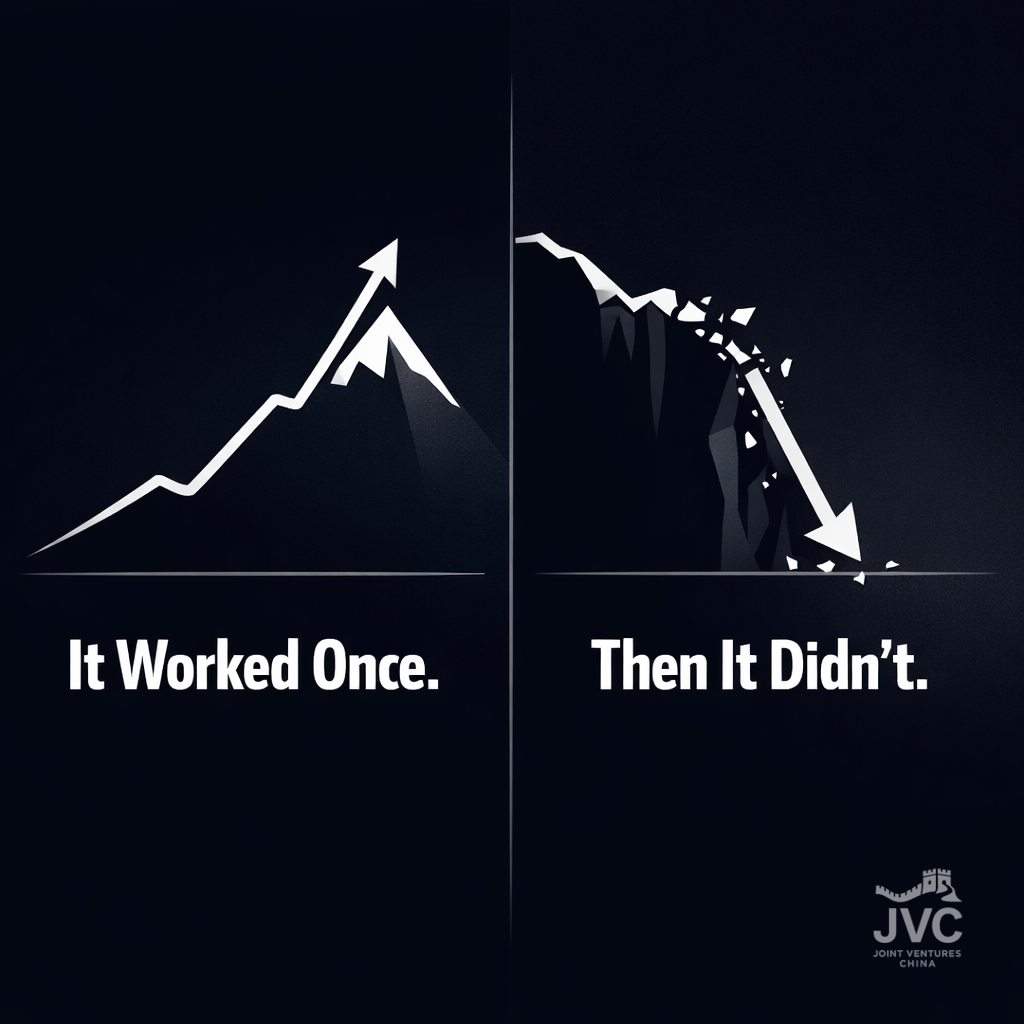
Most Western companies do not fail in China.
They fail after they succeed.
The first deal closes.
The pilot works.
The relationship feels strong.
And that is exactly when things start to break.
Because what looks like momentum is often something else entirely.
It is not a scalable system.
It is a temporary alignment.
This reflects a deeper issue in how China business strategy actually works at a system level. For a full breakdown, see China Business Strategy: Why Western Playbooks Fail and What Actually Works.
And when companies try to scale it, everything changes.
This is the real reason why scaling in China fails.
Not because the strategy was wrong.
But because the conditions that made it work no longer exist.
1. The First Win Is Misleading
The first success in China feels like validation.
It tells you:
- The product works
- The partner is aligned
- The market is responsive
So the natural assumption is simple:
We have figured it out.
But that assumption is almost always wrong.
Because the first win in China usually happens inside a very controlled environment:
- A limited group of stakeholders
- A narrow decision path
- A specific moment of internal alignment
Everything is contained.
Nothing is stressed.
And most importantly, nothing has to scale.
What you experienced was not a proven system.
It was a moment where the system happened to align.
Your first win in China is usually situational, not structural. It’s the second level where we see why scaling in China fails.
What looks like progress in early stages often hides how decisions are actually being made inside Chinese organizations, especially when those decisions are not happening in the room, as explored in Decisions Don’t Happen in the Meeting — And That’s Normal in China.
2. Why Western Teams Misread Early Success
After that first success, Western teams move quickly to capitalize on it.
They do what has worked everywhere else:
- Replicate the model
- Expand the scope
- Increase the pace
Because in most markets, early traction means you are on the right path.
In China, it often means something very different.
It means the conditions were right once.
Not that they will hold under pressure.
This is also why speed in China is often misunderstood in the early stages, where early momentum can feel faster than it actually is, as explained in Speed in China Doesn’t Look Fast – Until It Does.
Many companies underestimate how quickly complexity increases during expansion, especially when early success creates a false sense of repeatability, a pattern widely discussed in strategy execution research as seen at Harvard Business Review.
Three assumptions quietly take hold:
- We understand how this works now
- We can scale this approach
- The relationship is stable
None of these are actually true.
Because what made the first success possible was not fully visible.
Alignment was partial.
Risk was contained.
Internal agreement was easier to maintain.
This is where many China strategies begin to break down, and why scaling in China fails even when the initial market entry appears successful, something addressed in How to Do Business in China: A Practical Guide for Western Leaders.
Once you move beyond that initial scope, those conditions start to change.
And the system begins to behave very differently.
3. Why Scaling in China Fails After the First Win
Scaling introduces something most Western teams underestimate.
Visibility.
Once a project starts to expand:
- More stakeholders get involved
- More departments are affected
- More internal scrutiny is applied
What was once a contained decision becomes a shared risk.
And that changes behavior immediately.
Decisions take longer.
Communication becomes less direct.
Progress feels less certain.
From the outside, it looks like momentum is slowing down.
But what is actually happening is more important.
The system is protecting itself.
More people now need to align.
More risk needs to be managed.
More internal agreement has to be built before movement continues.
What feels like slowing down is often the system moving into a different phase of coordination and execution, as explored in Why Sequence Beats Speed in China’s Factories.
This is the point where most companies make their biggest mistake.
They interpret this shift as resistance.
So they push harder.
And that is where why scaling in China fails begins to reveal itself.

The second level is why scaling in China fails, when complexity hits.
4. The Hidden System You Didn’t See
The mistake most Western teams make is simple.
They think their first success means they understand China.
They don’t.
What they actually experienced was a narrow slice of alignment inside a much larger system.
At the beginning:
- Fewer people are involved
- Decisions are easier to coordinate
- Risk is easier to contain
So everything feels fast.
Clear.
Responsive.
But that is not the full system.
It is a controlled version of it.
As soon as you try to scale, you are no longer working with:
- One aligned partner
- One motivated team
- One contained decision
You are now interacting with:
- Multiple stakeholders
- Internal hierarchies
- Competing priorities
- Risk management layers
Nothing has changed about the system itself.
Only your exposure to it has changed.
The system did not become more complex.
You simply started seeing more of it.
To understand why this shift happens, you have to understand how hierarchy structures decision-making and speed inside Chinese organizations, as detailed in Chinese Business Hierarchy: The System Behind China’s Speed.
As organizations scale, internal coordination and risk management become significantly more complex, a challenge often highlighted in global operating model research.
And this is where most strategies begin to fail.
Because Western teams try to scale what they experienced.
Instead of adapting to what actually exists.
5. The Scaling Trap
Once things start to slow down, the instinct is predictable.
Push harder.
- Accelerate timelines
- Expand faster
- Increase pressure
- Ask for clearer commitments
Because in most markets, pressure creates momentum.
In China, it usually creates the opposite.
Pressure increases risk.
And when risk increases:
- Transparency decreases
- Communication becomes more cautious
- Alignment takes longer to rebuild
From the outside, it feels like resistance.
Internally, it is risk management.
At this stage, behavior shifts because no one wants to be the first to take on visible risk as exposure increases, as explained in Chinese Business Decision Making: Why No One Wants to Be First to Say Yes.
This is the trap.
The more you push to scale,
the more friction you create inside the system.
The faster you try to scale, the more the system slows you down. The shift becomes clearer when you understand how China strategy execution actually works across stakeholders and internal systems.
6. What Successful Companies Do Differently
The companies that scale successfully in China do something that feels counterintuitive.
They do not try to replicate their first success.
They rebuild alignment as they grow.
That means:
- Re-mapping stakeholders at each stage
- Re-confirming internal agreement
- Expanding in sequence, not all at once
- Reducing visible pressure during transitions
They understand something most teams miss:
Scaling in China is not replication.
It is re-alignment.
The deeper issue is not strategy itself, but whether alignment exists to support execution at scale, which becomes even clearer in Why Alignment Matters More Than Strategy in China.
Scaling in China is where most strategies quietly break.
If you are navigating expansion, partnerships,
or joint ventures in China,
subscribe for weekly insights on how alignment,
decision-making, and execution actually work.
7. A Practical Reset Framework
If scaling in China is not about replication,
then what should you actually do?
1. Re-identify the real decision makers
The people who mattered in the first deal
are often not the ones who matter at scale.
2. Reconfirm internal alignment
Do not assume alignment carries forward.
It rarely does.
3. Reduce visible pressure
Pushing harder feels productive.
It usually creates delay.
4. Sequence expansion deliberately
Do not scale everything at once.
To avoid a China expansion strategy failure expand in stages.
Let alignment catch up before increasing speed.
Conclusion
Most Western companies think scaling problems in China are execution issues.
They are not.
They are alignment issues that only become visible under scale.
What worked once felt repeatable.
What worked once felt proven.
But it was neither.
It was a moment where the system aligned just enough to move.
And when that alignment changed, the strategy didn’t fail.
It simply stopped working under different conditions.
This is why scaling in China fails.
Not because companies lack capability.
But because they try to scale outcomes instead of rebuilding alignment.
In China, success is not what you replicate.
It is what you realign, over and over again.
Frequently Asked Questions
1. Why does scaling in China often slow down after early success?
Scaling in China slows down because more stakeholders, departments, and internal approvals become involved as visibility increases. What was once a contained decision becomes a shared risk, requiring broader alignment before execution can continue. This shift is one of the main reasons why scaling in China fails when companies try to move too quickly without rebuilding alignment.
2. What is the biggest mistake Western companies make when scaling in China?
The most common mistake is assuming early success can be directly replicated. Western teams often try to scale a proven outcome without recognizing that the original success depended on specific alignment conditions that no longer exist at scale. This misunderstanding is a core reason why scaling in China fails.
3. How can companies successfully scale in China?
Companies that scale successfully in China focus on rebuilding alignment at each stage of growth. This includes re-identifying decision makers, confirming internal agreement, reducing visible pressure, and expanding in sequence. Rather than replicating past success, they treat each phase of scaling as a new alignment process.
Enjoying this Insight?
Get weekly real-world insights on Chinese business culture, joint ventures, and China manufacturing.

About the Author — Kevin Burton
Kevin Burton is the General Manager of a China joint venture company manufacturing advanced fiberglass materials for industrial thermal protection systems and EV safety applications. He writes about Chinese business culture, joint venture governance, and how Western leadership assumptions often collide with China’s execution-driven operating systems.