
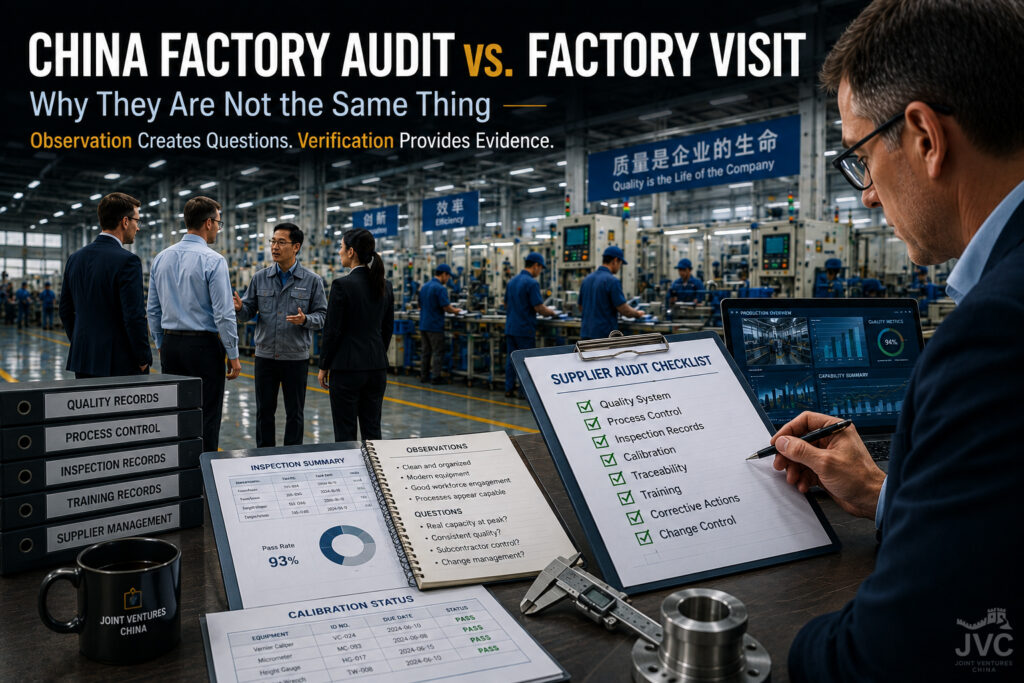
“We audited the factory.”
I have heard executives use some version of that statement many times after returning from China. But when you ask what the audit actually involved, the answer often sounds very different.
They met with senior management. They reviewed a company presentation. They walked through the production areas. They looked at equipment, talked about capacity, inspected a few products, perhaps reviewed some quality documents, and then had lunch or dinner with the supplier.
That may have been a very useful factory visit.
But it was not necessarily a China factory audit.
The distinction matters because a factory visit and an audit are designed to accomplish different things. A factory visit helps you understand a supplier, its management, its capabilities, and how the operation appears to function. A China factory audit is intended to verify whether specific requirements, processes, and claims are actually supported by evidence.
Understanding the difference between a China factory visit and a China factory audit is only the beginning. Before awarding significant business, companies should evaluate the supplier as a complete manufacturing organization—not simply the condition of its factory. Knowing how to verify a Chinese supplier means assessing manufacturing capability, engineering resources, quality systems, management discipline, production capacity, and the supplier’s ability to support your business over the long term.
Both can be valuable. A Chinese factory audit and an experienced factory visit serve different purposes, and neither completely replaces the other.
The problem begins when executives believe they have verified something simply because they have seen it.
A Factory Visit Helps You Understand the Business
A good factory visit in China can tell you an enormous amount about a supplier.
Walking through a manufacturing operation gives you information that is difficult to obtain from presentations, quotations, emails, or video conferences. You can see how material moves through the factory, where work-in-process accumulates, which equipment is operating, how production areas are organized, and how supervisors and employees interact.
You can also begin comparing what management tells you with what you actually observe.
If a supplier describes a highly automated manufacturing process but you see substantial manual handling, that deserves further discussion. If management describes strong demand but large sections of the plant appear inactive, you may want to understand why. If a company claims significant available capacity but every critical machine is already running continuously, that creates a different set of questions.
None of these observations necessarily indicate a problem. They provide context.
That is one reason a factory visit in China can be so valuable when executives know what to observe beyond the prepared tour. The objective should not simply be to see the factory. It should be to understand how the business actually operates.
This is also where experience matters. Someone who has spent years around manufacturing facilities will often notice things that would mean very little to someone unfamiliar with production operations.
A factory visit is therefore not a lesser version of a China factory audit. It is a different tool designed to answer different questions.
A China Factory Audit Is Designed to Verify Something
A China factory audit should begin with a different question.
What specifically are you trying to verify?
Perhaps you need to confirm that the supplier has the manufacturing capacity it claims. Perhaps you need to determine whether inspection procedures are actually followed, whether measurement equipment is calibrated, whether raw materials can be traced through production, or whether operators are working from controlled specifications.
The purpose is not simply to observe. It is to compare requirements or claims against objective evidence.
That distinction is consistent with formal auditing principles. ISO 19011 provides international guidance for auditing management systems and describes a structured framework for conducting effective audits. The standard addresses audit principles, audit programs, audit methodology, and auditor competence.
For executives, however, the important point is simpler.
A supplier may tell you that every incoming raw material is inspected before entering production. During a factory visit, you might see an incoming inspection area and conclude that the process exists.
During a China factory audit, you would go further.
You might select several recently received materials and trace them backward through the records. You would look for evidence that the required inspection occurred, that the correct specifications were used, that the results were recorded, and that nonconforming materials were handled according to the supplier’s established procedures.
Seeing the inspection area tells you something.
Verifying the records tells you something different.
This is one of the fundamental differences between a factory visit and a supplier audit China companies may undergo as part of customer qualification. The visit creates understanding. The audit seeks evidence.
Why the Difference Matters More in China
There is nothing uniquely Chinese about preparing for an important customer visit.
Factories throughout North America, Europe, and Asia clean production areas, organize conference rooms, complete maintenance items, brief employees, and make sure the facility presents itself well when an important customer is arriving.
Experienced Chinese manufacturers are no different.
The mistake is assuming that what you see during a scheduled visit automatically represents an ordinary production day.
The production line you want to see may be running when you arrive. The most experienced operators may be assigned to it. The conference room presentation may describe capabilities that exist somewhere within the broader company organization but not necessarily at the facility you are visiting.
Again, none of this automatically means someone is attempting to deceive you.
It means you need to distinguish between presentation and verification, which is one of the primary reasons a China factory audit can add value beyond the factory tour.
That distinction becomes especially important when conducting China supplier verification because the commercial organization selling a product, the legal entity signing the contract, and the manufacturing facility producing the product may not always be as closely aligned as a foreign buyer assumes. Understanding those relationships should be part of any serious China supplier verification process before significant business is awarded.
Some processes may be subcontracted. Specialized equipment may be located at another facility. Certain certifications may apply to a particular legal entity or manufacturing site. Samples may have been produced using processes that differ from normal high-volume production. Chinese businesses often operate in this interlinked spider web of connections and processes.
A Chinese factory audit can help clarify these questions, but only if the audit is designed to investigate them.
Simply walking through the plant with a checklist does not guarantee that you understand the underlying manufacturing structure.
What an Experienced Factory Visit Can Reveal That an Audit Might Miss
There is also a danger in moving too far in the opposite direction and assuming that a formal audit is always superior to an experienced factory visit.
It isn’t.
A poorly conducted audit can produce a very impressive report while missing some of the most important operational risks in the factory.
An auditor working through a standardized checklist may confirm that procedures exist, forms are completed, and records are available. Meanwhile, an experienced manufacturing executive walking through the same facility may notice that work-in-process is accumulating between two operations, maintenance appears reactive rather than preventive, or operators are routinely working around a process that management claims is controlled.
Those observations may never appear on a standard supplier audit China checklist, yet they may identify the operational issues that deserve the most attention.
You may notice machines sitting idle that supposedly represent significant production capacity. You may see temporary repairs that have clearly become permanent. You may notice unusual quantities of scrap or rework, poorly identified material, excessive inventory between operations, or a warehouse that appears inconsistent with the production volume management described.
Sometimes the most valuable observation is simply that something does not make sense.
That does not prove there is a problem. It tells you where to ask the next question.
A checklist tells an auditor where to look. Experience often tells an executive what does not look right.
This is why I would never treat a factory visit China executives conduct as merely a ceremonial activity before the “real” supplier audit begins. Done properly, the visit can identify the risks that the subsequent audit should investigate.
Continue Reading Joint Ventures China
Practical insights on manufacturing, supplier management, joint ventures, and operating businesses in China are published regularly at Joint Ventures China.
What an Audit Can Verify That a Factory Visit Cannot
The opposite is equally important.
There are many things you simply cannot determine by walking through a factory.
A clean calibration laboratory does not tell you whether measurement equipment is actually within its calibration period. A rack of inspection records does not tell you whether those records are complete. A controlled-document system on a computer screen does not prove that operators on the production floor are using the latest specification.
These questions require evidence.
A Chinese factory audit can examine whether corrective actions were actually completed, whether inspection records correspond with production history, whether employee training is current, whether specifications are revision-controlled, and whether traceability works backward from finished product through the manufacturing process. More importantly, reviewing previous quality failures can reveal whether corrective actions actually prevented the problem from recurring, rather than simply confirming that the required reports were completed.
This is where a well-designed quality system in China becomes important. Inspection can identify a nonconforming product, but the underlying manufacturing system determines whether that problem occurs in the first place.
ISO describes ISO 9001 as a globally recognized quality-management standard intended to help organizations establish, maintain, and continually improve a quality management system, including areas such as resources, competence, documented information, operations, performance evaluation, and improvement.
ISO 9001 quality management systems overview
A certificate alone, however, should not end the investigation.
Certification can provide useful evidence that a quality management system has been independently assessed. It does not eliminate the need to understand whether the systems most important to your particular product and business are functioning effectively.
That is especially important when the consequences of failure are significant.
The Best Approach Is Usually Both
The choice should rarely be framed as factory visit versus factory audit.
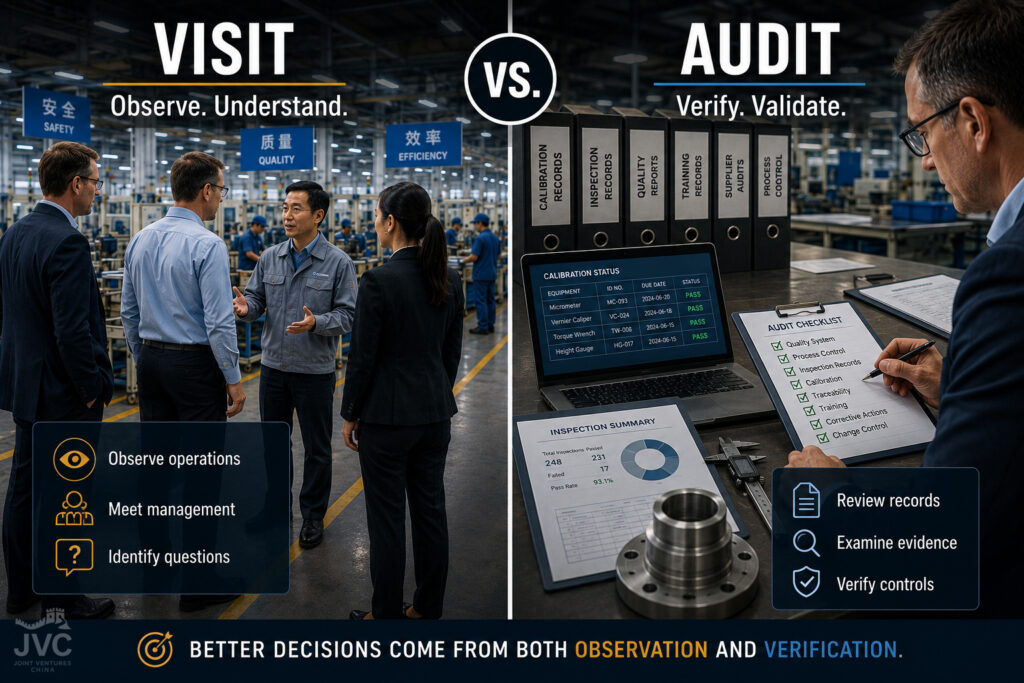
The strongest approach is usually to understand first and verify second.
A good factory visit gives executives context. It helps them understand the manufacturing process, management structure, equipment, production flow, and potential weaknesses of the operation.
Those observations should create questions.
A well-designed China factory audit can then investigate the questions that matter most and test whether the supplier’s explanations are supported by evidence. This is where a factory visit China executives conduct personally can become especially valuable, because direct observation helps determine where the formal audit should concentrate its attention.
Suppose, for example, you notice during the factory tour that one critical manufacturing operation appears to have very limited capacity. Rather than simply checking a box stating that the equipment exists, the audit can examine actual production records, cycle times, utilization, maintenance history, and available capacity.
Or perhaps you notice that a significant portion of the product disappears from the production flow and returns later as a completed subassembly. That observation should create questions about subcontracting, supplier controls, traceability, and responsibility for quality.
This is much more valuable than treating the factory visit and the supplier audit China process as two unrelated activities.
One should inform the other.
Don’t Audit the Checklist. Audit the Risk.
One of the weaknesses of standardized supplier audits is that they can create the illusion of precision.
A checklist may contain 50, 100, or even several hundred questions. Each answer can be assigned a score, and those scores can eventually produce a supplier rating that appears objective.
But not every question carries the same business risk.
A supplier can receive an excellent overall audit score while performing poorly in the one area most capable of damaging your business.
For a highly engineered product, engineering change control in China may be one of the most important areas to audit. An unauthorized change to a raw material, process parameter, specification, or subcontractor could fundamentally change product performance even if every other section of the audit looks excellent.
For another product, manufacturing capacity may represent the greatest risk. A supplier may be capable of producing excellent samples but unable to maintain quality when production increases dramatically.
In a safety-critical application, traceability, process control, testing, and corrective action may deserve far more attention than other elements of the audit.
For a supplier dependent on outside processors, subcontractor control may become one of the most important areas to investigate.
This is why the objective of a China factory audit should not be to complete the checklist.
It should be to reduce uncertainty about the risks that could affect your business.
The checklist is a tool. It is not the objective.
An effective Chinese factory audit should therefore spend more time investigating the few issues that could seriously affect your business than documenting dozens of low-risk items simply because they appear on a standard form.
China Supplier Verification Goes Beyond the Factory Floor
There is another limitation worth understanding.
Even an excellent factory audit does not necessarily answer every question about the supplier itself.
You may verify that the factory has capable equipment, good process controls, trained employees, and an effective quality system. You may still need to understand who actually owns the company, which legal entity will receive your purchase orders, whether the manufacturing site belongs to that entity, and how other affiliated companies fit into the relationship.
You may also need to confirm whether critical manufacturing steps occur somewhere other than the facility you visited.
That broader China supplier verification process becomes particularly important before a buyer commits significant tooling, engineering resources, intellectual property, or long-term production volume to a supplier.
This is the natural next step after determining what the factory itself can do.
A good China factory audit tells you a great deal about manufacturing capability and systems.
It does not automatically tell you everything you need to know about the company behind them.
Before Your Next Factory Visit in China
Before the next supplier visit, decide what you are actually trying to learn.
Some questions can be answered through observation. Others require verification.
If you want to understand the production flow, equipment condition, management team, factory organization, or general operating environment, spend time walking the facility and asking questions. Do not rush through production simply because an audit checklist is waiting in the conference room.
If you need to determine whether a process is consistently followed, whether capacity claims are accurate, whether traceability works, or whether the quality system actually controls production, identify the evidence necessary to verify those claims.
Most importantly, identify your highest-risk assumptions before you arrive. That preparation makes both the factory visit and the subsequent China factory audit considerably more effective.
What are you assuming about this supplier that would create a serious problem if it turned out to be wrong?
That question will often tell you more about what your Chinese factory audit should examine than another page of generic audit questions.
The best factory visits create better questions.
The best Chinese factory audits provide evidence-based answers.
Understanding the difference between the two can give Western executives a much clearer picture of the suppliers they are relying upon. Those activities become even more valuable when they are incorporated into a broader China supplier verification framework that evaluates not only the factory, but the supplier’s overall manufacturing capability and long-term suitability as a business partner.
Frequently Asked Questions
What is a factory audit in China?
A China factory audit is a structured assessment used to verify specific aspects of a supplier’s manufacturing capabilities, processes, quality systems, capacity, controls, or compliance. Unlike a general factory tour, an effective audit looks for evidence that stated procedures and capabilities are actually being implemented.
What is the difference between a factory audit and a factory inspection?
A factory audit generally evaluates the manufacturing operation, systems, processes, and controls behind production. A product inspection typically evaluates specific products or production lots against defined requirements. Both can be important, but they address different risks.
Can a factory visit replace a supplier audit?
Usually not. A factory visit can provide valuable insight into management, manufacturing capabilities, production flow, equipment, and operating conditions, but many important claims require records or other evidence to verify. Likewise, an audit should not completely replace an experienced visit to the production floor.
Should you visit a Chinese factory before placing an order?
For strategically important, technically demanding, high-volume, or high-risk products, visiting the manufacturing operation can provide information that is difficult to obtain remotely. The appropriate level of supplier audit China buyers require should depend on the value, complexity, and risk of the business rather than simply following the same process for every supplier.
Enjoying this Insight?
Get weekly real-world insights on Chinese business culture, joint ventures, and China manufacturing.

About the Author — Kevin Burton
Kevin Burton is the General Manager of a China joint venture company manufacturing advanced fiberglass materials for industrial thermal protection systems and EV safety applications. He writes about Chinese business culture, joint venture governance, and how Western leadership assumptions often collide with China’s execution-driven operating systems.
Editorial Transparency
These articles are based on my professional experience leading manufacturing operations and joint ventures in China. I use AI as an editorial assistant to help organize ideas, improve clarity, and review drafts. Every article is personally reviewed, edited, and approved by me, and the opinions and conclusions expressed are my own.