
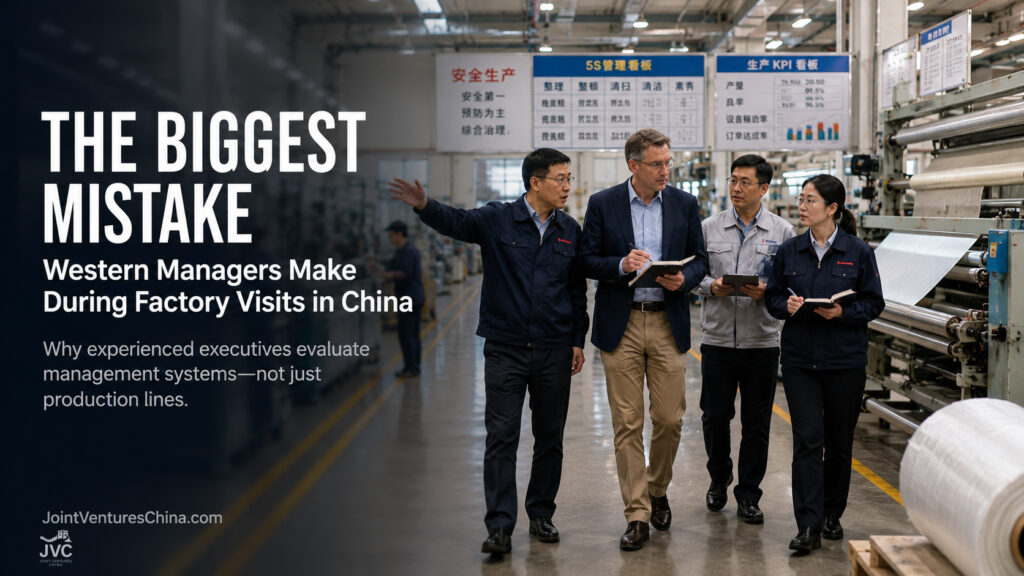
Most Western executives approach China factory visits with a clear objective: to evaluate a supplier’s capabilities, assess manufacturing quality, and determine whether the company is capable of becoming a reliable long-term business partner. They observe the production lines, inspect the equipment, review quality systems, and speak with management, assuming that what they see provides an accurate picture of the company’s day-to-day operations.
Unfortunately, that assumption is often the most costly mistake they make.
A well-planned factory visit can reveal a tremendous amount about a business, but it can also create a misleading impression if viewed in isolation. By the time an important customer arrives, the facility has often been carefully prepared. Production schedules may have been adjusted, managers assembled, work areas organized, and key personnel selected to answer questions. None of these preparations are unusual or inappropriate. Companies throughout the world want to present themselves professionally when prospective customers, investors, or business partners are on site.
In China, however, those preparations are often especially comprehensive. Welcoming an important visitor is viewed not only as a business obligation but also as an opportunity to demonstrate competence, organization, and respect. Considerable effort may be invested in ensuring that the factory presents itself at its very best. The result is that visitors are frequently evaluating a carefully prepared environment rather than observing the operation exactly as it functions during a normal production week.
This does not mean the factory is being deceptive. In many cases, the operation genuinely reflects high standards. The challenge is that even an excellent factory cannot be fully understood during a single visit. The conversations employees choose not to have, the decisions postponed until after you leave, and the routine operational challenges that exist in every manufacturing business often remain invisible to visitors.
During almost three decades of working in China, I have participated in scores of China factory visits as a customer, supplier, joint venture partner, and manufacturing executive. Some facilities immediately demonstrated world-class capabilities. Others initially appeared impressive but later revealed organizational weaknesses that could never have been identified during a carefully planned tour. The lesson I have learned is that the purpose of a factory visit extends well beyond inspecting machinery or confirming production capacity. The real objective is to understand the organization behind the facility – how decisions are made, how problems are communicated, who truly holds influence, and whether the company you are visiting is actually the business that will manufacture your products.
The most valuable lessons from China factory visits are often found not in what you see, but in what you learn to question.
Success Begins Before You Arrive
One of the most common misconceptions about China factory visits is that the evaluation begins when you walk through the front door. In reality, the most successful visits begin days or even weeks before boarding the airplane.
Preparation dramatically improves the value of every conversation, every observation, and every question you ask during the visit. Without that preparation, it is surprisingly easy to spend valuable time examining equipment and production lines while overlooking the organizational details that often have a much greater impact on long-term success.
One of the first steps should be conducting supplier due diligence in China before scheduling the visit. Many executives rely almost entirely on the supplier’s website, company presentation, or sales team. While those resources are helpful, they should be supplemented with independent research into the business itself.
Begin by confirming the legal name of the company you intend to visit. Is it the same legal entity that appears on quotations, contracts, and purchase orders? Is the manufacturing company the same business you have been negotiating with, or is another affiliated company involved? Does the organization own multiple manufacturing facilities, or are different products produced by different legal entities?
These questions are not intended to create suspicion. They simply establish a clearer understanding of the business relationship before discussions begin.
Research should also include the company’s ownership structure, registered capital, and corporate history whenever possible. Public corporate records can often provide valuable context about the size and maturity of the organization. Registered capital alone should never be viewed as a definitive measure of capability, but when considered alongside employee count, business scope, and years of operation, it helps develop a more complete picture of the enterprise.
Financial stability should also be part of your supplier due diligence in China. Publicly available information – such as years in operation, ownership continuity, major investments, and recent expansion – can provide valuable insight into a company’s ability to support a long-term partnership. While financial strength alone does not guarantee manufacturing excellence, it often influences a supplier’s ability to invest in equipment, engineering talent, quality systems, and future growth.
This type of supplier due diligence in China frequently reveals organizational structures that are not immediately apparent during a sales presentation. For example, the company hosting your visit may not actually own the factory you are touring. In other situations, a trading company may coordinate production across multiple affiliated manufacturers while serving as your commercial contact. Neither business model is inherently problematic, but understanding the structure before making assumptions can save considerable confusion later.
Understanding how the company is organized internally is equally important. Who leads engineering? Who manages quality? Does production report directly to ownership or through experienced operational managers? How are purchasing, scheduling, and customer service integrated into daily operations? Even if you cannot answer every question before arriving, identifying the organizational structure you hope to understand allows you to ask much better questions during the visit itself.
It is also worthwhile to research the company’s existing customers before your visit. Although customer information is not always publicly available, many manufacturers proudly identify major markets or industries they serve. Existing customers often reveal far more than a marketing brochure. A manufacturer supplying aerospace, automotive, medical, or other highly regulated industries has likely developed quality systems and operational discipline very different from those serving primarily commodity markets. Customer history does not guarantee future performance, but it provides important context for evaluating whether the supplier’s normal operating standards align with your own expectations.
Finally, prepare a written list of the specific topics you want to understand. Those questions should extend well beyond equipment specifications and production capacity. Consider asking about quality management systems, supplier qualification processes, inventory strategy, engineering resources, employee retention, preventive maintenance, production planning, continuous improvement initiatives, and how the company manages its own supply chain. These discussions often provide a much deeper understanding of the organization than a simple factory inspection ever could.
The executives who gain the greatest value from China factory visits rarely arrive hoping to be impressed. They arrive prepared to learn.
Every Factory Prepares for Important Visitors
One of the greatest mistakes Western executives make is assuming that what they observe during China factory visits represents an ordinary production day. In reality, every experienced manufacturer understands the importance of making a positive first impression.
This is not unique to manufacturing in China. Factories throughout North America, Europe, and Asia prepare for important customers. Work areas are cleaned, conference rooms organized, presentations rehearsed, and senior managers adjust their schedules to participate. Any well-managed company wants prospective customers to leave with confidence in its capabilities.
Chinese manufacturers are no different. In many cases, however, the preparation is especially comprehensive because hosting visitors carries additional cultural significance. A successful visit reflects not only on the company but also on the individuals responsible for organizing it, making professionalism and hospitality an important part of building a long-term business relationship.
As a result, production lines may be running selected products, experienced operators assigned to visible workstations, and engineering or quality personnel available throughout the tour to answer questions. None of these actions should be viewed as misleading. They simply reflect the company’s desire to present itself professionally.
Recognizing that reality naturally raises a more important question: if every factory prepares for an important customer visit, what aren’t you seeing?
What You Won’t See During China Factory Visits
Recognizing that every factory prepares for important visitors naturally leads to a more important question:
What aren’t you seeing?
For many experienced executives, that question ultimately becomes more valuable than the tour itself.
A well-organized facility, modern equipment, and professional presentations certainly deserve recognition. They demonstrate that management understands the importance of operational excellence and customer confidence. However, they rarely tell the complete story. The most significant organizational challenges are often those that cannot be observed during a scheduled visit.
You are unlikely to witness an unexpected equipment breakdown, a disagreement between production and quality, or the difficult conversations that occur when an important shipment is at risk. Purchasing personnel are unlikely to discuss supplier shortages. Engineers are unlikely to explain projects that have fallen behind schedule. Operators seldom raise concerns in front of senior management or visiting customers.
This is not because employees are attempting to conceal problems. Every manufacturing organization experiences operational challenges. The difference is that a scheduled customer visit is designed to showcase the company’s capabilities rather than its daily frustrations.
For that reason, I often spend as much time observing interactions as I do observing equipment.
Who answers technical questions without hesitation?
Who looks to someone else before responding?
When a difficult question is asked, who joins the conversation?
Do production managers and quality managers naturally support one another, or do they appear cautious about offering opinions?
Who seems comfortable making decisions?
Who quietly waits for approval?
These seemingly small observations often reveal more about the organization than another thirty minutes examining machinery.
One of the most revealing moments frequently occurs when something unexpected happens. A machine stops. A specification cannot immediately be located. A visitor asks a question that was not anticipated. Those situations provide a glimpse of how the organization responds when it moves beyond the prepared presentation. Does the team collaborate naturally? Does one individual dominate every decision? Does someone accept responsibility and solve the issue, or does everyone wait for direction?
Those reactions are difficult to stage because they reflect the company’s normal operating culture.
Another valuable observation involves the questions your host asks you. Organizations that are genuinely interested in long-term partnerships are usually just as curious about your business as you are about theirs. They ask about your applications, your customers, your quality expectations, your future growth plans, and the challenges you hope they can solve. A supplier that spends the entire visit talking only about itself may be focused on winning an order rather than building a long-term relationship.
The objective is not to catch people making mistakes. It is to understand how the organization responds when challenges arise.
The objective is to understand how the organization functions when the agenda no longer provides all of the answers.
Stay Connected
If you work with manufacturers or suppliers in China, subscribe to receive practical insights on leadership, manufacturing, and business strategy drawn from decades of executive experience.
Make Sure You Are Visiting the Company You Think You Are
One lesson that many Western executives learn only after years of working in China is that the company hosting the meeting is not always the company manufacturing the product.
This is one of the reasons why supplier due diligence in China should begin long before the visit itself.
China has many outstanding manufacturers, and it also has many excellent trading companies, sourcing organizations, and affiliated business groups. There is nothing inherently wrong with any of these business models. In fact, many trading companies provide exceptional technical support and manage highly sophisticated manufacturing networks.
The important point is simply to understand which business model you are dealing with.
Before or during your visit, confirm that the legal company name displayed on the building matches the legal entity appearing on your quotation, purchase agreement, and future commercial documents. If those names differ, ask why. The explanation is often completely legitimate, but it is a discussion worth having.
I also recommend confirming that the name on the building matches the registered legal entity you researched before your trip. It is surprisingly common to discover that the manufacturing site, sales office, and contracting entity are different companies within the same corporate group. Understanding that structure helps you determine who actually owns the assets, who employs the workforce, and who has the authority to make important decisions.
Public corporate records frequently provide valuable information that supports these discussions. Registered capital, employee count, business scope, years of operation, and corporate ownership should never be interpreted in isolation, but together they often help explain how the organization is structured and where important decisions are made.
A company with relatively modest registered capital and a small employee count is not automatically a trading company. Likewise, a large registered capital does not guarantee manufacturing excellence. These are simply pieces of information that should be evaluated alongside everything else you learn during your visit.
During one meeting you may discover that the sales organization occupies one office while production occurs in another city. During another, you may learn that several factories within the same corporate group specialize in different manufacturing processes. Neither situation is necessarily a concern. The value lies in understanding the structure before making assumptions about who controls production, quality, engineering, or commercial decisions.
This knowledge becomes particularly important whenever product development, engineering changes, quality investigations, or supply disruptions occur. Knowing whether you are working directly with the manufacturer or through another organization significantly influences how quickly issues can be resolved and who ultimately has the authority to make decisions.
Understanding how to verify a Chinese supplier therefore involves much more than confirming a business license.
It means understanding the organization behind the business.
Executive Insight: Strong business relationships are built on understanding, not assumptions. The more thoroughly you understand a supplier’s organization before making long-term commitments, the more successful the relationship is likely to become.
Continue Building Better Supplier Relationships
If your organization regularly evaluates manufacturers in China, you’ll also find practical guidance in Decisions Don’t Happen in the Meeting – And That’s Normal in China, which explains why important commitments often develop after formal meetings have ended. Understanding that decision-making process can dramatically improve both supplier communication and long-term partnership development.
The Most Important Conversations Often Happen After You Leave
One of the most surprising realities of China factory visits is that the meeting you attend is often only the beginning of the decision-making process.
Western executives sometimes conclude that a successful presentation, positive discussion, and enthusiastic agreement indicate that important decisions have already been made. In reality, many of the most meaningful conversations occur after the visitors have departed.
Once the conference room is empty and normal operations resume, managers compare impressions, engineers discuss technical feasibility, production supervisors evaluate capacity, purchasing reviews material availability, and senior leadership considers whether commitments made during the meeting can realistically be achieved.
In many Chinese organizations, meetings are designed to exchange information, strengthen relationships, and establish direction. Internal alignment frequently occurs afterward, when participants have time to consult colleagues, evaluate risks, and build consensus before making important commitments.
Recognizing this process fundamentally changes the way experienced executives interpret meetings during China factory visits.
Rather than viewing immediate agreement as a final decision, they understand that thoughtful organizations often require additional internal discussion before confirming significant commercial or technical commitments. They allow time for that process to occur and continue the conversation after returning home rather than assuming silence indicates either acceptance or rejection.
This also explains why prompt and well-organized follow-up communication is so valuable. A concise summary of technical discussions, agreed action items, open questions, and expected timelines often becomes one of the primary documents reviewed by managers who were not present during the meeting.
Patience should never be confused with inactivity.
Continue asking thoughtful questions. Provide additional technical information when requested. Confirm mutual understanding. Maintain regular communication while respecting the supplier’s internal decision-making process.
The companies that consistently build successful partnerships in manufacturing in China understand that the factory visit is not the conclusion of the evaluation.
It is the beginning of a much longer conversation.
Observe the System, Not Just the Factory
One of the most valuable lessons I have learned over decades of working in manufacturing in China is that outstanding companies distinguish themselves less by the appearance of their facilities than by the strength of their management systems.
Modern equipment can be purchased, buildings can be renovated, and production lines can be cleaned before an important customer arrives. Strong organizations, however, are far more difficult to build.
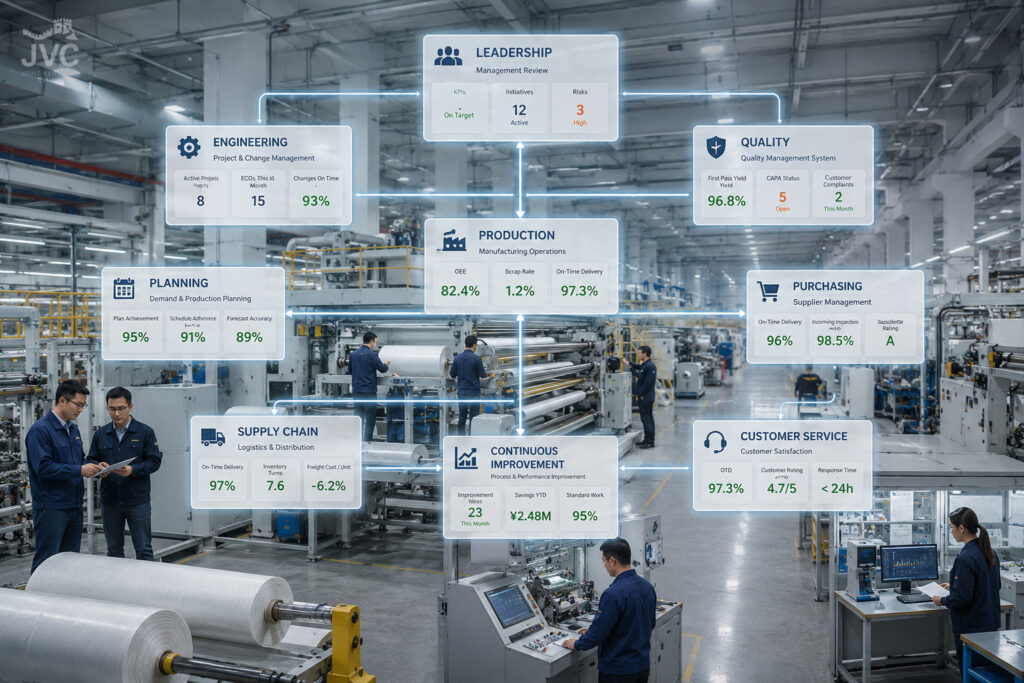
As you walk through the facility, pay close attention to how information flows throughout the organization. Observe how managers interact with engineers, how production personnel communicate with quality, and how supervisors respond when unexpected questions arise. Look beyond the equipment itself and evaluate the system that keeps the equipment operating effectively every day.
• When engineering changes are required, who approves them—and does the supplier have a clearly defined system for engineering change control in China?
• When a quality concern is identified, how quickly is the information communicated to production?
• When production falls behind schedule, who coordinates the recovery plan?
• When a customer requests an urgent change, how is that request managed?
These questions often reveal far more than another review of production capacity or machinery specifications.
An organization’s management systems determine whether success can be repeated consistently. They influence quality, delivery performance, customer responsiveness, employee development, and continuous improvement far more than the age of the equipment on the factory floor.
The same principle applies to quality: building a quality system in China means creating the process controls, accountability, measurement, and change discipline that produce consistent results—not simply inspecting finished products.
During my career, I have visited older factories with exceptional operational discipline that consistently outperformed much newer facilities equipped with state-of-the-art machinery. The difference was rarely the equipment itself. It was the quality of leadership, communication, accountability, and management.
Another valuable observation involves how the company approaches continuous improvement. Ask what major operational improvements have been implemented during the past year. Which quality metrics are monitored regularly? How are corrective actions managed? What investments are planned over the next several years?
Organizations that can clearly explain how they improve their business are often much stronger long-term partners than those that simply describe their current capabilities.
This perspective also changes the purpose of a factory inspection. It is important, however, to distinguish between visiting a factory to understand the business and conducting a structured audit to verify specific capabilities and controls. As explained in China Factory Audit vs. Factory Visit: Why They Are Not the Same Thing, the two activities serve different purposes and provide different kinds of information.
Rather than viewing either process simply as an opportunity to identify isolated problems, experienced executives use them together to determine whether the organization possesses the discipline, leadership, and management systems necessary to solve future problems as they arise. That is a much more valuable indicator of long-term success.
The Best Executives Visit More Than Once
A single visit provides information.
Multiple visits provide perspective.
One of the greatest advantages experienced managers develop is recognizing patterns over time rather than relying entirely on first impressions.
The first visit is naturally structured around introductions, presentations, and learning about the business. By the second or third visit, conversations become more candid. Managers become more comfortable discussing challenges. Engineers begin seeking technical advice rather than simply presenting capabilities. Production personnel become familiar faces rather than strangers.
Relationships create trust.
Trust creates openness.
That progression is one of the reasons long-term business partnerships are so valuable. Each visit builds upon the previous one, allowing both organizations to develop a more complete understanding of one another.
This principle extends well beyond factory operations. Readers of What Happens After the Dinner Matters More Than the Dinner will recognize a similar pattern. Formal meetings and scheduled events establish the relationship, but genuine understanding develops gradually through continued interaction, follow-up discussions, and shared experience.
Likewise, understanding how decisions are made inside a supplier’s organization often requires observing the company over an extended period rather than drawing conclusions from a single presentation. As discussed in Chinese Business Decision Making: Why No One Wants to Be First to Say Yes , consensus and organizational alignment frequently develop over time rather than during a single meeting.
The same principle applies to the management systems that govern the organization. Many Western companies assume that processes, reporting structures, and performance metrics that work successfully at home can simply be implemented inside a Chinese factory. In practice, organizational effectiveness depends on how those systems align with local decision-making, communication, and leadership dynamics. As discussed in Why Western Management Systems Fail in China, successful operations are built by adapting management systems to the organization rather than assuming one approach works equally well everywhere.
Successful supplier relationships are therefore built through repeated engagement, thoughtful communication, and mutual trust—not simply through one successful visit.
Putting These Lessons Into Practice
The value of China factory visits is determined long before you step onto the production floor. The most successful executives approach each visit with a clear understanding of what they hope to learn and a structured plan for evaluating not only the facility, but also the organization that operates it.
Before any of your next China factory visits, take the time to prepare by:
- Researching the company’s legal structure, ownership, and registered manufacturing entity.
- Understanding its primary customers, target markets, and the industries it serves.
- Reviewing its quality management systems, certifications, and operational capabilities.
- Preparing questions that explore decision-making, engineering resources, production planning, and continuous improvement processes.
- Observing how managers and employees communicate, solve problems, and respond to unexpected situations during the visit.
- Following up promptly after returning home to reinforce key discussions, clarify outstanding questions, and support the supplier’s internal decision-making process.
Throughout the visit, remember that your objective extends far beyond determining whether the factory can manufacture today’s product. Your goal is to assess whether the organization possesses the leadership, management systems, technical capability, and culture necessary to become a reliable long-term business partner.
The executives who consistently make the best sourcing decisions are seldom those who ask the greatest number of questions during the factory tour. They are the ones who arrive with the deepest understanding of the business, ask the most thoughtful questions, and continue building their knowledge long after the visit has concluded.
Conclusion
The biggest mistake Western managers make during China factory visits is rarely overlooking a piece of equipment or failing to ask a particular question. More often, it is assuming that a single, carefully planned visit provides a complete understanding of the organization they are evaluating.
Every manufacturer wants to present itself professionally. Every leadership team hopes to make a strong first impression. That is true whether the facility is located in Shanghai, Chicago, Stuttgart, or Bangkok. A successful factory visit demonstrates how a company wants to be perceived; it does not necessarily reveal how the organization operates every day.
The most effective executives recognize this distinction. They arrive well prepared, having already completed supplier due diligence in China and developed a clear understanding of the company’s ownership, legal structure, customer base, and operational model. During China factory visits, they look beyond equipment and production capacity to evaluate leadership, communication, decision-making, and the management systems that ultimately determine long-term performance. They also understand that a factory inspection is only one part of a much broader evaluation, and that the strongest business relationships are built through continued dialogue, repeated observation, and mutual trust.
The next time you visit a manufacturing facility in China, remember that the production lines are only one part of the story. The organization behind them – its people, its leadership, its culture, and its management systems – is the business you are truly evaluating.
Preparing for a visit is also the first step in a broader supplier verification process. A factory tour can answer many important questions, but it should be combined with a structured evaluation of the supplier’s manufacturing capability, engineering resources, quality systems, management team, and long-term business stability. Understanding how to verify a Chinese supplier provides that broader framework before significant business is awarded.
The most successful executives do not leave believing they have found all the answers. They leave with a clearer understanding of which questions still need to be asked.
Frequently Asked Questions
Why are China factory visits important?
China factory visits provide an opportunity to evaluate far more than equipment and production capacity. They help buyers understand a supplier’s management systems, organizational structure, quality culture, leadership, and long-term partnership potential.
What should I research before visiting a supplier?
Begin with supplier due diligence in China by researching the company’s legal entity, ownership structure, registered capital, manufacturing locations, customer base, quality certifications, and business history. The better prepared you are before the visit, the more meaningful your observations will become.
How do I verify a Chinese supplier?
Understanding how to verify a Chinese supplier involves more than confirming a business license. Compare the legal company name with the entity shown on quotations and contracts, review public corporate information, understand ownership relationships, and confirm who actually owns and operates the manufacturing facility.
Is a factory inspection enough to qualify a supplier?
No. A factory inspection is an important part of the evaluation process, but it should be combined with organizational research, technical discussions, customer references, follow-up communication, and multiple visits whenever practical.
Where can I learn more about supplier due diligence?
The International Trade Administration publishes practical guidance on evaluating overseas suppliers and international sourcing practices:
Related Articles
Continue Reading About Manufacturing & Operations in China
- Factory Audits vs. Factory Visits
- How to Verify a Chinese Supplier
- Building Quality Systems in China
- Engineering Change Control
Editor’s Note: This article reflects practical lessons learned through decades of evaluating suppliers, managing manufacturing operations, and leading joint ventures in China. Every company is different, and every factory deserves to be evaluated on its own merits. The objective is not to become skeptical of every supplier, but to become more intentional in understanding the organizations with which you choose to build long-term business relationships.
Enjoying this Insight?
Get weekly real-world insights on Chinese business culture, joint ventures, and China manufacturing.

About the Author — Kevin Burton
Kevin Burton is the General Manager of a China joint venture company manufacturing advanced fiberglass materials for industrial thermal protection systems and EV safety applications. He writes about Chinese business culture, joint venture governance, and how Western leadership assumptions often collide with China’s execution-driven operating systems.
Editorial Transparency
These articles are based on my professional experience leading manufacturing operations and joint ventures in China. I use AI as an editorial assistant to help organize ideas, improve clarity, and review drafts. Every article is personally reviewed, edited, and approved by me, and the opinions and conclusions expressed are my own.