
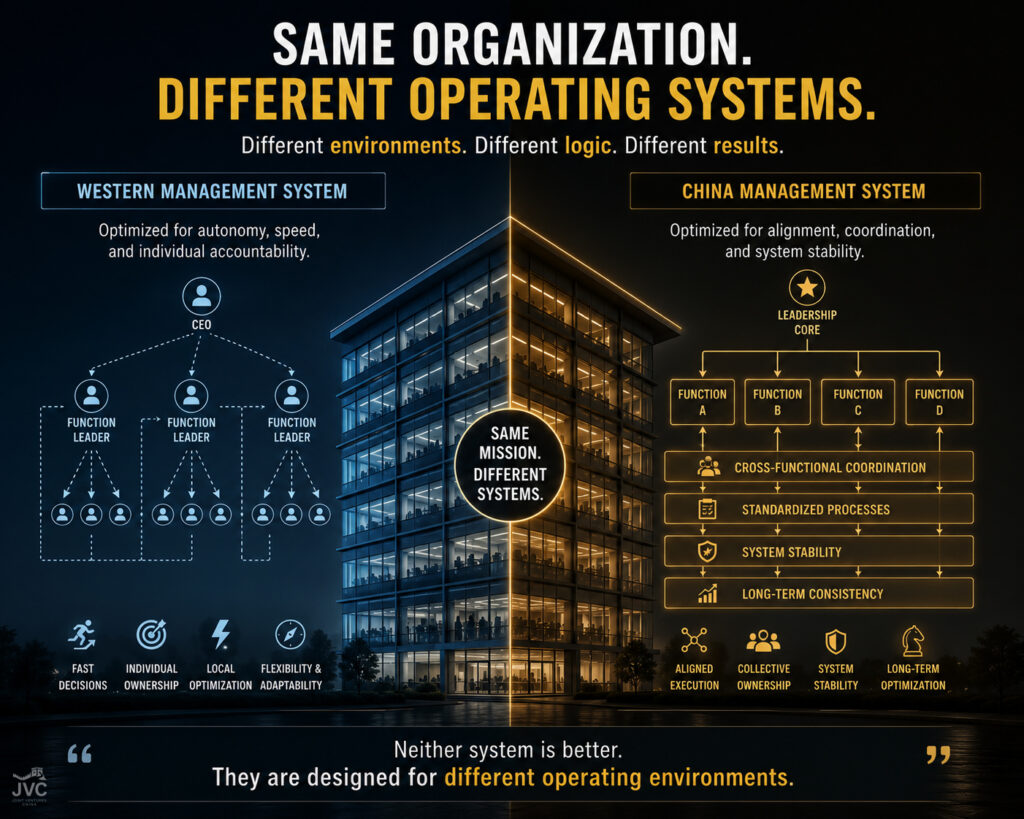
Most Western companies do not fail in China because of culture.
They fail because they apply Western management systems to an operating environment built around different organizational assumptions, coordination models, and execution logic.
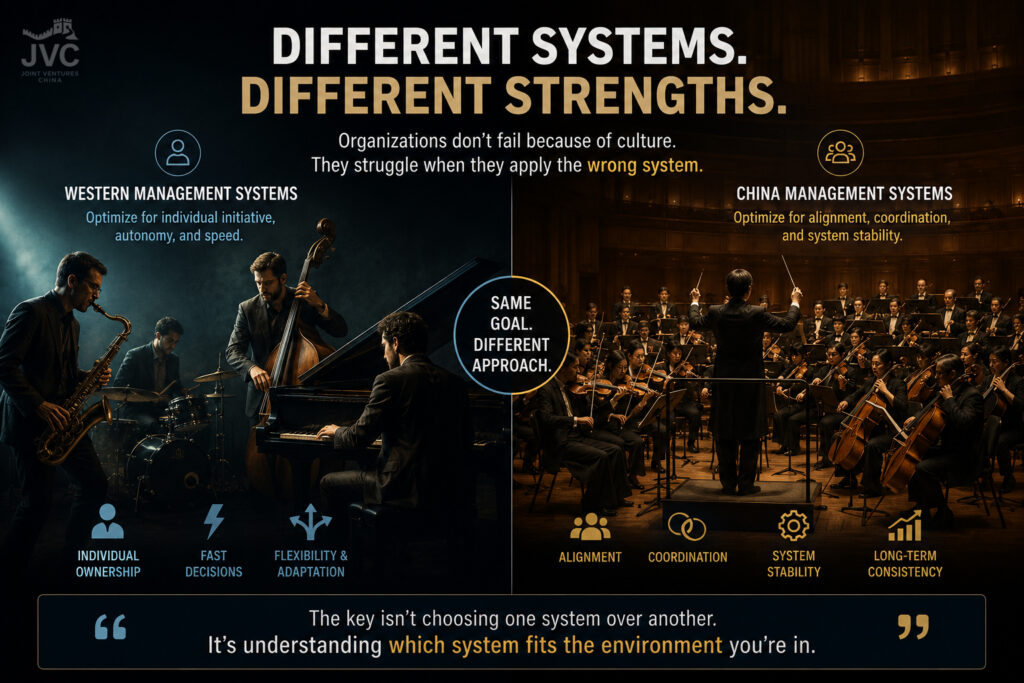
This does not mean one system is superior to the other.
It means they evolved in different business environments and were designed to optimize for different outcomes.
Many Western leadership teams enter China assuming that good management is universal. If a management structure creates speed, accountability, and innovation in New York, London, or Chicago, they expect it to function similarly in Shanghai, Shenzhen, or Chongqing.
But organizations do not operate independently from their environment.
The same leadership behaviors that create speed in one system can create friction in another.
That is why so many executives misunderstand what is actually happening inside Chinese organizations and broader organizational systems in China.
The Mistake Most Western Companies Make
The biggest mistake many companies make in China is assuming their existing management logic can simply be transferred into a different operating environment unchanged.
Most executives do not consciously think:
“Western systems are better.”
What they usually think is:
“This is simply how effective organizations operate.”
That assumption becomes dangerous in China because many Western management systems were developed inside business environments that reward:
- local initiative
- decentralized authority
- rapid decision-making
- individual ownership
- direct accountability
Those systems can work exceptionally well in environments optimized for flexibility, innovation, and fast adaptation.
But Chinese management systems often evolved around different priorities tied to coordination, alignment, and long-term execution continuity.
As explored in Why Strategy Doesn’t Drive Results in China. Systems Do, the deeper issue is often not strategy itself, but the assumptions underneath the management structure applying it.
As a result, management structures that create efficiency in one environment can unintentionally create organizational friction in another.
The problem is not incompetence.
The problem is mismatch.
What Western Management Systems Are Designed to Optimize
Most Western management systems are designed to maximize responsiveness and local optimization.
In many Western companies, authority is intentionally pushed downward into the organization. Managers are encouraged to make independent decisions, move quickly, solve problems locally, and challenge assumptions openly.
This creates several advantages:
- faster adaptation
- entrepreneurial thinking
- accountability at the individual level
- rapid innovation
- strong local initiative
In highly competitive and fast-moving markets, these characteristics can be extremely effective.
Western organizations also tend to reward visible ownership. Teams often expect individuals to:
- defend ideas openly
- challenge leadership directly
- debate decisions publicly
- escalate problems quickly
- prioritize speed over consensus
None of these approaches are inherently wrong.
In fact, they are often major strengths.
But they are strengths optimized for specific operating conditions.
That distinction matters, especially when multinational companies attempt to apply those same assumptions inside organizational systems in China that evolved around different coordination logic.
What Chinese Management Systems Are Designed to Optimize
Chinese organizational systems often optimize for something different:
alignment.
Many Chinese organizations place greater emphasis on:
- coordinated execution
- cross-functional stability
- internal alignment
- hierarchy as a coordination mechanism
- long-term continuity
- controlled organizational risk
As discussed previously in Chinese Business Hierarchy: The System Behind China’s Speed, hierarchy in China often functions less as a status structure and more as a coordination system.
This is one reason many Western management systems struggle when applied directly inside Chinese operating environments.
Western executives may interpret layers of approvals, alignment-building, or delayed commitments as inefficiency.
Internally, however, the organization may be optimizing for:
- reducing execution risk
- protecting system stability
- ensuring cross-department coordination
- preventing organizational fragmentation
Many Chinese management systems are designed to prevent organizational fragmentation during periods of rapid growth or operational scale expansion.
In many Chinese companies, speed comes after alignment, not before it. That sequencing is often misunderstood by Western executives accustomed to organizations where rapid local initiative is prioritized over coordinated execution. It is also why alignment often matters more than strategy in China.
This dynamic helps explain why China can sometimes appear slow during the decision phase and then move extremely fast during execution.
The logic underneath the system is different.
Why Western Executives Misread Chinese Organizations
This is where misunderstanding usually becomes operationally dangerous.
Many executives enter China expecting organizational behavior to follow the assumptions built into Western management systems.
When it does not, they often interpret the difference incorrectly.
They see:
- delayed decisions
- unclear commitments
- indirect communication
- limited debate
- excessive coordination
- too many approvals
And they conclude:
- the organization lacks urgency
- teams are avoiding accountability
- leadership is weak
- employees are resistant to change
But very often, the organization is operating according to a completely different coordination model.
What appears inefficient externally may actually be an attempt to maintain:
- organizational alignment
- political stability
- execution continuity
- cross-functional coordination
- long-term reliability
This misunderstanding becomes especially common in joint ventures, multinational subsidiaries, and cross-border leadership teams. Many Western executives assume visible debate is necessary for healthy decision-making, while Chinese teams often rely more heavily on alignment-building before disagreement becomes public, something explored further in Why Chinese Teams Don’t Debate Decisions the Way Western Teams Do.
Even when there is little visible debate, Western executives often make another incorrect assumption: that calm communication reflects organizational certainty. In reality, Chinese teams may still be evaluating risk, testing internal alignment, or coordinating across leadership before expressing confidence externally. Understanding Chinese business confidence requires recognizing that confidence and certainty are not always communicated the way Western leaders expect.
Decision timing is also frequently misunderstood. In many Chinese organizations, important decisions are often shaped before or after the formal meeting itself, which is why decisions frequently do not happen in the meeting in the way many Western executives expect.
Western leaders frequently attempt to increase speed by pushing harder:
- demanding faster decisions
- decentralizing authority aggressively
- increasing pressure publicly
- bypassing hierarchy
- escalating conflict directly
Ironically, these actions can sometimes reduce transparency instead of increasing it.
As discussed in How China Responds to Pressure, pressure inside Chinese organizations often changes information flow behavior. Teams become more cautious, approvals slow down, and communication becomes less direct. This helps explain why many Western companies misread organizational stability in China, assuming transparency creates stability when many Chinese management systems first create alignment before visibility.
The issue is usually not the people.
It is the interaction between two different operating systems.
This misunderstanding sits at the center of many failures in China business management, especially when leadership teams assume organizational behavior should mirror the operating logic they are familiar with at home.
The Hidden Cost of Applying the Wrong System
When companies apply the wrong management logic to the wrong environment, the damage is often subtle at first.
Meetings still happen.
Reports still get submitted.
Targets still get discussed.
But friction quietly builds underneath the organization.
This is one reason Western management systems can unintentionally create instability in China when leadership teams attempt to force familiar structures into a very different coordination environment.
Local teams may begin:
- avoiding visible disagreement
- delaying difficult information
- escalating less openly
- protecting hierarchy more aggressively
- prioritizing organizational safety over speed
From the outside, executives may interpret this as resistance.
Internally, the organization may simply be adapting defensively to preserve stability.
This is why many companies mistakenly believe they have a “communication problem” in China. In reality, the issue is often structural, rooted in the mismatch between the assumptions built into Western management systems and the coordination logic operating underneath the Chinese organization.
Research from MIT Sloan has also emphasized how organizational systems and incentives shape behavior differently across environments, particularly in multinational operating structures.
The same leadership behaviors that create speed and accountability inside one management environment can create hesitation and risk sensitivity inside another.
That is the hidden cost of misunderstanding how organizational systems actually function.
Most Western companies misunderstand China at the systems level.
Subscribe for weekly insights on Chinese business culture, management systems, and how leadership and execution actually work inside China.
Why “Adapting to China” Often Fails
Many multinational companies believe they adapted successfully to China because they:
- hired local teams
- translated processes
- localized branding
- opened regional offices
- adjusted communication styles
But the underlying operating assumptions often remain unchanged.
The organization still expects Chinese teams to respond according to the logic of Western management systems.
That is where the friction arises.
True adaptation requires more than localization.
It requires understanding what the organizational system itself is optimizing for.
China is not simply a Western business environment operating in another language. As discussed in How to Do Business in China: A Practical Guide for Western Leaders, many of the mistakes Western companies make come from assuming familiar management assumptions automatically transfer across environments.
Leadership teams also frequently underestimate how deeply organizational control structures influence execution inside China, particularly in joint ventures where authority, alignment, and operational control may function very differently than expected. This becomes especially important when understanding who actually controls a China joint venture.
And many of the visible “slowdowns” foreign executives encounter are actually consequences of organizational sequencing. What appears slow at the beginning may be the alignment phase that later enables very fast coordinated execution, a pattern explored in Why Alignment Comes Before Speed in China.
Understanding Chinese management systems requires recognizing that execution consistency and organizational stability are often prioritized differently than in many Western operating environments.
This is one reason China business management often feels confusing to executives who are evaluating organizations through assumptions built in entirely different business systems.
China often runs on a fundamentally different coordination model.
And leadership teams that fail to recognize that difference frequently spend years trying to solve problems that their own operating assumptions are creating.
Different Systems Evolved for Different Environments
The discussion around China often becomes overly simplified.
Western executives sometimes assume Chinese systems are outdated or excessively rigid.
Chinese organizations sometimes view Western systems as unstable or overly fragmented.
In reality, both systems evolved to solve different organizational challenges.
Many Western management systems are extremely effective in environments that reward flexibility, innovation, local initiative, and rapid adaptation.
Many Chinese organizational systems are extremely effective in environments that reward alignment, coordination, execution consistency, and large-scale operational stability.
The broader challenge in China business management is recognizing that successful leadership behaviors are often environment-dependent rather than universally transferable.
The problem begins when companies assume one management logic functions universally everywhere.
It does not.
Organizations are shaped by the environments they evolve within.
Understanding organizational systems in China requires looking beyond surface-level communication differences and recognizing the coordination logic underneath the organization itself.
Many companies think they are adapting to China.
In reality, they are still trying to force China to operate like home.
Frequently Asked Questions
Why do Western management systems struggle in China?
Western management systems often struggle in China because they were developed inside different organizational and business environments. Many Western systems prioritize autonomy, local decision-making, and rapid initiative, while many Chinese organizations prioritize alignment, coordination, and execution continuity. Problems usually emerge when leadership teams assume the same management logic functions equally well in both environments.
Are Chinese management systems better than Western management systems?
Not necessarily. Both systems evolved to solve different organizational challenges. Many Western management systems perform exceptionally well in environments that reward innovation, flexibility, and decentralized decision-making. Many Chinese management systems perform exceptionally well in environments that reward coordinated execution, organizational stability, and long-term alignment. The issue is usually not superiority, but system fit.
Why do Chinese companies sometimes appear slow at first but move very fast later?
Many Chinese organizations spend more time building alignment before execution begins. During this phase, foreign executives may perceive delays, excessive approvals, or unclear progress. But once alignment is established internally, Chinese organizations can often move extremely quickly because departments, leadership teams, and operational systems are already coordinated before execution starts.
Enjoying this Insight?
Get weekly real-world insights on Chinese business culture, joint ventures, and China manufacturing.

About the Author — Kevin Burton
Kevin Burton is the General Manager of a China joint venture company manufacturing advanced fiberglass materials for industrial thermal protection systems and EV safety applications. He writes about Chinese business culture, joint venture governance, and how Western leadership assumptions often collide with China’s execution-driven operating systems.