
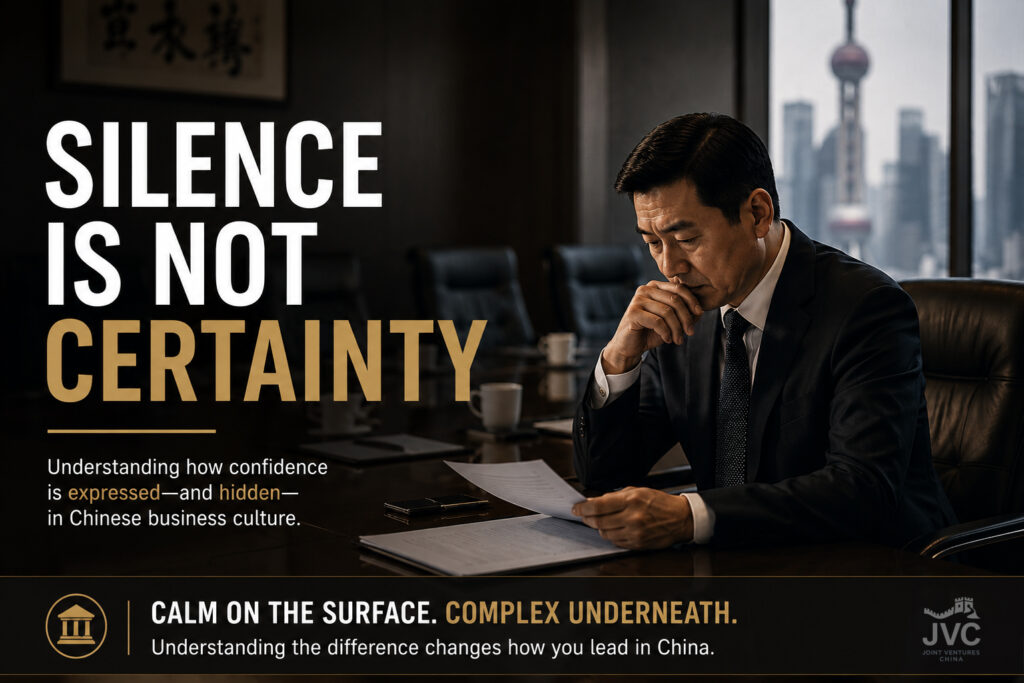
Most Western executives misread confidence in China.
The mistake usually happens in the calmest meetings.
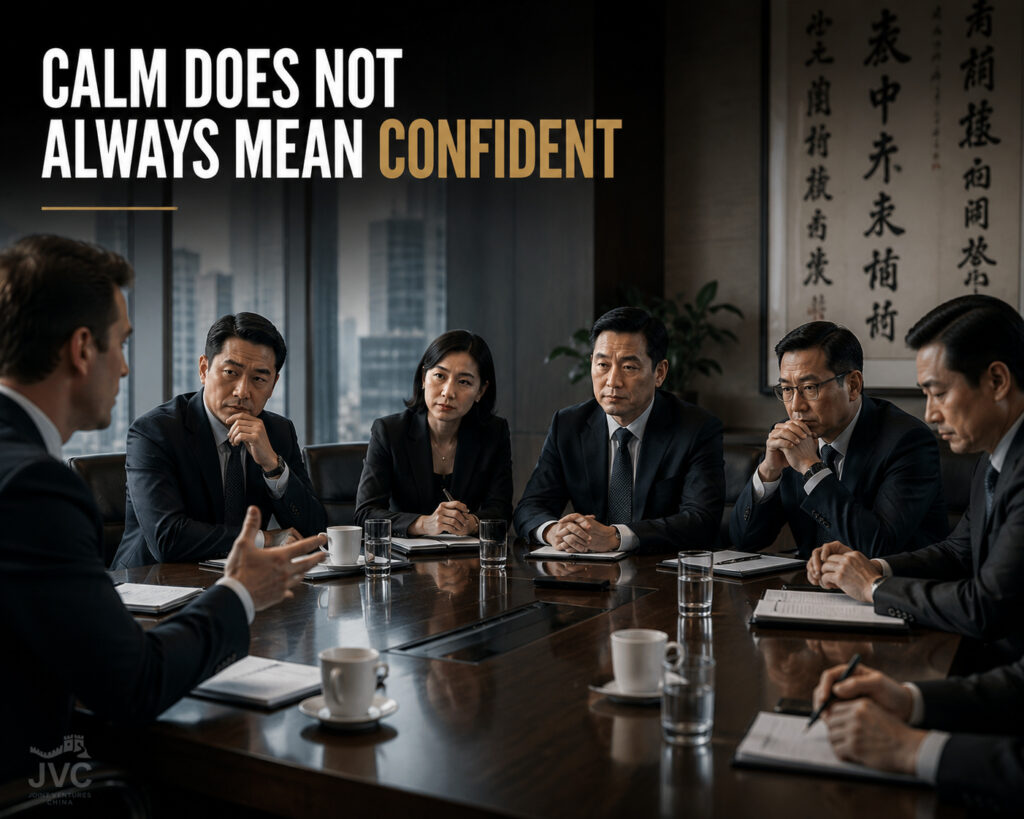
A Chinese team appears composed. Measured. Stable. Professional. The conversation feels polite and orderly. Nobody openly disagrees. No one appears emotional. Questions are thoughtful. Responses are controlled.
So Western leaders often leave the meeting believing:
“Things look good.”
But in many cases, the organization may still be internally evaluating risk, checking alignment, testing consensus, or quietly debating next steps behind the scenes.
This is one of the most misunderstood aspects of Chinese business confidence.
Western executives are often trained to interpret visible calmness as evidence of internal certainty. But in many Chinese organizations, calmness is not necessarily proof of alignment. Sometimes it is a mechanism for preserving stability while alignment is still forming.
That difference changes how leaders should interpret meetings, negotiations, forecasting, escalation, and communication in China.
Understanding Chinese business confidence requires understanding the operating logic underneath the behavior.
Why Western Leaders Misread Chinese Business Confidence
In many Western companies, confidence is expressed visibly.
Executives are expected to:
- communicate decisively
- debate openly
- challenge assumptions directly
- reveal concerns quickly
- state positions clearly
- commit publicly
In Western leadership culture, visible certainty is often treated as organizational strength.
That expectation shapes how many executives interpret international business behavior. When they encounter calm, stable, polite communication in China, they naturally assume the organization feels internally aligned and comfortable moving forward.
But Chinese business confidence is often expressed differently.
Many Chinese organizations prioritize:
- organizational stability
- hierarchy alignment
- risk management
- internal coordination
- preserving cohesion
That means uncertainty is frequently managed quietly rather than exposed immediately.
In practice, this creates one of the biggest misunderstandings in business culture in China. Western executives may interpret calm communication as evidence of certainty when internally the organization is still evaluating the situation carefully.
The external behavior looks stable because stability itself is considered important.
This is one reason Chinese leadership can appear difficult for foreign companies to read accurately at first.
Research from Harvard Business Review has also highlighted how Chinese organizational behavior is heavily influenced by relationship preservation, hierarchy sensitivity, and collective coordination. Many Western executives underestimate how strongly these factors influence communication and decision timing inside Chinese companies.
Calmness Does Not Always Mean Alignment
One of the biggest mistakes foreign executives make is assuming that smooth meetings mean decisions are complete.
In many Chinese organizations, the real decision process often continues after the meeting ends.
A meeting may appear highly successful:
- positive tone
- no visible disagreement
- measured responses
- agreement around the table
- respectful communication
But internally, multiple stakeholders may still need to:
- evaluate operational risk
- consult leadership
- test internal consensus
- coordinate across departments
- assess political implications
- protect existing relationships
This is why Chinese decision making frequently feels slower or less transparent to Western managers, even when everyone appears supportive in the room.
The issue is not necessarily resistance.
Often the organization is still protecting internal alignment while uncertainty exists.
This dynamic becomes especially important in Chinese organizations where leadership groups are attempting to avoid forcing individuals into premature public commitments. The system often prefers to let alignment form collectively before certainty becomes visible externally. That operating logic is one reason why Chinese decision making can appear indirect even when the organization is actively working toward resolution.
Many Western executives underestimate how much internal political coordination can continue quietly after meetings conclude. Follow-up conversations, hierarchy review, and operational alignment frequently continue behind the scenes before a final position is revealed publicly.
The same process frequently continues after business dinners in China. A successful dinner often marks the point where visible interaction ends and private evaluation begins, giving internal stakeholders an opportunity to build alignment before any public commitment is made.
Those follow-up conversations often explain why Chinese teams avoid visible disagreement (Blog 36). What appears to be complete agreement during the meeting may simply reflect that concerns will be raised later through private discussions, after additional consultation, or once internal alignment has progressed.
This becomes especially important in larger Chinese companies where Chinese leadership structures operate through layered coordination and hierarchy review. Premature public disagreement can create instability inside the organization. As a result, concerns are often handled carefully and privately rather than debated openly in real time.
That hesitation to move too quickly is closely connected to the broader organizational psychology explored in why no one wants to be first to say yes.
Western executives sometimes misinterpret this as evasiveness.
In reality, it is often risk management.
That distinction is critical to understanding business culture in China.
Why Chinese Organizations Protect Stability During Uncertainty
Western companies often assume transparency is always the fastest route to problem-solving.
But many Chinese organizations operate from a different assumption:
stability must be protected while problems are still being evaluated internally.
That operating logic influences how Chinese leadership manages uncertainty.
For example:
- concerns may not be escalated immediately
- disagreements may not be voiced publicly
- departments may avoid premature commitments
- managers may communicate cautiously before alignment exists
- decisions may remain intentionally flexible until consensus strengthens
This does not necessarily mean dishonesty or manipulation.
It often means the organization is attempting to prevent instability before the system fully understands the risk.
Many of these differences are rooted in the broader mismatch between Western management assumptions and Chinese organizational systems. Western companies often optimize around visible accountability and rapid disclosure, while Chinese organizations frequently optimize around coordinated stability and controlled escalation. These deeper structural differences affect everything from communication behavior to operational execution.
In many Western environments, exposing uncertainty quickly is viewed positively because it accelerates problem resolution.
In many Chinese environments, exposing uncertainty too early can create:
- hierarchy disruption
- organizational embarrassment
- political sensitivity
- pressure before alignment exists
- loss of face for multiple stakeholders
As a result, Chinese business confidence can appear externally stable even when internal discussions remain unresolved.
This is one reason pressure often backfires in China.
Western executives sometimes believe stronger pressure will force faster transparency.
But pressure frequently causes Chinese organizations to become even more cautious because uncertainty becomes more dangerous to expose publicly.
The organization may then reduce communication instead of increasing it.
Understanding China Requires Reading What Is Not Being Said
Chinese organizations often communicate alignment quietly before they communicate certainty publicly.
That relationship between pressure and reduced transparency becomes especially visible during operational stress, negotiations, or missed timelines. In many cases, the harder foreign companies push for certainty, the more carefully Chinese organizations begin managing information flow internally and externally.
This dynamic affects Chinese decision making constantly in joint ventures, manufacturing relationships, negotiations, and multinational operations.
The Strategic Mistakes Western Leaders Make
When Western executives misread Chinese business confidence, several predictable problems emerge.
The first is premature forecasting.
A calm meeting gets interpreted as operational certainty. Leadership assumes projects are progressing smoothly. Forecasts become more aggressive. Deadlines get locked in too early.
Then unexpected delays appear later because internal alignment had not actually been completed yet.
The second mistake is escalating pressure.
Executives assume:
“If everyone agreed earlier, why are things slowing down now?”
So they increase urgency.
But in many Chinese organizations, pressure increases risk sensitivity rather than reducing it. Teams become more careful. Communication becomes more controlled. Escalation becomes more politically sensitive.
Transparency decreases.
The third mistake is misunderstanding silence.
Many Western leaders interpret silence as passive agreement.
But in business culture in China, silence can mean:
- uncertainty
- incomplete alignment
- caution
- political sensitivity
- internal evaluation still underway
Experienced operators learn not to over-interpret polite stability too early.
They watch for operational confirmation instead.
This misunderstanding is also connected to how Western companies often misread organizational stability itself inside China. Calm operations, orderly meetings, and measured communication do not always indicate certainty or confidence. Sometimes they indicate that the organization is still protecting internal cohesion while risk evaluation continues quietly underneath the surface.
This is one reason experienced China operators often appear more patient than first-time foreign executives. They understand that Chinese decision making frequently continues long after the visible conversation ends.
What Effective Leaders Learn to Watch Instead
Executives who succeed in China eventually stop focusing only on words.
Instead, they learn to watch systems.
They pay attention to:
- follow-up actions
- execution speed
- who joins future meetings
- changes in communication flow
- operational coordination
- downstream implementation
- sequencing behavior
Because real Chinese business confidence often appears operationally before it appears verbally.
Experienced China operators also learn to observe hierarchy behavior closely. Changes in who attends meetings, who speaks less, who suddenly becomes involved, or how communication flows across departments often reveal more about organizational confidence than the meeting language itself. These hierarchy-driven coordination patterns are deeply embedded in Chinese leadership structures and help explain how large organizations maintain alignment at scale.
An experienced leader learns that:
- execution signals matter more than enthusiasm
- coordination matters more than presentation quality
- alignment matters more than verbal certainty
This is especially important when managing Chinese leadership teams or operating inside multinational organizations in China.
A calm presentation does not automatically mean the organization is ready to move.
A lack of disagreement does not automatically mean everyone agrees.
A positive meeting does not automatically mean internal alignment is complete.
Understanding this changes how leaders interpret Chinese decision making entirely.
Instead of pushing harder for immediate certainty, effective leaders learn how to:
- reduce unnecessary pressure
- allow alignment to form
- observe operational signals
- recognize hidden uncertainty
- build trust gradually
- interpret silence more accurately
That creates better forecasting, better communication, and better long-term execution.
Chinese Business Confidence Often Looks Different Than Western Executives Expect
Chinese business confidence is frequently misunderstood because many Western leaders are interpreting Chinese organizations through Western operating assumptions.
In Western companies, confidence is often demonstrated visibly and directly.
In many Chinese organizations, confidence is often demonstrated through stability, coordination, and controlled communication while uncertainty is still being evaluated internally.
That difference changes how organizations communicate risk, alignment, commitment, and decision-making.
And once leaders understand that distinction, many confusing moments in China suddenly become easier to interpret.
The calmest room is not always the most certain one.
Sometimes it is simply the room where the organization is still protecting stability while the real decision process continues quietly underneath.
Enjoying this Insight?
Get weekly real-world insights on Chinese business culture, joint ventures, and China manufacturing.

About the Author – Kevin Burton
Kevin Burton is the General Manager of a China joint venture company manufacturing advanced fiberglass materials for industrial thermal protection systems and EV safety applications. He writes about Chinese business culture, joint venture governance, and how Western leadership assumptions often collide with China’s execution-driven operating systems.