
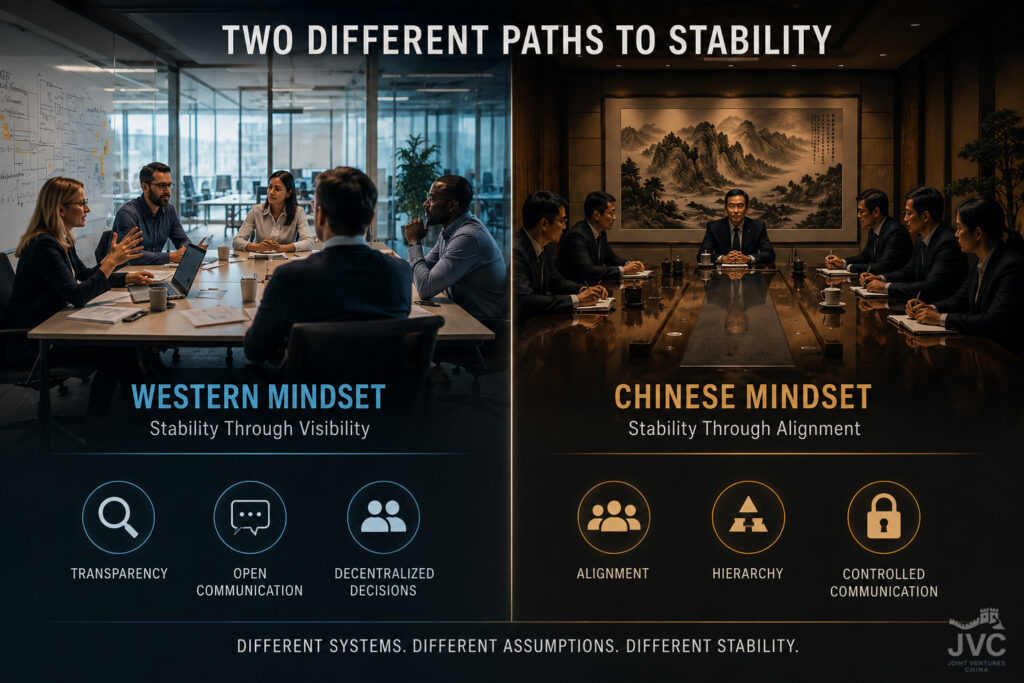
Western executives often believe organizational stability comes from transparency. If information moves freely, disagreement is visible, and problems are escalated quickly, the organization becomes healthier and more resilient over time. Most Western management systems are designed around that assumption because visibility is seen as the mechanism that allows companies to identify risks early, improve accountability, and adapt quickly when conditions change.
But many Chinese companies are built around a very different idea of organizational stability. Inside many Chinese management systems, stability is often created through alignment before visibility. Coordination matters more than immediate disclosure, internal agreement matters more than visible debate, and communication is frequently managed carefully long before decisions become visible externally.
This difference creates one of the biggest misunderstandings between Western and Chinese organizations.
Western leaders often spend years trying to remove the exact behaviors that many Chinese management systems use to preserve internal stability. They push for more direct escalation, more visible disagreement, faster accountability, flatter communication structures, and constant transparency. Sometimes those changes improve organizations. But sometimes they unintentionally weaken the internal coordination holding the system together.
The mistake is assuming both systems are optimizing for the same kind of stability.
In many cases, they are not.
How Western Organizations Define Stability
Most Western organizations associate stability with visibility. If employees openly challenge decisions, leaders often view that as healthy engagement rather than organizational friction. If problems surface quickly, executives believe risk becomes easier to manage because issues can be addressed before they spread further through the organization. If teams escalate concerns directly, organizations can adapt faster and maintain stronger accountability across departments.
This approach has enormous strengths. Western management systems are often highly effective at innovation, rapid feedback, decentralized initiative, and visible accountability. In many Western companies, organizational trust increases when communication becomes more open because employees believe transparency reduces politics and improves decision-making quality. That assumption shapes everything from meeting structure to performance reviews and leadership development.
It also shapes how Western executives interpret Chinese business communication. When updates become slower, filtered, or less direct, Western leaders often assume the organization lacks transparency, employees are avoiding accountability, or management is intentionally hiding problems.
But many Chinese management systems are responding to a different set of organizational risks entirely.
This is one reason Western executives frequently struggle to understand why Chinese meetings often prioritize alignment over visible decision-making. The meeting itself may not be the mechanism producing stability. The coordination happening around the meeting may matter more than the discussion happening inside the room.
How Chinese Organizations Often Define Stability
Many Chinese management systems are designed around coordination first. That coordination is often reinforced through hierarchy, role clarity, carefully managed communication, and controlled escalation paths. This is not simply a cultural preference or communication habit. It is an organizational design philosophy that shapes how information moves internally and how risk is managed across the company.
In many Chinese companies, uncontrolled disagreement can create instability inside the system before leadership alignment exists. Premature escalation can expose individuals to unnecessary risk, while public criticism can weaken coordination rather than improve it.
This is where Chinese business hierarchy functions very differently than many Western executives expect.
Western organizations often view hierarchy as something that slows communication and limits initiative. But inside many Chinese management systems, hierarchy is frequently used to preserve alignment while decisions are still forming internally. The structure itself becomes part of the coordination mechanism.
That is one reason Chinese business hierarchy often supports execution speed instead of preventing it. Western leaders sometimes interpret this behavior as hesitation or excessive caution, but inside many Chinese management systems, stability is not created by exposing every disagreement immediately. Stability is often created by preventing fragmentation before alignment exists.
This also changes the nature of Chinese business communication. Communication is often designed to protect coordination, manage organizational risk, preserve working relationships, and avoid destabilizing the system prematurely. That does not mean problems are ignored. It means problems are often managed differently than Western executives expect.
As Chinese teams frequently avoid direct public debate during decision-making, Western executives can mistakenly assume there is no disagreement internally at all. In reality, much of the alignment process may be occurring privately across the organization long before visible consensus appears externally.
Why Western Pressure Can Quietly Backfire
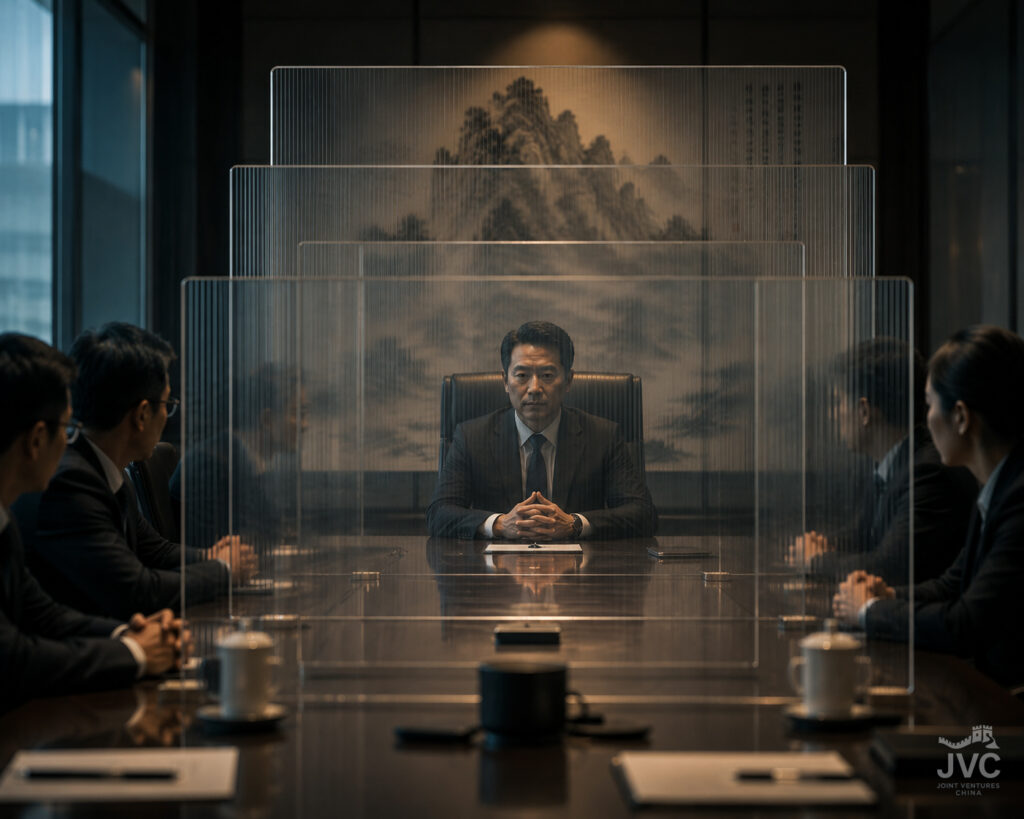
This is where many cross-border leadership problems begin. Western executives often try to improve organizational performance by increasing pressure for direct feedback, faster escalation, aggressive transparency, and visible accountability. But many Chinese management systems interpret that pressure differently – because organizational trust is often tied more closely to predictability and coordination than to immediate visibility.
The harder leaders push for instant transparency, the more carefully information may become managed internally.
The organization starts protecting itself.
Information becomes more filtered. Risk becomes less visible. Updates become more cautious. Employees become less willing to expose uncertainty before alignment exists.
Ironically, pressure intended to increase transparency can sometimes reduce it.
This is one reason pressure often produces the opposite reaction Western leaders expect in China . Inside many Chinese management systems, employees may believe they are preserving organizational stability by controlling how incomplete information moves through the company. Western leaders may interpret filtered updates as dishonesty or avoidance, while employees inside the organization may believe they are preventing confusion, conflict, or unnecessary instability while alignment develops internally.
This dynamic also affects Chinese business communication in important ways. Western leaders often assume communication quality improves when people become more direct under pressure. But inside many Chinese management systems, pressure can create defensive communication patterns instead. Employees become more cautious about exposing unresolved issues before leadership alignment exists because uncertainty itself may be viewed as destabilizing.
This is also why problems in Chinese organizations are sometimes escalated much later than Western executives expect. From a Western perspective, delayed escalation looks dangerous because problems become harder to solve over time. But from inside many Chinese management systems, premature escalation may look equally dangerous because it can create organizational disruption before leadership coordination exists.
Neither side is irrational.
They are optimizing for different forms of organizational stability in China.
Understanding the System Behind China
Most Western leadership advice assumes organizations operate the same way everywhere. In China, many of those assumptions break down.
Explore more articles on Chinese management systems, organizational behavior, and China business strategy at JointVenturesChina.com.
This is where many Western companies unintentionally damage trust inside Chinese management systems. They assume more pressure automatically creates more honesty and faster visibility. But organizational behavior does not always work that way. As direct feedback often functions differently inside Chinese organizations, aggressively forcing visibility can sometimes make communication less reliable instead of more reliable.
Why Chinese Organizations Can Suddenly Move Very Fast
Western executives often describe Chinese organizations as slow, cautious, opaque, or overly hierarchical until suddenly they are not. Many Chinese management systems appear slow only while alignment is still forming internally. Once coordination exists, resistance decreases, communication accelerates, and execution can move extremely quickly across the organization.
This is one reason speed in China often appears suddenly rather than gradually. Western companies frequently focus on visible activity because movement itself is viewed as evidence of progress. Chinese management systems often focus on invisible alignment first because coordination is viewed as the foundation that allows large-scale execution to happen consistently later.
That difference explains why some Chinese organizations can remain quiet for long periods of time and then execute at enormous speed once leadership alignment is achieved. It also explains why alignment frequently matters more than strategy inside Chinese organizations. Without coordination, execution speed becomes unstable. With coordination, even highly hierarchical organizations can move rapidly because the system is already synchronized internally.
This is where many Western executives misread Chinese management style. They assume caution indicates weakness or inefficiency when often the organization is still building internal agreement before visible movement begins.
As systems often matter more than strategy in China, understanding how stability is created inside the organization becomes essential for effective leadership.
The Real Leadership Mistake
The problem is not that Western organizations value transparency while Chinese organizations do not. The problem is that they define organizational stability differently. Western leaders often assume management systems should produce the same behaviors everywhere, including the same escalation patterns, communication styles, decision-making visibility, and leadership responses.
One of the clearest examples is how leaders interpret confidence itself. Western executives often assume calm communication and steady behavior indicate certainty inside the organization, when Chinese teams may still be evaluating risk, building internal alignment, or testing options privately. Understanding Chinese business confidence requires looking beyond visible behavior to the organizational processes happening beneath the surface.
But Chinese management systems frequently evolved around different operational assumptions regarding hierarchy, communication, risk exposure, and organizational trust. That affects how decisions move through the company and how employees respond to uncertainty inside the organization.
This is why many Western companies struggle after initial success in China. The issue is often not the strategy itself. The issue is trying to force different organizations to operate according to the same assumptions about stability, communication, and coordination.
As many China strategies begin failing after early momentum, leaders often discover the organization was functioning differently than they originally believed.
Even many Western management systems that work effectively in the United States or Europe can create unintended instability inside Chinese organizations if implemented without adaptation. Research from Harvard Business Review has repeatedly shown that organizational assumptions around hierarchy, communication, and trust can significantly affect international expansion outcomes.
The leaders who succeed in China are usually not the ones who force immediate conformity to Western management assumptions. They are the ones who learn to recognize how Chinese management systems actually preserve stability internally.
Stability Is Not a Universal Concept
Many Western executives believe stability comes from visibility. Many Chinese organizations believe stability comes from alignment. That difference shapes how organizations communicate, how leaders escalate problems, how hierarchy functions, and how execution speed develops over time.
The mistake is assuming all organizations become stable the same way.
Inside many Chinese management systems, what appears inefficient from the outside may actually be the mechanism holding the system together. And the organizations that eventually move fastest are often the ones that protected alignment first.
Enjoying this Insight?
Get weekly real-world insights on Chinese business culture, joint ventures, and China manufacturing.

About the Author — Kevin Burton
Kevin Burton is the General Manager of a China joint venture company manufacturing advanced fiberglass materials for industrial thermal protection systems and EV safety applications. He writes about Chinese business culture, joint venture governance, and how Western leadership assumptions often collide with China’s execution-driven operating systems.