

Most Western companies believe their China strategy is the problem.
So they rewrite it.
They refine the market positioning.
They adjust pricing.
They change the go-to-market plan.
And when results still don’t improve, they assume the strategy must still be wrong.
In most cases, it isn’t.
The issue is not the strategy. It is how it gets executed.
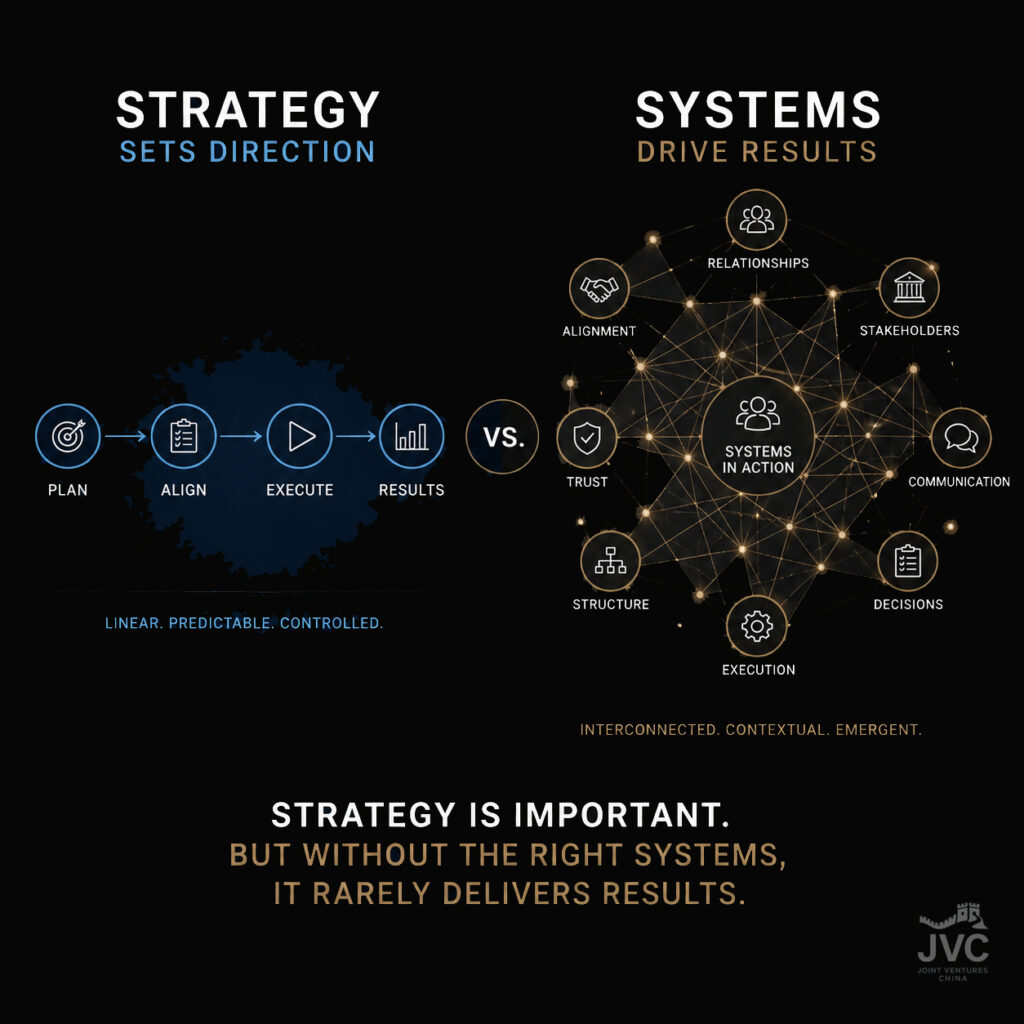
In China, results are not driven by the plan itself. They are driven by how China strategy execution actually works inside the system.
Western Strategy Assumes the Plan Drives the Outcome
In most Western operating environments, strategy sits at the top of the system.
You define a plan.
You align leadership.
You communicate direction.
Then execution follows.
The model is clean and linear.
Strategy leads to execution. Execution leads to results.
This model is not theoretical. It reflects how most Western organizations are designed to operate, with clear links between planning and execution. As outlined in Harvard Business Review’s research on execution discipline, even strong strategies fail without the systems to translate them into action. That assumption holds in Western environments, but it does not transfer cleanly to China.
This works because the surrounding system supports it.
Decision authority is clear.
Accountability is defined.
Teams are expected to move once direction is set.
If the plan is strong, execution typically follows.
This is why many Western leaders struggle when they encounter a different reality. They are operating with a mental model where strategy drives action. In China, the relationship between China execution vs strategy is fundamentally different.
Why Strategy Alone Doesn’t Work in China
In China, that same sequence breaks down.
Not because the strategy is wrong.
But because the system it depends on is different.
Execution does not follow strategy in a straight line.
It emerges from alignment.
This is where many companies misdiagnose the issue. They assume that if results are weak, it must be a case of why China strategy fails. So they revise the plan again instead of looking at how the system is functioning.
But the real issue is usually not the strategy.
It is whether alignment in China business has actually formed across the organization.
Alignment is often misunderstood as agreement in a meeting. In reality, it is a process that continues across departments and levels, often outside formal settings. The idea that alignment must exist before progress becomes visible is explored in why alignment matters more than strategy in China.
Without that alignment, the strategy remains theoretical.
The same dynamic appears in how decisions translate into action. Western teams expect decisions to trigger movement. In China, decisions are often only one step in a longer internal process, which is why decisions don’t happen in the meeting in the way Western teams expect.
Until that process is complete, nothing moves.
What Actually Drives Results in China: Systems, Not Strategy
If strategy is not the driver, what is?
The answer is not a single factor. It is a set of systems working together.
Understanding China strategy execution requires understanding how these systems interact.
Alignment Systems
Before execution begins, alignment must form across stakeholders.
Not just agreement in a meeting.
But real alignment across functions, leadership layers, and decision influencers.
This is the foundation of alignment in China business.
It is rarely visible from the outside.
It takes time.
And it often continues long after formal discussions appear complete.
This is also why external pressure tends to backfire. When alignment is incomplete, pushing harder increases risk perception rather than accelerating progress.
Without this system, even strong strategies stall.
Execution Systems
Once alignment exists, execution in China can move very quickly.
But that speed is not driven by urgency.
It is driven by structure.
Sequence matters.
Order matters.
Dependencies are resolved before movement begins.
This is why pushing for faster action often slows things down.
This pattern shows up consistently in operational environments where sequence determines outcomes, particularly in how sequence beats speed in China’s factories.
This is a critical distinction in China execution vs strategy. In Western systems, speed often comes from pushing harder. In China, it comes from structuring correctly.
Communication Systems
A third system operates underneath both alignment and execution.
Communication.
But not in the way Western teams expect.
In China, communication is often indirect, timed, and signal-based.
Progress is not always stated explicitly.
Concerns are not always raised directly.
Alignment is not always visible in real time.
This creates a gap for Western leaders.
They look for clear updates and explicit confirmation.
When they don’t see it, they assume nothing is happening.
In reality, the system is still working.
Many of these signals are subtle, but highly consistent once you recognize them, particularly the patterns described in signals Western leaders miss in Chinese business culture.
Why Western Companies Misdiagnose the Problem
When results lag, most companies follow a predictable pattern.
They assume the strategy must be wrong.
Then they push harder.
They ask for faster decisions.
They increase pressure.
They try to create clarity.
Each of these actions makes sense inside a Western system.
But in China, they often create friction.
Pressure disrupts alignment.
Forced clarity increases perceived risk.
Speed without sequencing creates resistance.
Those reactions are often misunderstood because many Western leaders assume organizational stability is created through transparency. In reality, many Chinese management systems first create alignment before visibility, a difference explored in why Western companies misread stability in China.
This leads to a false conclusion about why China strategy fails. The issue is blamed on the plan, when the real issue is how China strategy execution is functioning inside the organization.
A common pattern looks like this: A Western team agrees on a clear direction with their China counterpart and leaves the meeting confident. Weeks later, progress appears stalled. The instinct is to push for updates or escalate decisions. But internally, alignment is still forming across teams that were not in the room. What looks like delay is actually the system working. Pushing at this stage often resets that process rather than accelerating it.
The First Win Trap
Another common misread happens after early success.
Initial traction is achieved.
A deal is closed.
A product gains momentum.
This creates confidence in the strategy.
But that success is often fragile.
Early wins can create the illusion that the system is working when it is not fully built. This pattern shows up repeatedly in why your China strategy fails after the first win.
What appears to be strong China strategy execution is sometimes dependent on a narrow set of aligned individuals or favorable conditions.
When those conditions change, performance drops.
Not because the strategy changed.
But because the system behind it was never fully built.
Operating in China Is Not What It Looks Like
If you are leading teams, partnerships, or operations in China, most of what drives results is happening below the surface.
Alignment forms before decisions are visible.
Execution follows structure, not urgency.
And progress rarely looks the way Western teams expect.
Why China Strategy Execution Breaks Down Inside Organizations
Even when companies understand the need for systems, execution often still breaks down.
Not because the concept is wrong.
But because organizations underestimate how difficult it is to change how they operate.
Most teams try to layer China strategy execution on top of existing Western processes.
They keep the same reporting structures.
They maintain the same decision expectations.
They push for the same speed and clarity.
But the system underneath has not changed.
Many Western companies underestimate how deeply management systems are shaped by the operating environments they were designed for, especially when applying Western leadership assumptions inside Chinese organizations.
This creates tension.
Local teams hesitate because alignment is incomplete.
Global teams push because progress is not visible.
Middle management absorbs the pressure and slows communication.
This is where breakdown happens.
Effective China strategy execution requires adjusting how the organization works, not just what it plans.
How to Actually Improve Results in China
If strategy is not the primary driver, then improving results requires a different focus.
Focus on Alignment Before Optimization
Instead of refining the plan, focus on alignment.
Who needs to be aligned?
Where are the dependencies?
What sequencing is required?
Until alignment in China business is established, strategy improvements have limited impact.
Strengthen the System, Not Just the Plan
Look at how the organization actually operates.
- How decisions are made
- How information flows
- How stakeholders interact
- How execution is sequenced
Improving these systems often has more impact than changing the strategy itself.
This is where most companies see real improvement in China strategy execution.
Measure Progress Differently
Progress in China does not always look like movement.
Sometimes it looks like:
- Fewer objections
- More consistent follow-up
- Increased internal coordination
- Subtle changes in tone
These are signals that alignment is forming.
Once that alignment exists, execution accelerates.
This is why doing business in China strategy requires a different lens for interpreting progress. The signals are different, but they are highly predictive.
Strategy Still Matters — But It’s Not the Driver
None of this means strategy is irrelevant.
Strategy sets direction.
It defines priorities.
It frames decisions.
But it does not create outcomes on its own.
Systems do.
This is the core misunderstanding behind doing business in China strategy. Many companies focus on designing the right plan, but underestimate the importance of building the system that allows that plan to work.
Without the right systems, even strong strategies stall.
With the right systems, even imperfect strategies can succeed.
China Strategy Execution Determines Whether Strategy Works
Most companies assume they need a better plan.
In reality, they need a better system.
The strategy may already be good enough.
The question is whether the organization around it can execute.
This is why China strategy execution ultimately determines whether a strategy succeeds or fails.
If you step back, this is also the broader point behind why Western playbooks fail in China and what actually works.
Because the difference is not just what you plan.
It is how the system around that plan actually works.
Enjoying this Insight?
Get weekly real-world insights on Chinese business culture, joint ventures, and China manufacturing.

About the Author — Kevin Burton
Kevin Burton is the General Manager of a China joint venture company manufacturing advanced fiberglass materials for industrial thermal protection systems and EV safety applications. He writes about Chinese business culture, joint venture governance, and how Western leadership assumptions often collide with China’s execution-driven operating systems.