
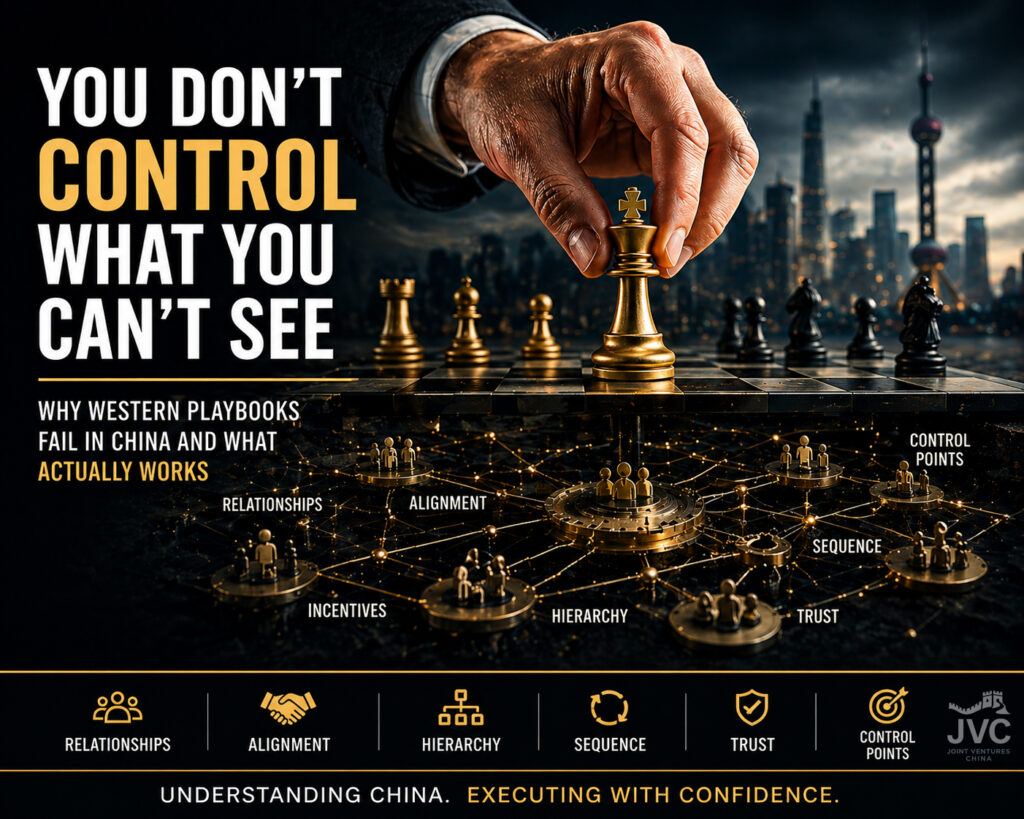
Most China strategies don’t fail because they are wrong.
They fail because they are built on the wrong assumptions about how strategy actually works in China.
Western leaders spend months refining positioning, market entry plans, and competitive analysis. The logic is sound. The slides are clean. The direction is clear.
And then execution stalls.
Not because the strategy is flawed, but because the system underneath it is not aligned to carry it forward.
In China, strategy does not fail at the idea level.
It fails at the system level.
Until that is understood, China business strategy will continue to feel unpredictable, slow, or inconsistent. Most failed China business strategy efforts break down not in planning, but in execution alignment.
Western Strategy Is Built on Clarity. China Is Built on Alignment.
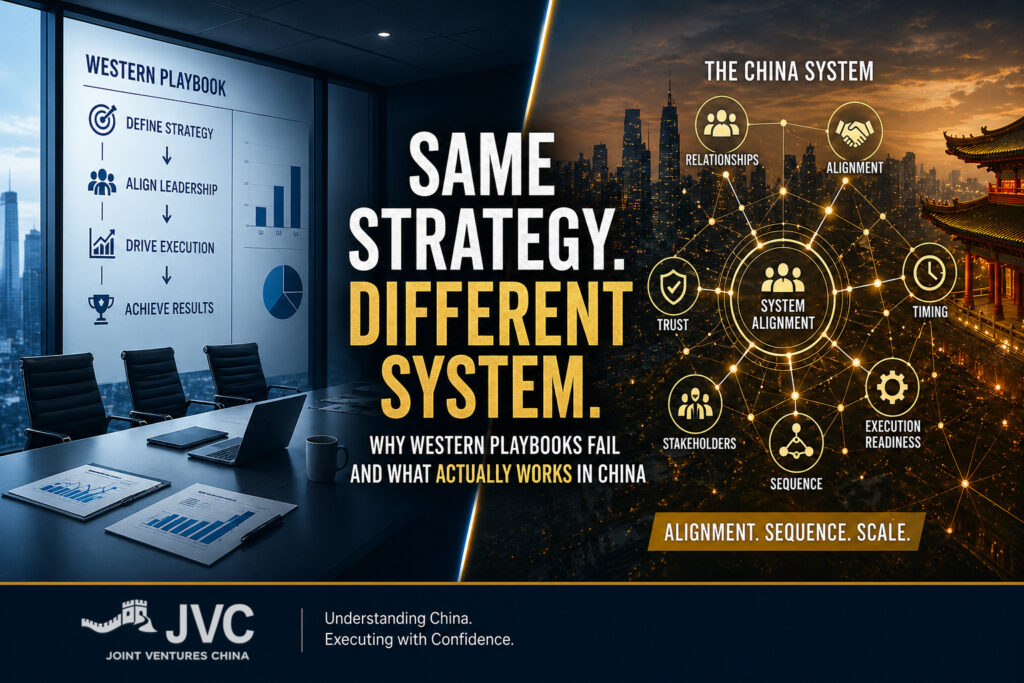
Western strategy starts with clarity.
Define the objective.
Align leadership.
Drive execution.
In China, the sequence is different.
Alignment comes first.
Then decisions.
Then execution.
Many Western leaders misread what is happening because they look for visible clarity too early. When it is not there, they assume a lack of direction.
In reality, the direction often exists. It is simply not fully surfaced yet.
As explored in Why Alignment Matters More Than Strategy in China, alignment in China is not a supporting step. It is the foundation.
As reinforced in Why Chinese Teams Don’t Debate Decisions the Way Western Teams Do, alignment is built differently. It does not happen through open debate. It forms through structured consensus over time.
That difference alone explains why many China market strategy efforts lose momentum before they begin.
In China, Strategy and Execution Are Not Separate
One of the biggest structural mistakes in doing business strategy China is assuming that strategy and execution are separate phases.
In Western models:
- Strategy is developed first
- Execution follows
In China:
- Strategy is shaped through execution readiness
This reflects a fundamentally different China execution model, where decisions are not finalized until the system can support them.
The two are tightly connected.
Strategies that look strong on paper often fail in practice because they were never grounded in what the organization could actually execute.
As highlighted by Harvard Business Review, the gap between strategy and execution is one of the most common causes of business failure globally.
In China, that gap is smaller only because alignment is required before movement.
The implication is simple:
Strategy is not what you decide. It is what the system can execute.
That is the foundation of effective China business strategy.
The 5 Reasons Western Strategy Fails in China
1. Strategy Moves Faster Than Alignment
Western teams push to finalize strategy quickly.
Chinese organizations align first.
When strategy moves ahead of alignment, execution slows later.
This dynamic is explored in Why Alignment Comes Before Speed in China, where early speed creates downstream delays.
2. Leaders Push Before the System Is Ready
Pressure feels productive in Western environments.
In China, it introduces risk.
When leaders push too early, teams reduce transparency and slow communication.
As explained in How China Responds to Pressure, pressure does not accelerate progress. It often suppresses it.
3. Decisions Are Forced Too Early
China growth strategy is often misplaced by Western leaders who often try to lock decisions in meetings.
Chinese teams avoid committing before alignment is complete.
The result is polite agreement without real commitment.
The full dynamic is broken down in Chinese Business Decision Making: Why No One Wants to Be First to Say Yes.
4. Alignment in China: Local Teams Are Not Truly Aligned
Many strategies assume alignment because leadership agreed.
But alignment in China at the top does not mean alignment exists across the system.
Execution in China depends on broader organizational cohesion.
This becomes critical in joint ventures, as discussed in Who Actually Controls a China Joint Venture?
5. Execution Is Assumed, Not Built
Western strategies often assume execution capability.
China builds execution through sequence.
If the sequence is wrong, the system slows down.
That is why Why Sequence Beats Speed in China’s Factories connects directly to strategy, not just operations.
What Effective China Strategy Looks Like
If Western strategy is about clarity, effective China business strategy is about structure.
The principles shift:
- Sequence before speed
- Alignment before commitment
- Structure before scale
- System before individual
Most China growth strategy efforts succeed or fail at this level.
Not at the idea level.
At the system level.
Research from McKinsey & Company consistently shows that companies succeeding in China adapt their operating models, not just their positioning.
In China, the operating model is the strategy.
Building the right China business strategy is only the beginning. Long-term success depends on recognizing that every strategy has a shelf life and must continue evolving as markets, competitors, and customer expectations change. Companies that continually challenge their assumptions are far more likely to sustain success than those relying on yesterday’s playbook.
Why Most China Market Strategy Looks Right But Fails Anyway
A common frustration for Western leaders is this:
A strategy can be logically correct, commercially sound, and be aligned with market opportunity –
and still fail in China.
Not because the market rejected it.
Because the system never carried it forward.
This is where China market strategy diverges most sharply from Western expectations.
In Western environments, strong strategy increases the probability of success. But that does not make for the best China growth strategy.
In China, strong strategy without alignment increases friction.
That friction shows up in subtle ways:
- Timelines begin to slip without explanation
- Teams agree in meetings but hesitate in execution
- Communication becomes less direct
- Progress feels inconsistent rather than linear
These are not execution failures in the traditional sense.
They are alignment signals.
Most Western leaders misinterpret them and respond by pushing harder on the strategy.
That is where things begin to break.
This pattern sits underneath Why Your China Strategy Fails After the First Win.
The first success builds confidence.
The second attempt exposes structural gaps.
Understanding China strategy is one thing. Executing it is another. The gap becomes clear when you look at how China strategy execution actually works inside organizations.
Understanding China strategy is one thing. Executing it is another.
If you are navigating China business strategy, joint ventures, or execution challenges, I share practical insights each week on how alignment, structure, and real operating systems drive results in China.
The Real Role of Leadership in China Strategy
If strategy in China is system-driven, leadership plays a different role.
It is not just about defining direction.
It is about shaping the conditions that allow execution.
This is a critical shift in doing business strategy China.
Western leadership often emphasizes:
- Clarity
- Accountability
- Speed
In China, effective leadership emphasizes:
- Alignment
- Stability
- Sequence
This is not about lowering standards or moving slower.
It is about understanding where control actually sits.
Real control dynamics in China joint ventures is rarely as simple as ownership or reporting lines.
It exists in the system.
If the system is not aligned, authority alone will not drive execution.
This is why many Western executives feel like they are losing control.
They are not.
They are operating in a system where control is distributed differently.
Strategy Without Structure Creates Invisible Risk
Another reason China growth strategy fails is because structural risk is underestimated.
In Western environments, risk is often explicit:
- Financial risk
- Market risk
- Competitive risk
In China, much of the risk is structural and initially invisible:
- Misaligned incentives across departments
- Unclear sequencing between functions
- Partial alignment masked by polite agreement
- Hidden dependencies
These risks do not appear in strategy decks.
They emerge during execution.
By the time they are visible, the cost of correction is high.
This is why structure matters more than speed.
Sequence is how structure expresses itself.
Why China’s Model Creates Speed at Scale
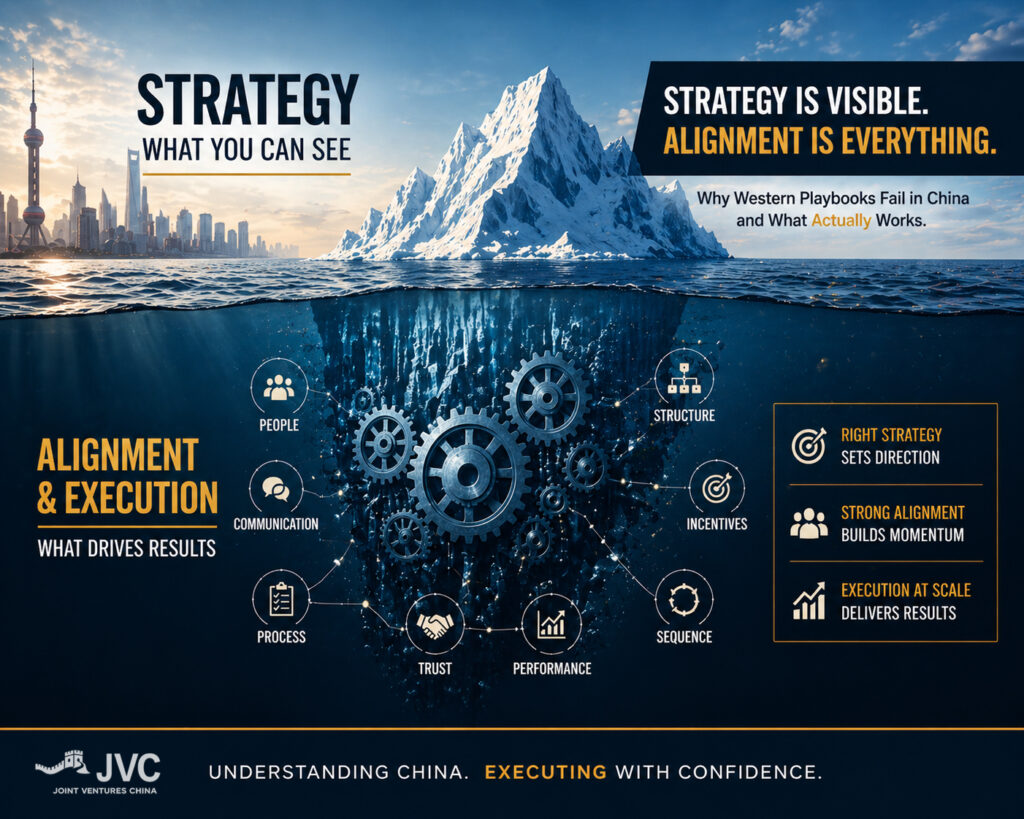
From the outside, China can look slow.
Meetings feel inconclusive.
Decisions seem delayed.
Progress appears unclear.
Then everything moves.
Factories scale.
Projects accelerate.
Execution becomes extremely fast.
This is not randomness.
It is structure.
As discussed in China Was Built to Scale. Now It Challenges the West on Innovation, China’s advantage is the ability to scale aligned systems rapidly.
As explained in Chinese Business Hierarchy: The System Behind China’s Speed, hierarchy is part of the execution engine.
Supporting research from MIT Sloan reinforces that organizational structure drives execution speed in complex systems.
The key insight:
China is not slower. It is quieter earlier.
How to Build a Strategy That Actually Works in China
To build an effective China business strategy, the approach must change.
Not just the content of the strategy.
But how it is developed.
The traditional strategy vs execution China debate breaks down here, because the two are inseparable.
1. Do Not Finalize Strategy Before Alignment
Treat early strategy as directional, not fixed.
Allow alignment to shape the final direction.
2. Map Stakeholders Early
Identify who actually influences execution.
Not just formal decision makers.
3. Expect Delayed Visible Progress
Lack of visible movement does not mean lack of progress.
It often signals that alignment is still forming.
4. Measure Execution Signals, Not Meeting Outcomes
Progress is not measured by decisions in meetings.
It is measured by what happens after.
This connects directly to Decisions Don’t Happen in the Meeting — And That’s Normal in China.
The Strategic Shift Most Leaders Miss
The most effective leaders in China do one thing differently.
They stop asking:
What is the best strategy?
And start asking:
What can this system execute together?
That shift changes everything.
It reshapes how strategy is built.
How decisions are made.
How success is measured.
Most importantly, it aligns strategy with reality.
Because in China, strategy is not something you declare.
It is something the system proves.
Conclusion: Strategy Does Not Create Speed. Alignment Does
Western strategy tries to move faster.
Chinese strategy tries to move together.
That difference explains why so many well-designed strategies fail in China.
They are built to move fast, not to move together.
Until that shifts, even the strongest China business strategy will struggle to deliver results.
Frequently Asked Questions
Why do most China business strategies fail?
Most China business strategies fail not because the strategy itself is wrong, but because the organization is not aligned to execute it. In China, alignment across the system must happen before decisions are finalized, otherwise execution slows or breaks down.
What is different about strategy in China compared to the West?
Western strategy focuses on clarity first and execution second. In China, alignment comes first, followed by decisions and execution. Strategy is shaped by what the system can execute, not just what leadership decides.
How should Western companies approach China market strategy?
Western companies should treat early strategy as directional, not fixed. They should focus on building alignment across stakeholders, understanding execution constraints, and allowing the strategy to evolve based on what the organization can execute together.
Enjoying this Insight?
Get weekly real-world insights on Chinese business culture, joint ventures, and China manufacturing.

About the Author — Kevin Burton
Kevin Burton is the General Manager of a China joint venture company manufacturing advanced fiberglass materials for industrial thermal protection systems and EV safety applications. He writes about Chinese business culture, joint venture governance, and how Western leadership assumptions often collide with China’s execution-driven operating systems.