
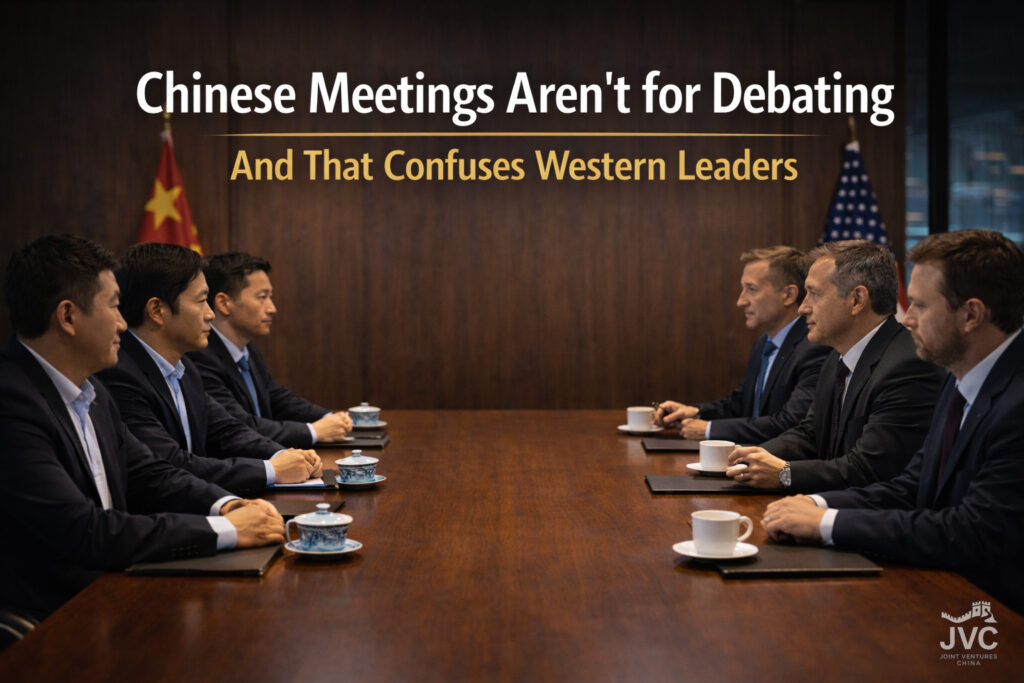
One of the most common misunderstandings Western executives experience in China happens inside the meeting room.
The meeting begins. The agenda is clear. The room is full of capable managers.
But something feels different.
There is very little debate.
Few people challenge the proposal directly.
Questions are limited.
The meeting ends with polite acknowledgement but no clear decision.
For Western leaders used to debate-driven meetings, this can feel confusing or even unproductive.
But the assumption is wrong.
These differences often reflect deeper patterns inside Chinese decision making culture and broader Chinese business culture dynamics that Western leaders often misinterpret.
Chinese meetings are not designed for debating ideas.
Many of these differences emerge because Chinese and Western organizations evolved around different management systems and operating environments rather than different levels of competence or engagement.
They serve a very different purpose inside Chinese organizations.
Understanding Chinese decision making culture is critical for anyone working with Chinese teams, suppliers, or joint venture partners.
Western executives often interpret quiet Chinese meetings as a lack of engagement or initiative. In reality, they are often seeing a different decision-making system at work. Chinese decision making culture builds consensus before meetings, confirms alignment during meetings, and finalizes execution afterward. Once leaders understand this sequence, many confusing interactions suddenly make sense.
What is Chinese Decision Making Culture?
Chinese decision making culture refers to the organizational process in which alignment is often built through private discussions before and after formal meetings rather than through public debate during the meeting itself. This structure prioritizes relationship stability, risk management, and consensus formation before decisions are finalized.
Western Meetings Are Designed for Debate
In most Western organizations, meetings are where ideas are tested.
Managers bring proposals into the room and expect them to be challenged.
People interrupt.
Arguments happen.
Different departments defend their perspectives.
This kind of debate is not considered disruptive.
It is considered productive.
The logic is simple: strong ideas survive scrutiny.
By the time the meeting ends, the best argument wins and the group moves toward a decision.
In this system, the meeting itself is the arena where alignment is created.
That assumption shapes how Western executives behave when working internationally.
It also explains why many Western managers believe a quiet meeting means something went wrong.
Chinese decision making culture approaches this process differently.
Chinese Meetings Serve a Different Purpose
Chinese organizations typically build alignment before the meeting ever begins.
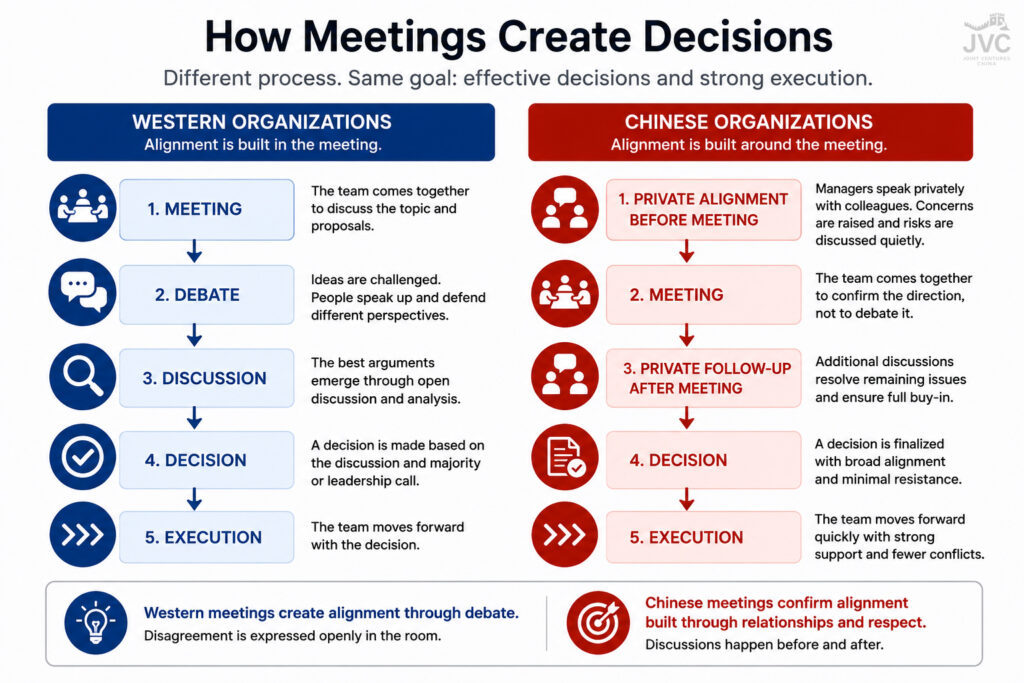
Managers speak privately with colleagues.
Concerns are raised informally.
Potential risks are discussed quietly.
By the time the group gathers in the meeting room, much of the real alignment work has already happened.
The meeting itself is not meant to create the debate.
It is meant to confirm the alignment.
That is why Chinese meetings often appear calm and orderly.
Participants are not avoiding disagreement.
They have simply addressed many of those disagreements earlier.
This structure protects relationships and reduces the risk of public confrontation.
It also helps organizations move forward without exposing individuals to unnecessary political risk.
These dynamics are closely related to what many Western executives discover when reading Decisions Don’t Happen in the Meeting — And That’s Normal in China.
Why Public Debate Creates Risk in Chinese Organizations
In Western companies, openly challenging a proposal can demonstrate leadership.
In Chinese organizations, public disagreement can create a different set of problems.
When a proposal is challenged in front of others, it can create several risks.
Loss of face for the person presenting the idea.
Exposure of internal disagreement.
Pressure on managers who may not yet have full authority to decide.
This concern goes beyond simple embarrassment. Saving face in Chinese business can influence when disagreement is expressed, who raises it, and whether that conversation happens publicly or privately.
Because of this, many Chinese teams prefer to address disagreements privately, a pattern that reflects the structural role hierarchy plays in Chinese organizations, something explored further in Chinese Business Hierarchy: The System Behind China’s Speed.
Sensitive issues are discussed before or after meetings rather than during them.
This approach allows problems to be solved without damaging relationships or reputations.
This approach also creates several practical advantages for the organization.
When concerns are raised privately, managers can speak more openly without putting colleagues in an uncomfortable public position. Senior leaders have time to evaluate competing viewpoints before committing to a final direction, and departments can resolve disagreements without turning routine meetings into visible conflicts.
The result is often greater organizational alignment once a decision is announced.
While Western organizations frequently use meetings to discover disagreement, Chinese organizations often use meetings to demonstrate that alignment has already been achieved.
Neither approach is inherently better.
Each evolved to solve different organizational challenges. Western companies often prioritize rapid idea testing through open discussion, while Chinese organizations frequently prioritize coordinated execution by reducing unnecessary public conflict.
For Western leaders who expect open debate, the absence of visible disagreement can feel uncomfortable. In fact, the absence of debate and the absence of visible disagreement are not the same thing. Teams may have significant concerns while still choosing not to express them publicly during the meeting. Understanding why Chinese teams avoid visible disagreement (Blog 36) provides additional insight into how concerns are communicated through private conversations, follow-up discussions, and behind-the-scenes alignment.
Just as importantly, the absence of visible disagreement should not be mistaken for visible confidence. Calm meetings, measured communication, and polite acknowledgement can give Western leaders the impression that everyone is fully aligned, when the organization may still be evaluating risk privately. Understanding Chinese business confidence helps explain why calmness and certainty are not always the same thing inside Chinese organizations.
But the absence of visible debate does not mean the absence of rigorous analysis.
In many Chinese organizations, the analysis, negotiation, and consensus-building simply occur outside the formal meeting, where participants can speak more candidly without creating unnecessary political or interpersonal risk.
These patterns are a core feature of Chinese decision making culture.
What Western Leaders Often Misread
When Western executives encounter a quiet Chinese meeting, several common misinterpretations occur.
Some assume participants are disengaged.
Others believe people are reluctant to contribute ideas.
In reality, the opposite may be true.
These patterns reflect a broader system in how China business strategy actually works, where alignment is built privately before decisions become visible and execution begins.
Participants may already understand the direction of the decision and see no need to challenge it publicly.
Or they may be waiting for the appropriate time to raise concerns privately.
This is why pushing for debate inside the meeting can sometimes slow progress rather than accelerate it.
Public pressure may force participants to protect themselves instead of sharing information openly.
These dynamics connect closely to patterns described in Chinese Business Decision Making Culture: Why No One Wants to Be First to Say Yes.
One Real Example
Imagine a Western executive presenting a proposal to a Chinese leadership team.
The meeting is quiet.
No one objects.
No one challenges the recommendation.
Several managers simply nod in agreement.
A Western manager may leave believing everyone supports the proposal.
Later that day, however, individual managers begin speaking privately with one another and with senior leaders. Questions are raised, practical concerns are discussed, and adjustments are suggested outside the formal meeting.
When the proposal returns a few days later, it has been refined and broader alignment has been established.
To a Western executive, it can feel as though the decision changed after the meeting.
In reality, the decision-making process was still taking place. The meeting confirmed the current direction, while the real alignment continued through private conversations before the final decision was made.
How Alignment Happens Around the Meeting
A helpful way to understand the difference is to look at what happens before and after meetings.
In many Chinese organizations, the sequence often looks like this.
Private conversations before the meeting.
The formal meeting to confirm direction.
Additional alignment after the meeting.
Final decision.
The visible meeting is only one part of a larger process.
The same pattern often extends beyond management meetings into formal governance. Many Western directors expect important board meetings to be where major decisions are made, when in reality much of the alignment may already have been established beforehand, as discussed in Why China Joint Venture Boards Rarely Decide What You Think They Do.
Western organizations often follow a different pattern.
Meeting.
Debate inside the meeting.
Follow-up discussions.
Decision.
Both systems aim to reach effective decisions.
They simply organize the process differently.
These structural differences also help explain why Speed in China Doesn’t Look Fast — Until It Does.
Alignment work often happens quietly first, allowing execution to move quickly once a decision is finalized.
Understanding Chinese decision making culture helps leaders recognize why this sequence works.
Why This Matters for International Leaders
Executives working with Chinese teams often try to encourage more open debate during meetings.
They ask direct questions.
They invite disagreement.
They push for immediate feedback.
These actions are usually well intentioned.
But they can unintentionally create pressure that makes participants more cautious.
When people feel exposed in a public setting, transparency tends to decrease rather than increase.
A more effective approach is to recognize where discussion actually happens.
Conversations before and after the meeting often provide more insight than the meeting itself.
Recognizing how Chinese decision making culture shapes these interactions helps leaders interpret what they are seeing more accurately.
For additional perspective on global decision structures, research from Harvard Business Review has also examined how different organizational cultures manage decision authority and risk.
Meetings Are About Confirmation, Not Confrontation
Once Western managers recognize how Chinese meetings function, the experience often begins to make more sense.
The meeting is not where ideas are attacked.
It is where alignment becomes visible.
The real work often occurs outside the room, through smaller conversations that allow issues to be resolved privately.
When this process works well, the meeting appears calm because most of the difficult discussion has already taken place.
This structure allows organizations to move forward with fewer public conflicts and stronger internal support.
Understanding Chinese decision making culture reveals why meetings function this way.
Conclusion
Chinese meetings are frequently misunderstood because Western executives expect them to function like Western meetings.
They do not.
In many Chinese organizations, debate happens privately, alignment forms gradually, and the meeting itself serves to confirm direction rather than challenge it.
Recognizing how Chinese decision making culture shapes meetings helps leaders interpret what they are seeing more accurately.
A quiet meeting does not mean nothing is happening.
It often means the important conversations have already taken place.
Western leaders often judge Chinese meetings by what they can observe inside the conference room. The more useful question is what happened before anyone entered it. Once you recognize that alignment often forms outside the meeting itself, many behaviors that once seemed confusing become entirely logical.
Frequently Asked Questions About Chinese Decision Making Culture
Why do Chinese meetings have less debate?
Chinese organizations often address disagreements privately before meetings. This approach reduces public confrontation and protects relationships while still allowing issues to be resolved.
Do Chinese teams avoid disagreement?
No. Disagreements still occur, but they are usually handled through private conversations before or after formal meetings rather than through public debate during the meeting.
Why do Western managers misread Chinese meetings?
Western managers are often accustomed to debate-driven meetings where decisions are shaped through public discussion. Chinese organizations often build alignment outside the meeting first, which can make meetings appear unusually quiet.
Why are Chinese meetings usually so quiet?
Chinese meetings are often quieter because many important discussions occur privately before the meeting begins. The formal meeting is frequently used to confirm alignment rather than create it, reducing public disagreement while allowing organizations to execute decisions more efficiently.
Enjoying this Insight?
Get weekly real-world insights on Chinese business culture, joint ventures, and China manufacturing.

About the Author — Kevin Burton
Kevin Burton is the General Manager of a China joint venture company manufacturing advanced fiberglass materials for industrial thermal protection systems and EV safety applications. He writes about Chinese business culture, joint venture governance, and how Western leadership assumptions often collide with China’s execution-driven operating systems.