
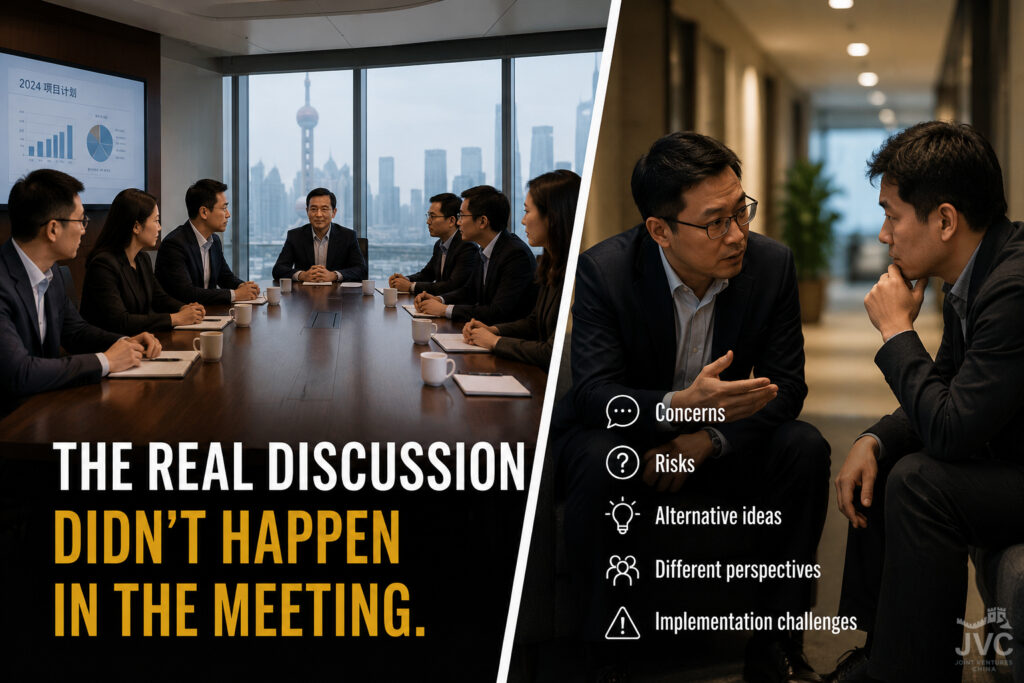
A Western manager leaves a meeting in China feeling satisfied.
The proposal was presented. Everyone nodded. Nobody challenged the idea. No objections were raised.
The decision appears settled.
Then a few days later, progress slows. New concerns emerge. Questions that never appeared in the meeting suddenly surface. Individuals begin raising issues privately that nobody mentioned when the group was together.
Many foreign managers reach the same conclusion:
“Why didn’t anyone say this in the meeting?”
The assumption is understandable. In many Western organizations, meetings are where disagreement is expected to happen. If nobody objects, most leaders assume there is broad support for the decision.
But in China, that assumption can be dangerous.
The disagreement may have existed all along. It was simply being expressed in a different way.
Understanding this difference is an important part of understanding Chinese business culture and one of the most common lessons foreign executives learn while doing business in China.
Western Leaders Are Trained To Value Visible Debate
Most Western management systems encourage direct discussion.
Employees are often expected to challenge ideas, raise concerns, and openly discuss alternatives. Leaders frequently view healthy debate as evidence of engagement rather than resistance.
In many organizations, the purpose of a meeting is not merely to communicate a decision. It is to test assumptions, identify weaknesses, and improve the final outcome through discussion.
When viewed through that lens, silence can feel uncomfortable.
If nobody speaks up, a Western manager may wonder whether employees are paying attention, whether they understand the issue, or whether they have anything valuable to contribute.
These assumptions often create misunderstandings when managing Chinese teams. Understanding these assumptions are an important piece of doing business in China.
Many foreign executives enter Chinese business meetings expecting the same communication patterns they experienced at home. Instead, they encounter a different set of priorities and behaviors.
The objective remains the same—making sound business decisions—but the path toward that objective can look very different.
Preserving Harmony Often Matters More Than Winning The Argument
One reason visible disagreement is less common in China is that public disagreement can create unintended consequences.
A direct challenge may embarrass a colleague. It may cause someone to lose face. It may place pressure on a manager to defend a position publicly before all relevant information has been considered.
Public disagreement can also affect status and reputation, which is why understanding Face in Chinese business culture helps explain why concerns are often raised privately rather than in front of the group.
In many organizations, maintaining productive relationships is viewed as equally important as proving a point.
As a result, concerns are often expressed through more private channels.
A manager may wait until after the meeting to share a concern. A colleague may seek clarification through an individual discussion. An employee may first discuss an issue with trusted relationships before raising it more broadly.
This behavior is not necessarily evidence of fear or dishonesty.
Rather, it reflects a different approach to Chinese workplace communication., especially in Chinese business meetings.
Over the years, I have experienced numerous situations where a meeting appeared to end with unanimous agreement, only to receive thoughtful and valuable feedback later through one-on-one conversations. The discussion happened. The disagreement existed. It simply occurred in a different setting.
For Western leaders, this can initially feel inefficient. For many Chinese managers, however, it feels respectful and practical.
Silence Does Not Mean Agreement
One of the most expensive mistakes foreign managers make in China is assuming that silence equals support.
In reality, silence can mean many different things.
An employee may need additional information.
A department may need internal consultation before committing to a position.
A stakeholder may disagree but prefer to discuss concerns privately.
A team member may be waiting to hear the opinion of a senior leader before expressing a view.
These dynamics are often influenced by organizational hierarchy, which remains a significant factor within many Chinese companies.
They are also related to the tendency of many teams to delay commitment until they see waiting for others to signal support from key decision-makers.
This distinction becomes particularly important during Chinese business meetings.
A room that appears fully aligned may still contain unresolved concerns. Individuals may simply be choosing a different time and place to address them.
Foreign leaders who assume visible consensus automatically represents actual consensus often find themselves surprised later during implementation.
Why Western Leaders Misinterpret Silence
The misunderstanding is not entirely the fault of foreign managers.
Western leaders are generally trained to associate participation with engagement.
Employees who speak up are often viewed as committed, prepared, and invested in the outcome. Managers frequently encourage discussion because disagreement is viewed as a tool for improving decisions.
As a result, many executives instinctively interpret silence as a warning sign.
If nobody challenges an idea, they may assume people are disengaged, unprepared, indifferent, or unwilling to contribute.
In reality, none of those conclusions may be accurate.
This is similar to the broader challenge of misreading confidence and engagement when working across cultures. Behaviors that appear obvious through a Western lens often carry very different meanings in China.
The issue is not that Chinese employees are less engaged.
The issue is that engagement is often demonstrated differently.
Much Of The Debate Happens Behind The Scenes
One observation that consistently surprises Western executives is how much discussion occurs outside the formal meeting itself.
In many Western organizations, debate often occurs before a decision is finalized.
In China, much of the alignment process may occur before disagreement becomes visible.
Conversations happen individually. Stakeholders consult with one another. Opinions are tested privately. Concerns are evaluated before they are presented publicly.
This process can make Chinese business meetings appear unusually calm compared to their Western counterparts.
The same pattern often continues during business dinners in China. Although the atmosphere may feel relaxed and social, many organizations use these dinners to strengthen relationships before the most important internal discussions begin. The visible interaction may be ending, but the real evaluation process is often just getting started.
What many foreign managers fail to recognize is that the discussion may already have happened elsewhere.
By the time a proposal reaches a formal meeting, key stakeholders may have already exchanged views through informal channels. The meeting itself may serve a different purpose than many Western executives expect.
In many organizations, meetings often confirm alignment rather than create it.
Understanding this aspect of Chinese business culture helps explain why seemingly simple decisions sometimes require extensive consultation behind the scenes.
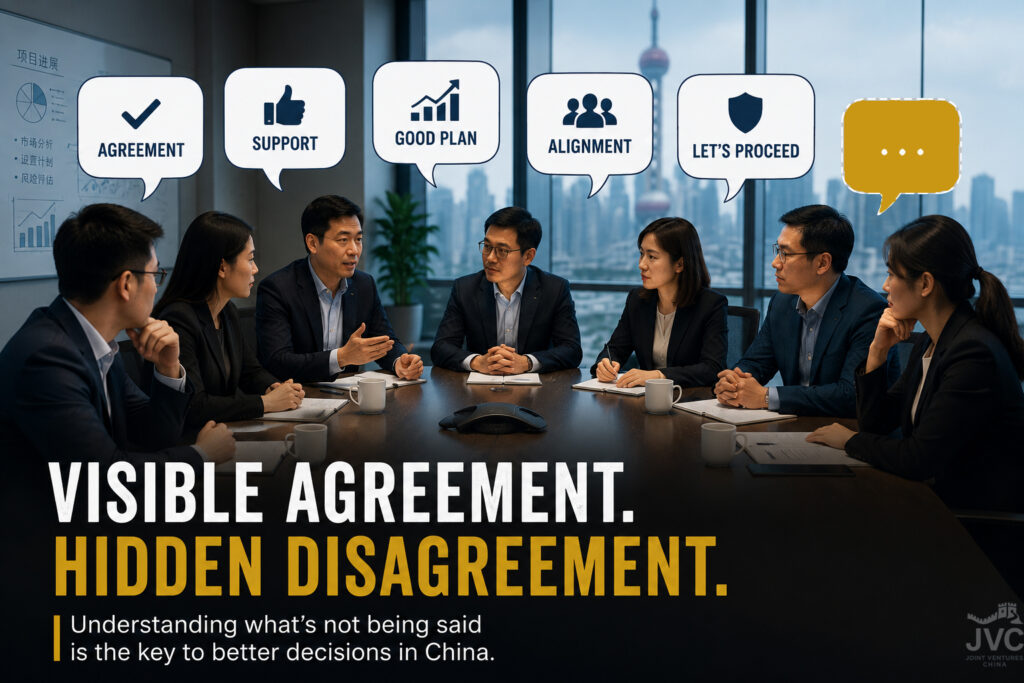
What Happens When Foreign Leaders Force Debate
Once foreign managers recognize that people are withholding concerns, many attempt to solve the problem by encouraging more direct debate.
Unfortunately, this often creates new problems.
Leaders may say things like:
“Come on, somebody must disagree.”
“I want honest feedback.”
“Don’t be afraid to challenge me.”
While these statements are well-intentioned, they can unintentionally increase discomfort.
Employees may suddenly feel pressure to publicly oppose colleagues. Individuals who have not yet consulted stakeholders may be forced into taking a position prematurely. Team members may worry about creating unnecessary tension or causing someone to lose face.
The result is often the opposite of what the leader intended.
Rather than encouraging openness, the discussion becomes even more cautious.
Research on leadership and communication, including work published by Harvard Business Review on psychological safety, suggests that people contribute more effectively when they feel safe raising concerns without fear of embarrassment or negative consequences.
In China, creating that safety frequently requires different mechanisms than simply demanding more public disagreement.
The goal is not to force Western-style debate.
The goal is to create conditions where concerns can emerge naturally.
Continue Exploring Chinese Business Culture
If you work with Chinese teams, joint ventures, or business partners, understanding how decisions are discussed is only one piece of the puzzle.
Explore more articles on Chinese business culture, leadership, communication, and joint venture management at Joint Ventures China.
Chinese Teams Are Not Avoiding Disagreement
Perhaps the most important misconception to address is the belief that Chinese teams dislike disagreement.
In my experience, that is simply not true.
Many Chinese managers are exceptionally analytical. They identify risks quickly. They challenge assumptions. They often see operational problems long before they become visible to senior leadership.
The difference is not whether disagreement exists.
The difference is where, when, and how it is expressed.
Western organizations often reward direct confrontation of ideas.
Chinese organizations frequently place greater emphasis on preserving relationships while working toward the same outcome.
Neither approach is inherently superior.
Each evolved within a different cultural and organizational context.
The challenge for foreign leaders is recognizing that disagreement may be present even when it is not immediately visible.
What Effective Foreign Leaders Learn To Do
The most successful foreign managers in China eventually stop asking a simple question:
“Does anyone disagree?”
Instead, they learn to ask better questions.
Before The Meeting
Share materials early.
Allow time for consultation.
Encourage questions privately before the group discussion begins.
During The Meeting
Ask about risks rather than disagreement.
Invite perspectives without demanding opposition.
Pay close attention to who speaks, who remains silent, and who appears to be waiting for additional input.
After The Meeting
Follow up individually.
Verify alignment.
Ask what concerns remain unresolved.
Some of the most valuable information may arrive after the meeting rather than during it. Follow-up conversations, informal discussions, and individual meetings frequently reveal perspectives that never emerged in the larger group setting.
Successful leadership while doing business in China requires understanding how Chinese workplace communication actually functions rather than assuming it operates according to familiar Western norms.
Final Thoughts
The absence of visible disagreement is not evidence that everyone agrees.
It may simply reflect a different approach to communication, relationships, and decision-making.
Many foreign managers initially interpret silence as support. Others interpret it as passivity.
Both assumptions can be misleading.
A better interpretation is often that the conversation is not finished yet.
Understanding this reality is an important part of Chinese business culture. The leaders who succeed in China learn to listen not only to what is being said in the room, but also to what may be communicated afterward through less visible channels.
Because sometimes the most important disagreement is the one you never hear publicly.
Frequently Asked Questions
Why do Chinese employees avoid disagreeing in meetings?
Chinese employees do not necessarily avoid disagreement. Concerns are often expressed privately, through one-on-one conversations, or after stakeholders have had time to consult internally. The disagreement may exist, but it is not always expressed publicly. Chinese workplace communication operates outside of most meetings.
Does silence mean agreement in Chinese business culture?
No. Silence can mean many things, including the need for additional information, consultation with stakeholders, uncertainty about leadership preferences, or a preference for discussing concerns privately.
How should foreign managers encourage feedback in China?
Rather than demanding open disagreement, effective managers create opportunities for private feedback before and after meetings. Asking about risks, concerns, and implementation challenges often produces better results than asking who disagrees.
Are Chinese teams less willing to challenge ideas?
Not necessarily. Many Chinese teams actively challenge assumptions and identify risks. The primary difference is that disagreement is often communicated through different channels and at different stages of the decision-making process. Chinese business culture operates in different spheres than common Western expectations.
Enjoying this Insight?
Get weekly real-world insights on Chinese business culture, joint ventures, and China manufacturing.

About the Author — Kevin Burton
Kevin Burton is the General Manager of a China joint venture company manufacturing advanced fiberglass materials for industrial thermal protection systems and EV safety applications. He writes about Chinese business culture, joint venture governance, and how Western leadership assumptions often collide with China’s execution-driven operating systems.