
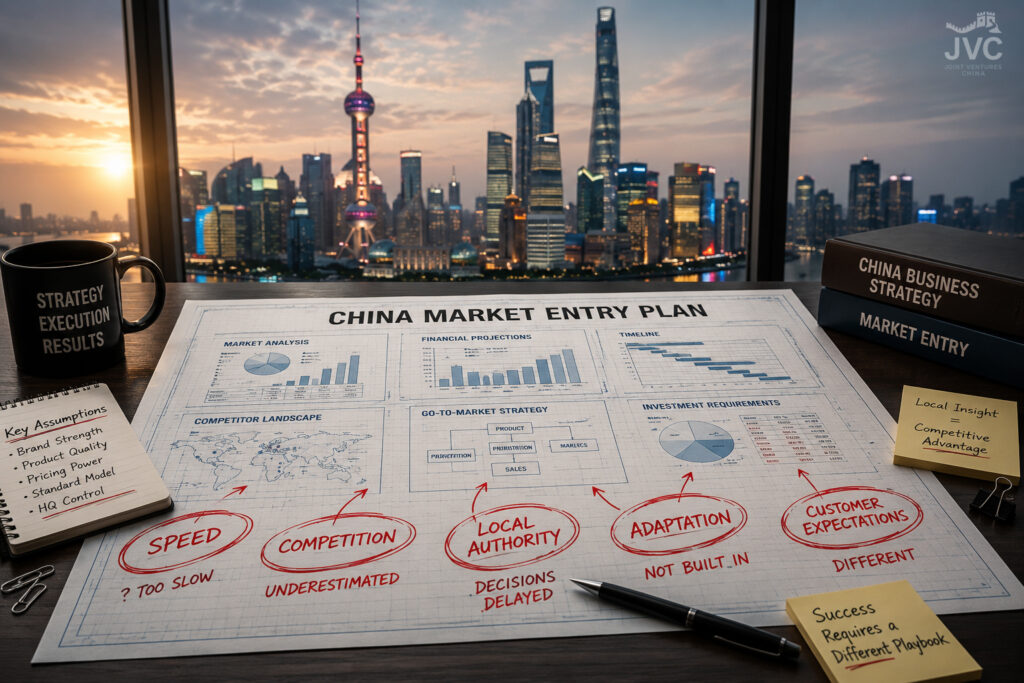
A Western company decides it is time to expand into China.
Months are spent developing a China market entry strategy. Market research is commissioned. Financial projections are built. Consultants are hired. Potential customers are identified. Leadership teams review presentations filled with charts, forecasts, and growth assumptions.
Everything appears well planned.
Then reality arrives.
Sales are slower than expected. Competitors respond aggressively. Customers behave differently than anticipated. Local teams struggle to gain authority. Headquarters becomes frustrated by the pace of progress.
Within a few years, many companies conclude that doing business in China was simply a bad market fit.
In many cases, however, the problem was not the market.
The problem was that the original China business strategy was built on assumptions that worked somewhere else.
Many organizations approach China as another geographic expansion opportunity. They assume that if a strategy succeeds in North America or Europe, it can be adapted and implemented in China with only minor adjustments.
That assumption is often where the problems begin.
China is not simply another market. It is a different business environment with different competitive dynamics, decision-making structures, customer expectations, and operating models. A successful China market entry strategy requires more than translating an existing business plan into a new language.
It requires adapting the way the company operates.
Most China Market Entry Plans Are Built on the Wrong Assumption
The biggest mistake companies make when entering the China market is assuming that success depends primarily on finding customers.
Finding customers matters, but it is rarely the hardest part.
The more difficult challenge is adapting to an environment that moves at a different speed and operates according to different expectations.
Many Western executives arrive in China expecting familiar business conditions. Instead, they encounter intense competition, rapidly evolving customer demands, and organizations capable of making decisions far faster than they are accustomed to.
What worked at home often produces very different results in China.
This is why many companies discover that their original China business strategy begins to unravel shortly after implementation. The assumptions behind the plan were built for a different environment.
China remains one of the world’s largest and most dynamic economies, with enormous industrial depth and market complexity. According to the World Bank, China continues to be a major driver of global economic activity and industrial development.
Mistake #1: Assuming Product Quality Alone Creates Success
Many Western companies believe superior products will naturally create market success.
The logic seems reasonable.
If a company has invested heavily in technology, engineering, manufacturing quality, or product performance, customers should recognize that value and reward it with market share.
Unfortunately, the market is rarely that simple.
China is filled with examples of technically superior products that struggled against competitors offering faster service, better customization, shorter lead times, or more aggressive commercial support.
Customers certainly value quality. However, they also value responsiveness, flexibility, and speed. Entering the China market requires a keen awareness to these expectations.
In many industries, competitors improve at a pace that surprises foreign companies. What appears to be a significant product advantage today may be far less meaningful twelve months later.
This rapid evolution helps explain why China has increasingly moved beyond its reputation as a manufacturing powerhouse and become a center of innovation. As discussed in China Was Built to Scale. Now It Challenges the West on Innovation, Chinese companies are no longer simply following global trends. In many sectors, they are helping define them.
A successful China market entry strategy recognizes that product quality is important, but it is rarely enough by itself.
Mistake #2: Trying to Manage China From Headquarters
Another common mistake is attempting to control China operations entirely from headquarters.
This approach often appears logical on paper. Senior leadership wants consistency. Corporate governance standards must be maintained. Major decisions require oversight.
The challenge is that China often moves faster than headquarters. Market speed in China is one of the most under-estimated aspects of business that Western managers don’t recognize.
Local opportunities emerge quickly. Customers request modifications. Competitors adjust pricing. Market conditions shift.
When every meaningful decision requires approval from another continent, organizations frequently find themselves reacting rather than leading.
I have seen situations where local teams recognized a necessary change immediately, but approval processes delayed action for weeks or months. By the time decisions were finalized, the opportunity had already passed.
Meanwhile, local competitors had already moved forward. Sometimes the difference is not measured in weeks, but in hours or a day. What takes a remote decision three days to turn around, a competitor has responded within hours and in some cases already provided the solution.
The challenge is not simply speed. It is also context.
Local teams see customer behavior, competitive actions, and operational realities every day. They often recognize problems and opportunities long before headquarters becomes aware of them. When every decision must travel through multiple layers of approval, valuable information can become diluted or delayed.
Many Western organizations unintentionally create a situation where local leaders are responsible for results but lack the authority needed to influence those results. This creates frustration for both headquarters and local management.
Successful companies establish clear governance while also defining which decisions can be made locally. The goal is not to reduce oversight. The goal is to ensure that decisions are made by the people closest to the market whenever possible.
This difference in speed is one reason Chinese organizations often outperform larger foreign competitors in rapidly changing markets. Their ability to change direction faster allows them to respond to customer demands and competitive threats with remarkable agility.
Companies entering China should not abandon oversight or governance.
However, their China business strategy must balance control with local authority. Organizations that empower capable local teams generally respond more effectively to changing market conditions than organizations attempting to manage every decision from headquarters.
Mistake #3: Copying Existing Management Systems Into China
Many companies assume their existing management systems can simply be transplanted into China.
Reporting structures are duplicated.
Approval workflows remain unchanged.
Performance metrics are copied directly from headquarters.
In theory, this creates consistency.
In practice, it often creates friction.
Management systems are products of the environments in which they were developed. Processes that function efficiently in one country may create unnecessary delays or confusion in another.
This does not mean Western systems are wrong.
It means they are not always optimized for local conditions.
Many organizations discover that local teams spend significant energy navigating systems designed for a completely different business environment.
The challenge becomes even greater in joint ventures, where multiple organizations bring different expectations regarding authority, reporting relationships, and decision-making processes. Joint Venture Governance structures that appear balanced on paper can function very differently in practice.
Likewise, many Western leaders mistake organizational stability for organizational effectiveness. As explored in Why Western Companies Misread Stability in China, what appears stable may actually conceal significant operational challenges beneath the surface.
Successful companies adapt management systems to local realities rather than assuming one model works everywhere.

Mistake #4: Underestimating Local Competition
Perhaps no mistake surprises foreign companies more than underestimating local competitors.
Many market entry plans assume that local firms operate with fewer resources, weaker technology, or less sophisticated business practices.
Those assumptions may have been true decades ago in some industries.
They are increasingly dangerous today.
Chinese competitors often possess deep local market knowledge, strong customer relationships, extensive distribution networks, and highly efficient decision-making structures.
They understand local buying behavior because they live it every day.
They understand customer expectations because they interact with those customers continuously.
Most importantly, they learn quickly.
A foreign company may spend six months analyzing a market trend.
A local competitor may spend six weeks testing responses.
Many foreign companies also underestimate how quickly Chinese competitors can close capability gaps.
A product feature that differentiates a Western company today may be matched in the next product generation. A manufacturing advantage may be replicated. A service model may be copied and improved. Companies that rely solely on historical strengths often discover that competitors are advancing faster than expected.
This is one reason market leadership in China can change rapidly. Organizations that remain successful are continuously improving rather than assuming yesterday’s advantages will remain intact. The market rewards adaptation far more than reputation.
This combination of scale, speed, and learning creates a formidable competitive environment.
Companies that underestimate local competition often discover that entering the market was far easier than achieving sustainable growth.
Organizations that succeed in doing business in China typically approach the market with humility. They assume competitors are capable, intelligent, and continuously improving.
More often than not, that assumption proves correct.
Entering the China market?
Join readers who receive practical guidance on China market entry, leadership, joint ventures, and business strategy.
Mistake #5: Measuring Success Too Early
Many companies enter China with unrealistic timelines.
They expect rapid profitability.
They expect immediate market share gains.
They expect growth to follow a predictable path.
When those expectations are not met, confidence begins to decline.
The problem is that meaningful market development often requires time.
Relationships must be established.
Distribution networks must be developed.
Local teams must gain experience.
Customers must build trust.
Many of the most important investments made during the early years of a China operation do not immediately appear in financial results.
This does not mean progress is absent.
It simply means progress is occurring beneath the surface.
One reason companies struggle after initial success is that they evaluate performance using short-term metrics rather than long-term capability building. As discussed in Why Your China Strategy Fails After the First Win, sustaining success often requires a different mindset than achieving initial success.
Organizations that remain patient during this phase frequently build stronger long-term foundations than organizations focused exclusively on immediate results.
What a Successful China Market Entry Strategy Looks Like
While every company is different, successful organizations often share several common characteristics.
First, they build local decision-making authority.
Second, they adapt faster than headquarters may initially prefer.
Third, they invest in relationships as seriously as they invest in products.
Fourth, they localize where necessary instead of insisting on complete standardization.
Fifth, they continuously learn and adjust their approach.
Many of these principles align closely with broader lessons about doing business in China. Companies that succeed rarely rely on a single advantage. Instead, they build organizations capable of learning and adapting to local conditions over time.
Most importantly, they recognize that entering the China market is not simply a sales initiative.
It is an organizational adaptation process.
The companies that perform best are usually not those with the most impressive presentations or the largest budgets.
They are the companies willing to learn, adapt, and evolve.
Frequently Asked Questions
What is a China market entry strategy?
A China market entry strategy is a structured plan that defines how a company will establish, operate, and grow its business in China. It typically includes market positioning, customer targeting, distribution channels, organizational structure, and competitive strategy.
Why do foreign companies struggle in China?
Many foreign companies struggle because they underestimate local competition, move too slowly, rely excessively on headquarters-based decision making, or fail to adapt their operating models to local market conditions.
Should companies localize products for China?
In many industries, some level of localization improves competitiveness. Chinese customers often have different expectations regarding features, service, pricing, delivery speed, and overall customer experience.
Is China still an attractive market for foreign companies?
Yes. China remains one of the world’s largest and most dynamic markets. While competition has intensified, companies that adapt effectively can still find significant opportunities for growth and long-term success.
Conclusion
Companies rarely fail in China because they lack a plan or do not have a China business strategy.
In many cases, they fail because they bring a plan designed for a different environment.
A strong China market entry strategy is not simply about identifying customers or selecting a market segment. It is about understanding how competition, decision-making, execution, and organizational behavior differ inside one of the world’s most dynamic business environments.
The organizations that succeed are not necessarily smarter than their competitors.
They are simply more willing to adapt.
That willingness to adapt often determines whether entering the China market becomes a growth story or an expensive lesson.
The most effective leaders understand that a successful China market entry strategy is not a document created during a planning exercise. It is a process of continuous learning and adaptation. Markets change, competitors evolve, and customer expectations shift. Companies that treat their China business strategy as a living framework are often better positioned than those attempting to execute a fixed plan developed years earlier. The goal is not perfection before entering the China market. The goal is building an organization capable of adapting after arrival.
Enjoying this Insight?
Get weekly real-world insights on Chinese business culture, joint ventures, and China manufacturing.

About the Author — Kevin Burton
Kevin Burton is the General Manager of a China joint venture company manufacturing advanced fiberglass materials for industrial thermal protection systems and EV safety applications. He writes about Chinese business culture, joint venture governance, and how Western leadership assumptions often collide with China’s execution-driven operating systems.