
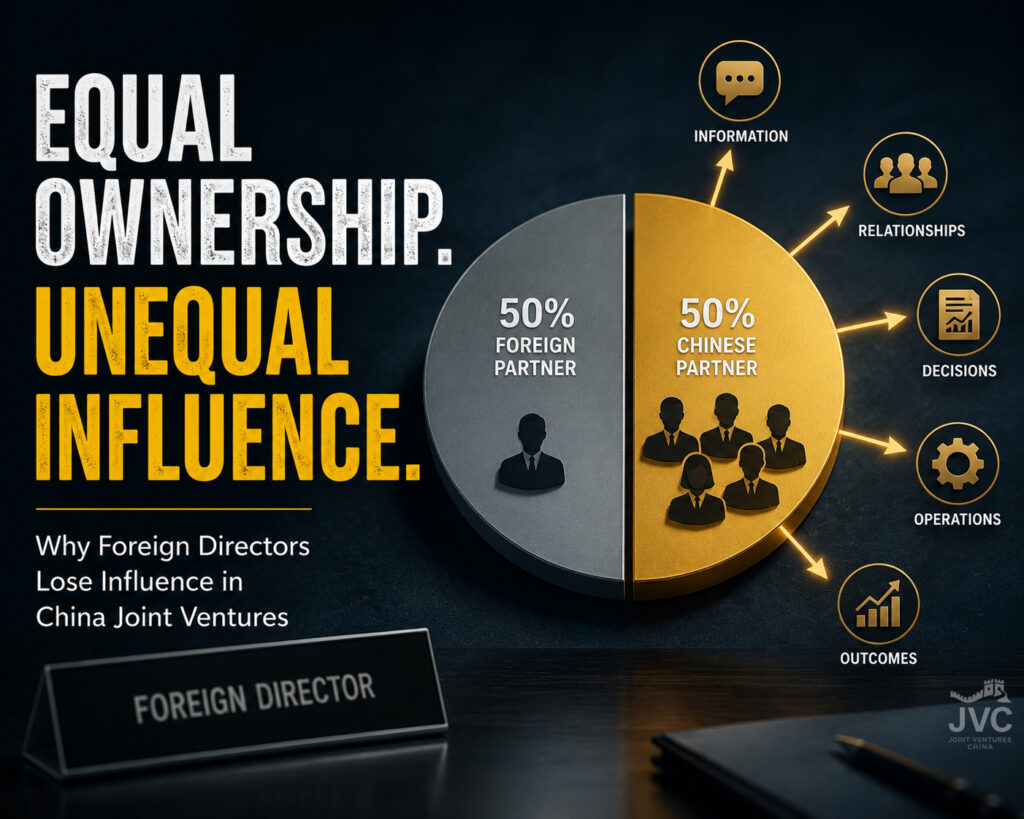
Many foreign directors discover they have a problem long before they understand its cause.
They still own the same percentage of the company. They still hold the same board seats. The shareholder agreement has not changed. Yet somehow they find themselves reacting to decisions rather than helping shape them.
Important developments seem to appear without warning. Recommendations arrive with strong internal support already behind them. Discussions that feel open on paper appear largely settled in practice.
In many China joint ventures, this shift is gradual and difficult to detect. The issue is rarely ownership. More often, it is influence.
This distinction sits at the heart of effective China joint venture governance and explains why many foreign directors in China struggle to maintain influence despite strong ownership positions. Many foreign executives assume that legal authority naturally creates influence. If they own 50 percent of the company, hold multiple board seats, and possess strong contractual protections, influence should follow.
In practice, it often works differently.
Ownership creates rights. Influence shapes outcomes.
Understanding the difference between the two is one of the most important leadership lessons for foreign executives operating in China.
The Illusion of Equal Ownership
One of the most persistent misconceptions in China joint venture governance is the belief that equal ownership creates equal influence.
The assumption is understandable. If two shareholders each own half of the company, it seems reasonable to expect both sides to possess comparable influence over strategy, operations, and decision-making. Contracts are negotiated, governance structures are established, and board representation is carefully balanced to reflect ownership percentages.
Yet ownership and influence are not the same thing.
Ownership determines legal rights. Influence determines who helps shape decisions before those rights ever need to be exercised.
This distinction becomes visible in many joint ventures where both parties possess identical voting rights but very different levels of involvement in the organization. One shareholder may maintain regular contact with management, receive information earlier, and participate in ongoing discussions about emerging issues. The other may engage primarily through formal reporting structures and scheduled board meetings.
Both shareholders may technically possess the same authority. Their practical influence may be very different.
This reality explains why discussions surrounding China joint venture control often become far more complicated than ownership percentages suggest. Organizational influence is shaped by information, relationships, trust, credibility, and participation. None of those factors can be fully captured in a shareholder agreement.
The result is that foreign executives sometimes focus heavily on protecting legal rights while paying less attention to how influence is actually created inside the organization. By the time they recognize the difference, they often find themselves reacting to decisions that have already gathered momentum internally.
This dynamic also helps explain why questions of ownership and questions of control frequently produce different answers. The practical realities explored in Who Actually Controls a China Joint Venture? often have less to do with share percentages than many executives initially expect.
Equal ownership can create equal rights. It does not automatically create equal influence.
Understanding this difference is one of the most important lessons in China joint venture governance and a recurring theme in discussions about China joint venture control.
Influence Is Built Between Board Meetings
Most foreign directors naturally view the board meeting as the center of corporate influence.
After all, major investments, strategic initiatives, budgets, and organizational decisions eventually require board oversight. The board is the highest formal authority within the governance structure, making it easy to assume that influence originates there.
In reality, influence often develops long before a board meeting begins.
Most significant decisions pass through a period of informal discussion before they ever reach a formal agenda. Operational leaders exchange ideas, stakeholders evaluate alternatives, concerns are raised, and different groups gradually align around preferred outcomes. By the time directors receive board materials, many of the most important conversations have already occurred.
This does not mean board meetings are unimportant. It means they often represent the conclusion of a process rather than the beginning.
A recommendation presented to the board may already reflect weeks or months of internal discussion. Risks have been debated. Alternatives have been considered. Key stakeholders have often reached broad alignment on the preferred path forward.
When foreign directors encounter this process for the first time, they sometimes conclude that management is withholding influence from the board. More commonly, they are discovering that influence was exercised earlier than they expected.
This pattern appears repeatedly throughout Chinese organizations. Decisions often emerge through a gradual process of alignment before becoming visible externally. Similar dynamics can be observed in Decisions Don’t Happen in the Meeting — And That’s Normal in China and in the consensus-building process described in Why No One Wants to Be the First to Say Yes in China.
The implication for foreign directors is important.
If engagement occurs only during formal governance events, influence opportunities become limited. Directors may retain full legal authority while finding themselves increasingly disconnected from the discussions that shaped the recommendation sitting in front of them.
Effective influence requires understanding not only how decisions are approved, but how they are formed.
The Side That Controls Information Often Controls Outcomes
If ownership creates rights and board meetings provide oversight, information often determines who exercises influence first.
One of the most important realities of China joint venture governance is that influence frequently follows information. The individuals who receive information earliest are typically better positioned to frame problems, define priorities, and shape potential solutions before formal decisions are required.
This principle applies everywhere, not just in China. However, it becomes particularly visible inside a China joint venture board structure when one shareholder maintains greater day-to-day proximity to operations than the other.
Consider a common situation. A production issue emerges, a customer raises a concern, or a major supplier disruption begins affecting delivery schedules. Local management becomes aware of the issue immediately. Internal discussions begin. Potential responses are explored. Different stakeholders evaluate risks and gradually align around a preferred approach.
Several weeks later, the issue appears in a board update.
By that point, the issue is no longer being discovered. It is already being managed.
The foreign directors may still possess full authority to approve or reject a recommendation. Yet the recommendation itself has already been influenced by the people who participated in the earlier discussions. The challenge is not necessarily governance. The challenge is timing.
Effective China joint venture governance requires directors to understand not only what information they receive, but when they receive it.
This is one reason why many concerns about China joint venture management eventually become concerns about information flow. Directors often focus on decision rights while overlooking the practical importance of when information is received.
Much of that information reaches the board through management, which makes it important to understand how the general manager shapes daily operating authority while remaining accountable to the full board.
The side that consistently receives information later will frequently struggle to maintain influence regardless of ownership percentage. In many cases, influence has already been exercised before a formal decision ever reaches the boardroom.
The Quarterly Board Meeting Trap
One of the most common ways foreign directors lose influence is through what might be called the quarterly board meeting trap.
The pattern is familiar. A board meeting is scheduled, materials are distributed, directors prepare their questions, and management presents recommendations requiring approval. Everything appears to function according to the governance framework established by the shareholders.
What many directors fail to recognize is that the most important part of the process often occurred weeks earlier.
Before the board package was assembled, management discussed the issue internally. Stakeholders evaluated options. Concerns were addressed. Potential objections were anticipated. Alignment gradually formed around a preferred direction. By the time the recommendation reaches the board, it often represents the outcome of dozens of prior conversations.
The board still possesses formal authority.
But influence has already been exercised.
This distinction explains why many foreign directors eventually feel that they are approving decisions rather than helping shape them. The governance structure remains intact. Their voting rights remain unchanged. Yet their ability to influence outcomes appears to diminish.
The issue is rarely that authority disappeared. More often, influence was created earlier in the process than they expected.
Understanding where decisions actually form is a critical part of effective China joint venture governance. Directors who engage only at formal governance checkpoints often discover that the most important discussions took place before the meeting ever started.
This is where many China joint venture governance systems appear effective on paper but deliver less influence in practice.
Organizational Presence Matters More Than Most Directors Realize
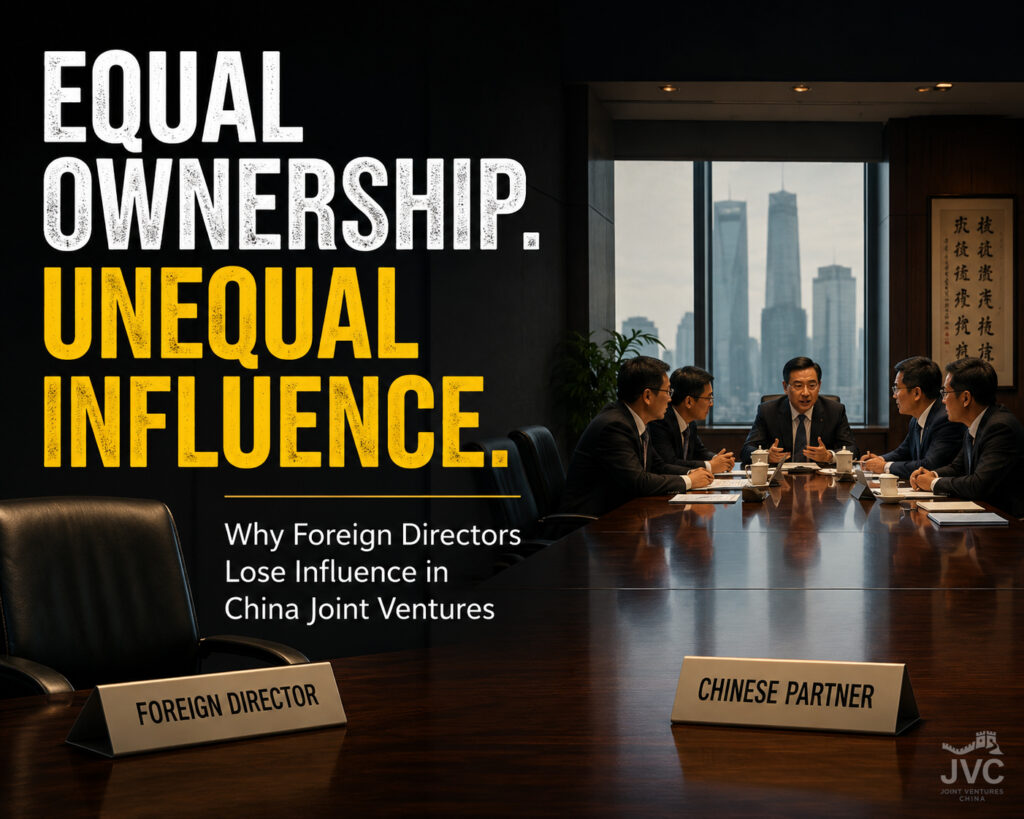
Influence tends to follow proximity.
This reality is frequently underestimated by foreign executives evaluating a foreign partner China joint venture. Organizations are not influenced solely through formal authority. They are influenced through ongoing interaction, shared experiences, regular communication, and daily problem solving.
One shareholder may have executives interacting with management every day. They participate in routine discussions, observe emerging challenges, and develop an understanding of the organization that extends beyond formal reporting. Another shareholder may engage primarily through monthly updates and quarterly meetings.
Both shareholders may possess identical legal rights.
Their practical influence can be very different. This is one reason many foreign directors in China overestimate the influence created by ownership while underestimating the influence created by organizational presence.
Daily interaction creates opportunities to ask questions before issues become problems. It creates opportunities to understand organizational priorities, build trust with management, and contribute to discussions while alternatives are still being evaluated. These interactions often shape outcomes long before a formal decision requires approval.
This is one reason why discussions surrounding China joint venture control frequently extend beyond ownership structures and voting rights. Influence often reflects the depth of organizational engagement as much as it reflects legal authority.
The operating reality of a joint venture is rarely captured entirely by an ownership chart. Influence develops through participation, and participation is difficult to replace through governance mechanisms alone.
Stay Ahead of
China Business Reality
Get practical insights on China joint ventures, leadership, governance, and decision-making delivered directly to your inbox.
Relationships Create Influence Before Governance Does
Many Western executives naturally view governance as the primary mechanism through which influence is exercised. Governance is important, but it is often not where influence begins.
Influence frequently starts with relationships.
This should not be confused with personal favors or informal arrangements. Effective business relationships create trust, credibility, and communication channels that improve the quality and speed of decision-making. Individuals are more likely to share concerns, seek input, and discuss emerging issues with people they trust and respect.
In practical terms, relationships often determine who receives information first, who participates in discussions early, and whose perspectives are considered before recommendations become formalized.
This dynamic appears throughout Chinese organizations and is closely connected to themes explored in Understanding Chinese Business Culture: The Signals Western Leaders Miss and What Chinese Business Meetings Are Actually For And Why Western Teams Misuse Them.
Strong governance remains essential. Clear reporting structures, accountability mechanisms, and board oversight all play important roles. However, governance generally works best when supported by strong relationships throughout the organization.
Without that foundation, many foreign directors discover that formal authority provides less influence than they expected. This challenge appears repeatedly in discussions involving foreign directors in China and the effectiveness of a China joint venture board.
Research from MIT Sloan Management Review has similarly emphasized that influence inside organizations often depends upon informal networks, trust, and access to information rather than formal reporting structures alone.
The most effective directors understand that governance and relationships are complementary rather than competing sources of influence. Strong relationships are often an overlooked component of successful China joint venture governance.
How Effective Foreign Directors Maintain Influence
The foreign directors who maintain influence over time tend to approach their role differently from those who gradually become disconnected from the organization.
They do not rely exclusively on formal authority. Instead, they focus on maintaining visibility into how the organization operates between formal governance events.
They invest time in understanding information flow. Strong China joint venture governance combines formal authority with continuous engagement between directors and management. They develop relationships with key stakeholders. They remain engaged between meetings rather than appearing only when approvals are required. Most importantly, they seek to understand how alignment develops inside the organization.
This does not mean interfering in management decisions or bypassing governance structures. It means recognizing that influence is an ongoing process rather than a quarterly event.
The most effective directors view influence as something that must be cultivated continuously. They understand that participation, credibility, and visibility are often just as important as contractual rights.
This perspective aligns closely with themes explored in Why Western Governance Fails in China Joint Ventures – Even with Strong Contracts, Chinese Business Hierarchy: The System Behind China’s Speed, How China Business Really Works – A Practical Guide for Western Leaders, and Why Western Management Systems Fail in China.
Research published by the Harvard Business Review has consistently highlighted the importance of informal influence networks in shaping organizational outcomes. Formal authority remains important, but leadership effectiveness often depends upon the ability to influence discussions before decisions become formalized.
The same principle applies inside China joint ventures. The strongest examples of China joint venture governance combine formal authority with continuous organizational engagement.
Warning Signs That Influence Is Slipping
Influence rarely disappears overnight.
More often, it erodes gradually through a series of small changes that appear harmless when viewed individually but become significant when viewed collectively.
One common warning sign is an increase in surprises. Important developments seem to emerge suddenly even though they have been under discussion internally for weeks or months. Directors begin learning about issues later in the process than they once did.
Another signal appears when board meetings become primarily informational. When a China joint venture board stops evaluating alternatives and begins simply endorsing recommendations, influence may already be shifting elsewhere in the organization. Rather than evaluating multiple alternatives, directors receive recommendations that already appear settled. Discussion remains possible, but meaningful influence over the outcome becomes increasingly difficult.
Reduced access to management can also be an indicator. Conversations become less frequent. Information becomes more structured and filtered. Direct interaction gives way to formal reporting. Directors still receive updates, but they have less visibility into how conclusions were reached.
A further warning sign is the disappearance of alternative viewpoints. Recommendations arrive fully formed. Questions receive answers, but directors gain little insight into the debates, concerns, or competing options that preceded the recommendation.
A more serious warning appears when the problem moves beyond diminished influence and begins affecting the company’s ability to make decisions. Repeated postponement, unresolved shareholder disagreement, or decisions that continually move upward without resolution may indicate the early stages of China joint venture deadlock, even before a formal board vote actually fails.
None of these developments necessarily indicate bad intentions. In many cases they simply reflect a gradual shift in where influence is being exercised.
The most effective foreign directors monitor influence the same way they monitor financial performance. They recognize that influence requires ongoing attention and that early warning signs are easier to address than deeply established patterns.
Conclusion
Foreign directors do not usually lose influence because of culture.
More often, they lose influence because they misunderstand how influence is created.
Ownership matters. Board seats matter. Contracts matter. But none of those mechanisms automatically create practical influence inside an organization. Influence is typically built through information flow, relationships, organizational presence, and participation in the discussions that shape alignment before decisions become visible.
This is one of the central lessons of effective China joint venture governance.
The foreign directors who maintain influence over time are rarely the ones relying most heavily on formal authority. They are usually the ones who understand how influence is actually built, where it is exercised, and how it evolves inside the organization.
That understanding often determines whether a director helps shape outcomes or simply reacts to them.
Frequently Asked Questions
Why do foreign directors lose influence in China joint ventures?
Foreign directors often lose influence when they rely primarily on ownership, board seats, or contractual authority while remaining disconnected from the information flow and relationship networks that shape decisions before they reach the boardroom.
Does owning 50% of a China joint venture guarantee equal control?
No. Equal ownership creates equal legal rights, but it does not automatically create equal influence. Practical influence is often shaped by organizational presence, information access, relationships, and participation in decision-making processes.
How can foreign directors maintain influence in a China joint venture?
The most effective directors remain engaged between meetings, build relationships throughout the organization, monitor information flow, and seek to understand how alignment forms before decisions become visible at the board level.
Enjoying this Insight?
Get weekly real-world insights on Chinese business culture, joint ventures, and China manufacturing.

About the Author — Kevin Burton
Kevin Burton is the General Manager of a China joint venture company manufacturing advanced fiberglass materials for industrial thermal protection systems and EV safety applications. He writes about Chinese business culture, joint venture governance, and how Western leadership assumptions often collide with China’s execution-driven operating systems.