
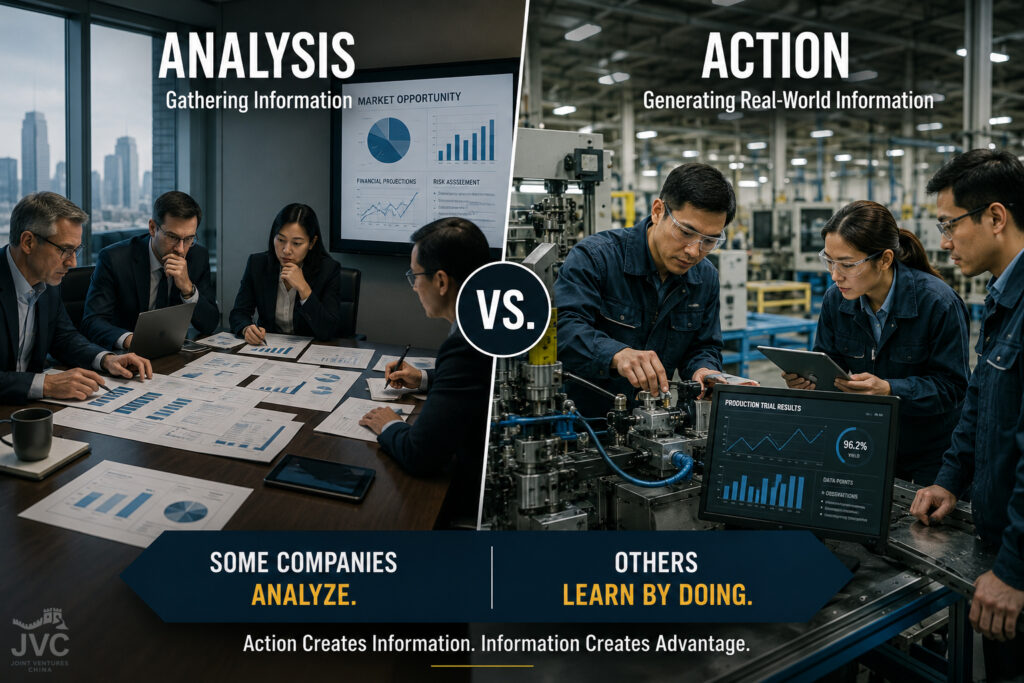
One of the biggest misconceptions Western leaders have about China is that its competitive advantage comes primarily from lower costs, larger factories, or government support. While those factors can matter, they do not fully explain the remarkable Chinese business speed that many foreign executives experience firsthand after entering the market.
Over the past two decades, I have observed countless situations where Western companies spent months gathering information, conducting reviews, and refining plans while their Chinese competitors were already testing, learning, and adapting in the marketplace. The difference was not intelligence. It was not work ethic. In many cases, it was not even resources.
The difference was the point at which each organization was willing to act.
Many Western companies view action as the reward for having enough information. Many Chinese companies view action as one of the fastest ways to obtain information. That subtle difference can dramatically influence execution, learning, and ultimately competitive advantage.
Understanding this dynamic is essential for anyone seeking to understand Chinese business speed and why organizations in China often seem capable of moving faster than their Western counterparts.
The Western Search for Certainty
Most Western management systems are designed to reduce risk before action occurs. Organizations develop business cases, conduct market research, build financial models, perform risk assessments, and seek alignment across multiple stakeholders. None of these activities are inherently wrong. In fact, they often improve decision quality.
The challenge emerges when organizations begin treating certainty as a prerequisite for action.
Many executives have experienced projects that spend months moving between departments, committees, and review processes. Additional information is requested, more analysis is performed, forecasts are refined, and scenarios are debated. Every step appears rational when viewed individually, yet collectively they can create significant delays.
The underlying assumption is that sufficient analysis will eventually produce enough certainty to justify action.
In reality, business environments rarely provide perfect information. Markets change, competitors move, customer preferences evolve, and assumptions become outdated. By the time all stakeholders feel comfortable, the opportunity itself may have changed.
This contrast becomes especially visible when comparing Chinese companies with their Western counterparts. Rather than asking, “Do we know enough to proceed?” the question is often, “What is the fastest way to find out?”
That difference sits at the heart of many examples of Chinese business speed.
Why Chinese Companies View Uncertainty Differently
One reason for this behavior is that uncertainty is often treated differently within many Chinese organizations. Instead of viewing uncertainty as a temporary obstacle that must be eliminated before action, it is frequently viewed as a normal condition of business.
Markets in China have evolved rapidly for decades. Entire industries have transformed within a few years. Customer preferences can change quickly. New competitors emerge constantly. Under those conditions, waiting for complete information can become a competitive disadvantage.
This perspective is influenced partly by broader elements of China business culture. Business leaders often operate in environments where adaptability and responsiveness are highly valued. The ability to adjust quickly may be considered more important than the ability to perfectly predict outcomes.
Many foreign managers initially interpret this approach as impulsive. After spending time in China, however, they often discover that the objective is not to eliminate planning. The objective is to shorten the distance between learning and execution.
That same pattern helps explain why visible agreement is often less important than internal alignment before execution begins. Once key stakeholders are aligned, organizations can move much faster than outside observers expect.
Similarly, understanding why nobody wants to be the first person to say yes in many Chinese organizations helps explain why rapid execution can coexist with careful internal consensus building. The caution frequently occurs before commitment. The speed often appears afterward.
Action as a Learning Tool
Perhaps the most misunderstood aspect of many Chinese business practices is the relationship between action and learning.
In many Western organizations, learning and execution are treated as separate phases. First, information is gathered. Then decisions are made. Finally, execution begins.
Many Chinese companies often blend those phases together.
Rather than trying to answer every question before moving forward, they may launch a limited product, conduct a manufacturing trial, test a new supplier, enter a regional market, or modify a process on a small scale. The objective is not reckless action. The objective is obtaining real-world information quickly.
I experienced this recently while supplying the Chinese semiconductor market. A customer requested a new thermal insulation cover and interface based on only broad guidance from the end user. They had a general idea of what they wanted but could not provide detailed specifications because they were still refining their own requirements. Rather than waiting for perfect information, we developed an initial product offering and put it in front of the customer. That first version was accepted, which immediately generated a new round of feedback, modification requests, and improvement opportunities.
What became clear throughout the process was that the customer was learning as much as we were. Each installation generated information that could not have been obtained in a conference room or through additional analysis. In China’s fast-moving semiconductor industry, customers are often already thinking about the next iteration while suppliers are still developing the current one. Companies that wait for every requirement to be fully defined can easily miss the opportunity to participate in the first generation of a product or even an entire market segment. By getting involved early, both customer and supplier accelerate the learning process.
I have seen this repeatedly in manufacturing environments as well. A Western team might spend weeks debating whether a process modification will improve efficiency. Engineers prepare analyses, managers review assumptions, and meetings are scheduled. Meanwhile, a Chinese team may simply run a controlled production trial, collect actual data, and evaluate results within days.
The decision itself becomes part of the learning process.
This approach reflects some of the most effective Chinese business practices I have encountered. Small experiments often provide better information than extensive theoretical discussions because they expose assumptions to reality.
The same principle applies beyond manufacturing. Product development teams may release limited versions of products to gather customer feedback. Sales teams may pursue opportunities before every internal process has been perfected. Operational teams may test organizational changes before building elaborate implementation plans.
Many Chinese companies recognize that some information can only be discovered through execution.
As discussed throughout the broader themes of China business culture, there is often a greater willingness to learn through adaptation rather than attempting to predict every outcome in advance.
Enjoying these insights about China business and cross-cultural leadership?
Subscribe to receive future articles on Chinese business culture, joint ventures, leadership, strategy, and execution directly in your inbox.
How This Creates Chinese Business Speed
Chinese Business Speed Comes From Shorter Learning Cycles
The most important insight is that Chinese business speed is often not about moving faster through a single decision. It is about completing more learning cycles in the same amount of time.
Imagine two companies facing the same opportunity.
The first company spends six months gathering information before acting. The second company spends one month gathering information, then begins testing, learning, and adjusting in the market.
Neither company possesses perfect information. The difference is that one organization begins collecting real-world feedback much sooner.
Over time, those learning cycles compound.
This dynamic helps explain why many industries in China evolve so rapidly. Companies are not necessarily making better initial decisions. They are often reaching better answers sooner because they are generating new information through action.
The structural foundations behind this phenomenon contribute significantly to the broader execution advantages discussed in the China speed and execution pillar. The speed itself is not the advantage. The ability to learn and adapt faster is what creates the advantage.
The same mechanism has also helped fuel China’s transition from manufacturing scale to increasing innovation capability. Organizations that learn faster often improve faster. Organizations that improve faster frequently become innovators.
This pattern is not unique to China. Similar concepts appear in startup ecosystems worldwide. The famous “build-measure-learn” philosophy popularized by The Lean Startup emphasizes rapid experimentation as a method of reducing uncertainty. The principle is simply applied at remarkable scale within many Chinese industries. Readers interested in the concept can explore additional background at https://theleanstartup.com.
The Risks of Moving Too Fast
Of course, this approach is not perfect. While shorter learning cycles can create significant advantages, speed without judgment can also create costly mistakes. Poorly designed experiments can waste resources, frequent changes can create confusion, and organizations that move too quickly may struggle to maintain alignment. Employees can experience change fatigue when priorities shift constantly, and leaders can sometimes mistake activity for progress.
This is where some observers misunderstand the lesson. The takeaway is not that analysis is unnecessary or that planning should be abandoned. Rather, it is that analysis and execution do not always need to occur as completely separate stages. The most effective organizations find ways to combine learning and action, using carefully controlled experiments to generate information while still maintaining strategic discipline.
The companies that consistently outperform are rarely the ones that move the fastest at all costs. They are the ones that balance speed with judgment. They move quickly enough to learn, but carefully enough to avoid unnecessary disruption. The goal is not reckless action. The goal is informed adaptation. That distinction is what separates productive execution from organizational chaos.

What Western Leaders Can Learn
Western leaders do not need to abandon their planning processes to benefit from this insight. In fact, many of the strengths of Western management systems—rigorous analysis, financial discipline, and risk management—remain valuable competitive advantages. The opportunity is not to replace those capabilities, but to complement them with a greater willingness to learn through action, and the result is often speed to market.
Instead of asking only how to gather more information before moving forward, leaders can begin asking different questions. What assumptions could be tested through a small experiment? What issues are being debated that could be resolved through real-world observation? What information are we waiting for that may only emerge once execution begins? And what could we learn in two weeks rather than six months?
Questions like these often reveal opportunities to shorten learning cycles without meaningfully increasing risk. Many of the world’s most successful organizations have discovered that execution itself can become a powerful source of information. That lesson sits at the intersection of strategy, leadership, and operational effectiveness, and it helps explain why some Chinese companies are able to respond to changing conditions with such remarkable agility.
Many of the assumptions Western executives bring into China are based on management practices that work well in their home markets but can produce very different results in a faster-moving environment. Leaders who understand that difference are often better positioned to compete effectively.
Frequently Asked Questions
Why do Chinese companies often move faster than Western companies?
Many people assume that Chinese companies move faster because they work harder or accept more risk. While those factors can sometimes play a role, the more significant difference is often how organizations approach uncertainty. Many Chinese companies are willing to begin learning through action before every question has been answered, allowing them to shorten learning cycles and adapt more quickly to changing market conditions.
Is Chinese business speed caused by government support?
Government support may influence certain industries, but it does not fully explain Chinese business speed. The ability to make decisions, launch trials, gather feedback, and adapt quickly can be observed across private companies, joint ventures, and state-owned enterprises. Organizational behavior, competitive pressure, and management practices often play a larger role than outside observers realize.
Are Chinese companies more willing to take risks?
Not necessarily. Many Chinese companies are highly pragmatic and risk-aware. The difference is often that they view small experiments as a way to reduce uncertainty rather than increase it. Instead of spending months debating assumptions, they may conduct a limited test, gather real-world information, and make adjustments based on actual results. This approach can sometimes reduce overall risk while accelerating learning.
How does China business culture influence execution?
China business culture often places a strong emphasis on adaptability, responsiveness, and practical problem-solving. While individual organizations vary, many managers operate in environments where market conditions change rapidly and competitors move quickly. As a result, there is often greater emphasis on learning through execution and adjusting along the way rather than attempting to predict every outcome before action begins.
Can Western companies adopt the same approach?
Yes. The lesson is not to abandon planning or analysis. Instead, Western leaders can look for opportunities to shorten the gap between learning and execution. Small pilot projects, controlled experiments, limited product launches, and rapid customer feedback loops can help organizations generate information more quickly while maintaining appropriate controls. The goal is not reckless action, but informed adaptation.
What is the biggest lesson Western leaders can learn from Chinese companies?
Perhaps the most important lesson is that action itself can be a source of information. Many Western organizations treat execution as the final step in a decision-making process. Many Chinese companies view execution as part of the learning process itself. In fast-moving markets, that difference can create a significant competitive advantage.
Conclusion
The real story behind Chinese business speed is not that Chinese organizations work harder, care less about risk, or ignore planning.
The difference is often found in their relationship with uncertainty.
Many Western companies treat action as something that happens after enough answers have been collected. Many Chinese companies treat action as one of the most effective ways to discover those answers in the first place.
Ultimately, Chinese business speed is not simply about moving faster. It is about creating learning faster. Organizations that shorten the gap between action and feedback gain information sooner, adapt sooner, and often outperform competitors who are still searching for certainty.
That does not mean every decision will be correct. It does mean that mistakes are identified earlier, adjustments are made sooner, and opportunities can be captured before they disappear.
In today’s competitive environment, the organization that learns fastest often wins. Many Chinese companies understand this instinctively.
While others wait for answers, they start doing.
Enjoying this Insight?
Get weekly real-world insights on Chinese business culture, joint ventures, and China manufacturing.

About the Author — Kevin Burton
Kevin Burton is the General Manager of a China joint venture company manufacturing advanced fiberglass materials for industrial thermal protection systems and EV safety applications. He writes about Chinese business culture, joint venture governance, and how Western leadership assumptions often collide with China’s execution-driven operating systems.