
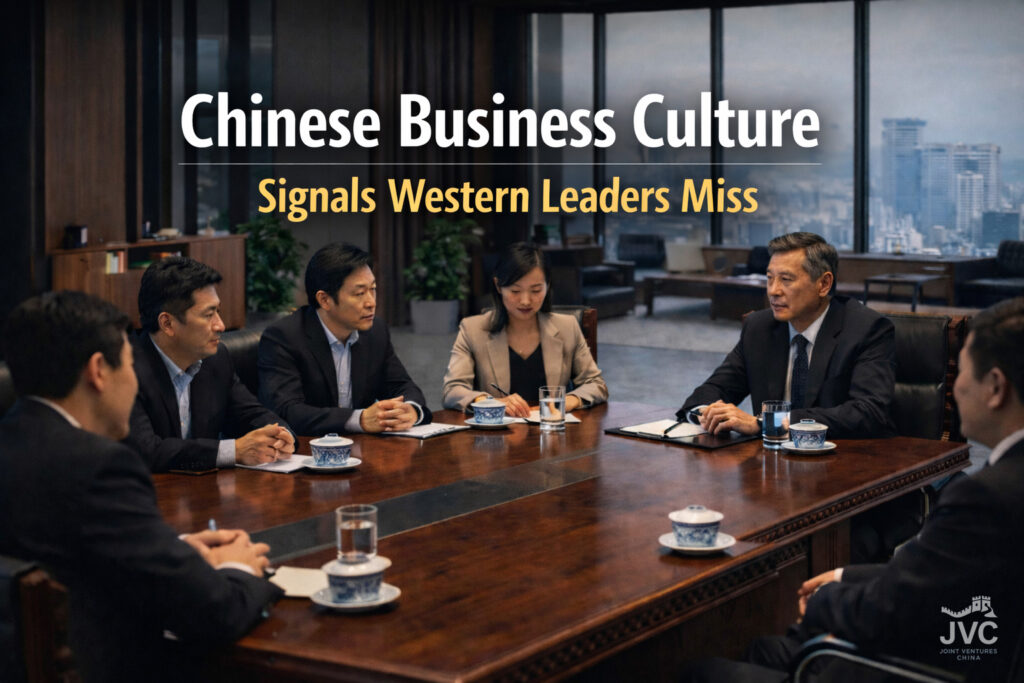
Western executives often describe Chinese business culture as difficult to read. Meetings feel inconclusive. Decisions appear to happen somewhere else. Silence is often interpreted as agreement.
The problem is not that Chinese business culture is unclear. The problem is that Western leaders are interpreting the signals through the wrong framework. What looks like hesitation, indirect communication, or excessive hierarchy is often part of a system designed to manage risk, preserve alignment, and protect the organization.
Once you understand the signals inside Chinese business culture, many interactions become far more predictable. Meetings serve a different purpose than most Western executives expect. Silence often carries information rather than agreement. Relationships function as coordination infrastructure rather than simple networking.
This article explains the signals Western leaders most often miss when working with Chinese companies.
1. Chinese Business Culture Prioritizes Stability Before Speed
Western executives often enter China expecting decisions to move quickly once a meeting is scheduled.
In many Western companies, speed is associated with decisive leadership. Leaders gather information, debate options, and push toward a clear outcome.
Chinese organizations often follow a different sequence.
Before action begins, the system first seeks stability and alignment.
This means that multiple stakeholders inside the organization need to understand the implications of a decision. Risks must be considered. Internal relationships must remain balanced. Authority must be respected.
Until that internal alignment forms, outward movement can appear slow.
But what many Western leaders interpret as hesitation is often something else entirely: risk management inside a hierarchical system.
Research on organizational culture at MIT Sloan School of Management describes culture as an operating system that shapes how decisions move through complex organizations.
Once alignment is established, the pace of execution frequently changes dramatically.
Factories move quickly. Teams coordinate efficiently. Decisions that seemed delayed suddenly produce rapid action.
This pattern is why many Western executives experience what feels like a contradiction when working with Chinese companies. Early conversations appear cautious or inconclusive. Later phases of execution move with surprising speed.
Understanding this sequence is one of the most important insights for interpreting Chinese business culture.
What looks slow at first is often the process of building alignment that allows the system to move quickly afterward.
As discussed in Speed in China Doesn’t Look Fast — Until It Does, what appears slow in early stages often reflects internal alignment rather than lack of momentum.
Much of this alignment occurs inside the organizational hierarchy, which coordinates risk and responsibility before execution begins. I explain this structure in more detail in Chinese Business Hierarchy: The System Behind China’s Speed.
2. Chinese Business Meetings Are Designed for Alignment, Not Decisions
One of the most common points of confusion for Western executives working in China is the role of the meeting itself.
In many Western companies, meetings are structured around producing a decision. Participants present information, debate options, and expect the group to move toward a clear outcome before leaving the room.
Chinese business meetings often serve a different purpose.
Instead of forcing a decision, meetings frequently function as a mechanism for testing alignment.
Participants observe reactions, listen for concerns, and gauge whether stakeholders are comfortable with the direction being discussed. Questions may be indirect. Feedback may be subtle. Silence may carry meaning.
From a Western perspective, these meetings can feel inconclusive.
The discussion may circle around the topic without producing a final answer. Participants may avoid direct disagreement. The meeting may end with phrases like “we will study this further” or “let’s continue discussing.”
But this does not necessarily mean progress has stalled.
In many Chinese organizations, the meeting is only one step in a larger sequence. After the formal discussion ends, conversations often continue through internal channels. Managers may speak privately with colleagues. Concerns may be addressed outside the group setting. Senior leadership may review the issue after internal alignment becomes clearer.
The actual decision frequently emerges after the meeting, once the internal system has had time to process the implications.
For Western leaders unfamiliar with this sequence, it can feel as though the meeting accomplished very little.
In reality, the meeting may have accomplished exactly what it was designed to do: surface reactions, identify potential risks, and signal whether alignment is beginning to form.
Understanding this role changes how meetings should be interpreted.
What looks like indecision is often the early stage of a decision-making process that continues beyond the conference room.
This dynamic is explored further in What Chinese Business Meetings Are Actually For and Decisions Don’t Happen in the Meeting — And That’s Normal in China.
3. Silence Is Often a Signal
Western executives frequently interpret silence in meetings as agreement.
If no one objects, the assumption is that the proposal is acceptable and the group is ready to move forward.
In Chinese business settings, silence can mean something very different.
Rather than indicating agreement, silence often signals that participants are recognizing potential risk or uncertainty. Individuals may hesitate to raise concerns directly in front of others, especially when hierarchy or group harmony could be affected.
Open disagreement can place colleagues in an uncomfortable position. Challenging an idea publicly may create tension, expose internal differences, or unintentionally cause someone to lose face.
Studies highlighted in Harvard Business Review have shown that communication patterns vary widely across cultures, and leaders who misread these signals often misinterpret caution as agreement.
As a result, silence sometimes functions as a protective response within the group setting.
Participants may choose not to express their concerns immediately. Instead, they may wait for a more appropriate moment to discuss the issue privately or through internal channels.
For Western leaders accustomed to direct debate, this dynamic can be difficult to interpret. A quiet room may appear to signal consensus when in reality the group is still processing the implications of the proposal.
Understanding this pattern is important because it changes how silence should be read.
In many cases, silence does not mean the group agrees. It means the system is still evaluating risk.
Recognizing this signal allows leaders to slow down, ask better questions, and create space for concerns to surface through the appropriate channels.
Key Insight:
Chinese business culture often prioritizes alignment before visible action. What Western leaders interpret as hesitation is frequently the internal process of managing risk, preserving relationships, and building consensus before execution begins.
4. Relationships Are Organizational Infrastructure
Western executives often think of relationships in business as networking.
Conversations over dinner, informal interactions, and social gatherings are seen as opportunities to build rapport or strengthen personal connections.
In Chinese business culture, relationships often serve a deeper organizational purpose.
They function as part of the information and trust infrastructure that supports coordination inside the system.
Formal meetings are not always the easiest place for people to raise sensitive concerns or share uncertain information. Hierarchy, group dynamics, and the desire to maintain harmony can make direct discussion difficult in a public setting.
Informal settings help create the conditions where more open communication can occur.
During dinners or private conversations, participants may speak more candidly about risks, internal concerns, or practical constraints. These discussions help build the understanding needed for alignment to form.
From a Western perspective, these interactions may appear purely social.
In reality, they often serve as an important extension of the decision-making process.
This dynamic is discussed further in What Happens After the Business Dinner Matters More Than the Dinner.
5. Follow-Up Is Where Real Progress Happens
Western executives often measure the success of a meeting by what happens during the meeting itself.
Was a decision made?
Was an agreement reached?
Was the next step clearly defined?
In Chinese business environments, progress frequently becomes visible after the meeting.
Once the formal discussion concludes, participants often continue conversations internally. Managers may review the proposal with colleagues, clarify concerns with their teams, or consult with senior leadership.
This follow-up period allows the organization to absorb the discussion, evaluate potential risks, and gradually build the alignment needed for action.
For Western leaders unfamiliar with this process, the period after the meeting can feel like a pause.
Emails may be brief. Updates may be limited. The next step may not appear immediately.
But inside the organization, conversations are often continuing.
Questions are being resolved. Concerns are being addressed. Alignment is slowly forming.
Once that alignment becomes clear, the organization can move forward quickly.
Understanding this pattern helps explain why experienced leaders working in China often pay as much attention to what happens after the meeting as they do to the meeting itself.
In many cases, the real momentum of the project becomes visible during the follow-up phase.
This process is explored in more detail in Why Follow-Up in China Matters More Than the Meeting.
6. Why Western Leaders Misread Chinese Business Culture Signals
Many of the misunderstandings Western leaders experience when working with Chinese companies come from misreading Chinese business culture through the wrong interpretive framework.
Western business culture tends to reward direct communication, rapid decision-making, and visible debate during meetings. Leaders often assume that clarity emerges through open discussion and that speed reflects strong leadership.
Chinese organizations often operate differently.
Research from McKinsey & Company has shown that organizations move faster once leadership alignment is established, particularly in hierarchical systems where authority and responsibility are clearly defined.
Communication may be more indirect. Concerns may be expressed privately rather than publicly. Decisions may emerge gradually as internal alignment forms.
When Western executives apply their own expectations to this system, normal signals can appear confusing.
Silence may be interpreted as agreement when it actually reflects caution. Meetings may appear unproductive when they are functioning as alignment mechanisms. Informal interactions may seem social when they are actually supporting information flow.
This mismatch of expectations can lead Western leaders to push for faster decisions, greater directness, or immediate commitments.
Ironically, these responses can slow the process rather than accelerate it.
When pressure increases too early, stakeholders inside the organization may need more time to evaluate risk, consult with colleagues, and protect the stability of the system.
Understanding the signals described in this article allows leaders to interpret these situations more accurately.
Once the underlying structure becomes visible, what initially feels confusing often becomes far more predictable.
Conclusion
Chinese business culture is often described as difficult for Western leaders to navigate.
But in many cases the challenge is not complexity. It is interpretation.
Meetings are designed to test alignment rather than force decisions. Silence can signal risk rather than agreement. Relationships help support the flow of information inside the system. Follow-up conversations allow internal alignment to form.
Each of these behaviors reflects the same underlying priority: maintaining stability while building the consensus required for coordinated action.
Once that alignment exists, Chinese organizations can often move with remarkable speed.
For leaders who understand the signals, the system becomes easier to read.
What once appeared opaque begins to look structured and predictable.
And working effectively with Chinese companies becomes less about forcing faster decisions and more about recognizing how alignment develops inside the organization.
Enjoying this Insight?
Get weekly real-world insights on Chinese business culture, joint ventures, and China manufacturing.