
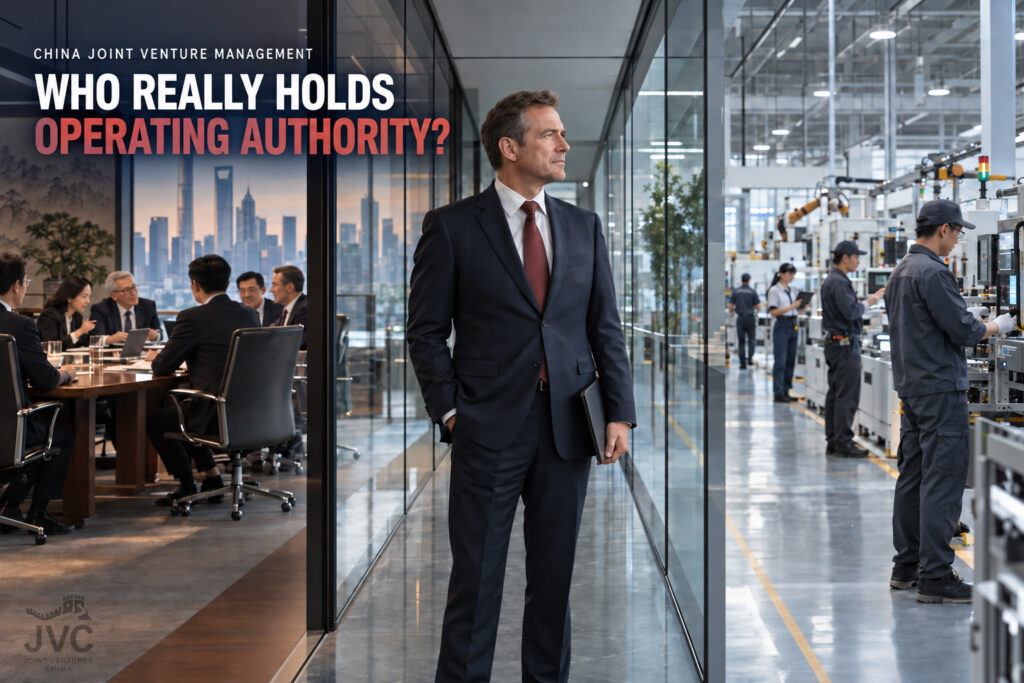
I have spent a good part of my career on both sides of the line that separates governance from management. I have sat in the boardroom discussing what a joint venture should do, and I have served as the China Joint Venture General Manager responsible for making those decisions work inside the business. The view is very different from each side.
From the boardroom, an approved decision can feel complete. The issue has been discussed, the resolution has passed, and management has been given direction. Inside the company, however, that is where the real work begins. Someone must interpret what the board intended, reconcile competing priorities, assign responsibility, secure the resources, and persuade the organization to move.
In a China joint venture, much of that responsibility comes together in the office of the general manager. The shareholders define the venture’s purpose, and the board holds formal governing authority, but the GM sits closer to the daily flow of information and action. That proximity shapes what the board sees, how quickly problems are raised, which initiatives receive attention, and whether an approved decision becomes an operating priority.
This is why China joint venture management can be difficult to understand from outside the company. Ownership percentages and board seats are visible. Daily influence is not. A shareholder may appear well protected on paper while becoming disconnected from the people, information, and decisions that determine how the business operates.
The important question is not simply which shareholder has the right to appoint the China joint venture general manager. It is whether the company has created a management system in which the GM has enough authority to lead while remaining accountable to the full board and to the joint venture itself.
China Joint Venture Management Depends on Two Levels of Authority
A joint venture needs both governance and management, but the distinction between them is often clearer on paper than in practice.
The board sets the direction of the company. It approves the strategy, budget, major investments, senior appointments, and other matters the shareholders have decided should not be left to management alone. The general manager operates within that direction, leading the management team and making the many decisions required to keep the company moving between board meetings.
The boundary is tested whenever an issue is important enough to concern the shareholders but operational enough to require a timely decision. A customer opportunity may require pricing flexibility. A production problem may require unplanned spending. A key employee may need to be hired or replaced. Each decision may fall within management’s normal responsibility while still affecting the interests of the shareholders.
A China joint venture management structure can weaken in either direction. If the board tries to approve every meaningful action, the company becomes slow and the GM cannot lead with confidence. If the board delegates broadly without defining the limits, management may make decisions that one or more shareholders believed were reserved for the board.
The answer is not simply to give one side more power. The board must retain control over decisions that can materially change the direction, risk, or value of the venture. The general manager must have enough authority to make the operating decisions that allow the company to execute.
When China joint venture management is working well, those two levels reinforce each other. The board does not run the company, and the GM does not determine its direction independently. Governance provides authority and accountability. Management turns both into action. China does not change that relationship, but it often makes the relationship more difficult to maintain.
The current PRC Company Law reinforces this distinction. For a limited liability company with a manager, Article 74 provides that the board appoints or removes the manager, while the manager remains accountable to the board and exercises authority under the Articles of Association or authority granted by the board. The legal framework therefore establishes the relationship, but the governing documents and board decisions still determine how that relationship will operate inside a particular joint venture.
The formal rules matter because effective China joint venture governance begins with a shared understanding of which decisions belong to the board and which have been delegated to management.
How the General Manager Turns Board Authority Into Action
The general manager is sometimes described as though the role were simply the highest position on an organization chart. That misses what makes the position so important in a joint venture. The GM is the point at which decisions made in one part of the organization must become action in another.
A board may approve an annual budget, but the budget does not determine which problem receives attention on Monday morning. It may authorize a capital project, but it does not coordinate the engineers, contractors, permits, suppliers, and internal approvals required to complete it. It may approve a sales plan, but it does not decide how aggressively the company should pursue one opportunity or respond to a competitor.
Those decisions accumulate every day. Individually, many are too small for the board. Collectively, they determine whether the company follows the direction the board intended.
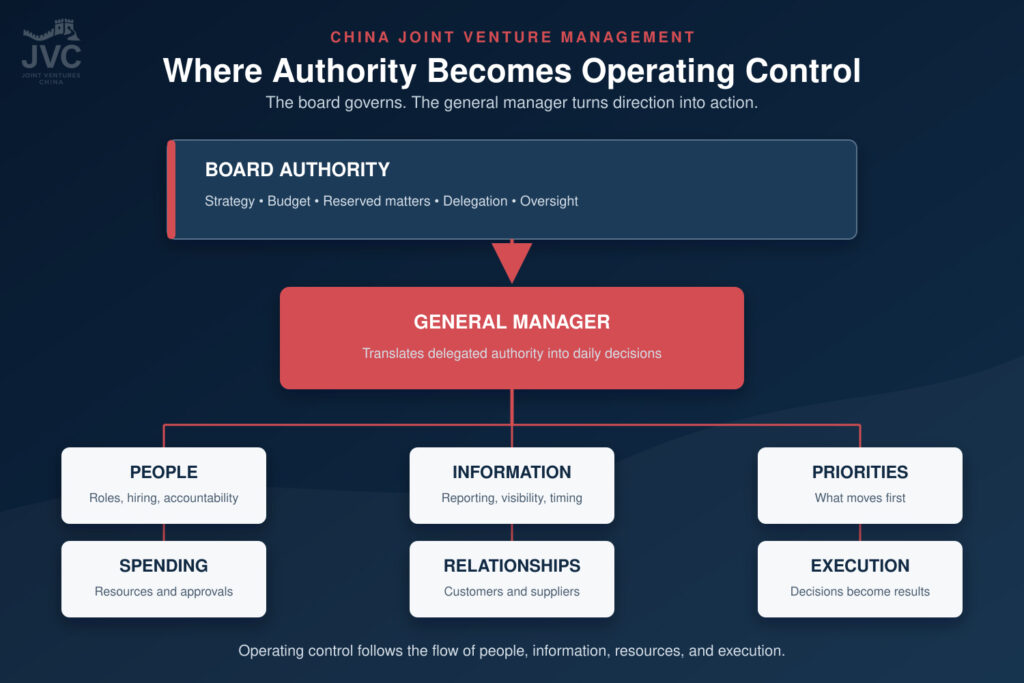
Much of the authority of the joint venture general manager comes from being close to those decisions. The GM receives information before it has been compressed into a board report, sees where resources are constrained, and knows which commitments are moving forward. No board can receive every production delay, personnel concern, customer request, or spending decision. Someone must decide what requires immediate action, what can wait, and what should be brought to the directors.
Priorities create another source of influence. A joint venture may have an approved strategy and operating plan while facing more demands than its people and resources can support. The company cannot treat every customer request, technical project, hiring need, and cost problem as equally urgent. The choices about what moves first rarely look like governance decisions, but over time they determine which parts of the strategy receive attention.
Personnel matters for the same reason. Employees respond not only to an organization chart, but also to the person who assigns responsibility, evaluates performance, approves resources, and influences advancement. If functional managers believe their real accountability runs to a shareholder, chairman, or parent organization, the GM may carry formal responsibility without full management authority.
The GM also interprets what the board has approved. A resolution may authorize a facility move, approve a commercial policy, or direct management to reduce costs without prescribing every step. Management must still decide the sequence, acceptable risks, speed of implementation, and when changing conditions justify a different approach.
A general manager who cannot exercise judgment is not really managing. The problem begins when necessary judgment becomes indistinguishable from changing the decision itself. A board decision can be implemented quickly, slowly, partially, or in a way that satisfies its wording without achieving its purpose.
This influence becomes especially important when one shareholder is close to the factory, employees, suppliers, and local relationships while another depends on scheduled meetings and translated reports. The GM is then shaping not only operations, but also the shared understanding on which governance depends.
Strong general managers recognize the responsibility that comes with that position. They use their proximity to give the full board a clearer view of the company, turn agreed direction into coordinated action, and identify when an operating decision has become important enough to require renewed board involvement.
Appointment Rights Do Not Guarantee Management Control
Foreign shareholders are often advised to protect the right to appoint the general manager. The logic is understandable. If the Chinese shareholder appoints the chairman, allowing the foreign side to nominate the GM appears to create balance.
It can help, but the balance is not as simple as the organization chart suggests.
A foreign-appointed GM may be responsible for performance while lacking the management authority needed to direct important functions. The finance manager may look to the Chinese shareholder for direction. Human resources may follow practices inherited from a parent organization. Procurement may depend on relationships controlled elsewhere. Deputy general managers may have stronger internal networks or more direct access to the chairman. The company seal, bank account, licenses, and government contacts may also sit beyond the GM’s practical reach.
The foreign shareholder may have secured an appointment right without securing meaningful China JV management control. This helps explain who actually controls a China joint venture, because operating influence often follows access to people, information, resources, and execution rather than the appointment right alone.
The reverse also deserves attention. A Chinese-appointed GM is not automatically incapable of serving the full joint venture. Many understand the local organization, know how to move issues through internal channels, and bring relationships the company genuinely needs. With clear authority, common objectives, transparent reporting, and collective oversight, that GM may be more effective than an expatriate appointed mainly to give the foreign side a sense of control.
Nationality is a poor substitute for governance. The more important question is whether the general manager understands that the role belongs to the joint venture rather than to the shareholder that nominated them.
That becomes harder when the GM remains closely connected to the appointing shareholder through compensation, another position, career history, personal loyalty, access to senior leaders, or dependence on the parent for technical and organizational support. Such relationships are common and may be part of what allows the venture to function. A GM with strong ties to a Chinese parent may secure resources and resolve local issues. A foreign-appointed GM may provide access to technology, customers, and global leadership.
The problem begins when those useful relationships become an alternative line of authority.
The GM may receive informal direction before a board meeting or feel pressure to delay an action that conflicts with one shareholder’s interests. Information may begin flowing to one side first because that communication feels normal and efficient. Eventually, the full board receives issues that have already been shaped elsewhere.
Accountability then becomes difficult to locate. The board assumes the GM is acting under delegated authority. The GM believes one shareholder has already provided direction. The other shareholder sees a decision that was never properly discussed. Each can describe its behavior as reasonable while trust continues to decline.
Effective China joint venture management does not require isolating the GM from either shareholder. It requires making accountability to the full board unmistakable whenever an issue affects the venture as a whole. Appointment rights matter, but so do authority over the management team, access to information and resources, agreed performance measures, and collective board oversight.
The general manager can maintain strong shareholder relationships and still act independently, but the role must have one institutional home. That home is the joint venture.
Managing a China Joint Venture?
Subscribe for practical insights on governance, management control, shareholder alignment, and the operating realities that determine whether a China joint venture succeeds.
How the Board Gradually Loses Influence Over Management
Boards rarely surrender authority through one obvious decision. Influence usually weakens through small accommodations that seem reasonable at the time. The erosion often begins not in the board decisions themselves, but in the informal actions that surround them.
A director calls a department manager directly because it is faster than working through the GM. One shareholder receives an informal update before the full board because its representatives are nearby. A management appointment is discussed privately and later presented as the only practical choice. A board resolution identifies the desired outcome but leaves responsibility and follow-up undefined.
Individually, these actions may cause no immediate harm. Together, they change how the company understands authority. Employees learn which conversations matter before the formal meeting. Managers discover whose approval carries the greatest practical weight. The GM begins responding to the shareholder most able to provide resources or remove obstacles.
This is one reason foreign directors can lose influence over China joint venture management without losing a board seat or voting right. Their formal position has not changed. Their distance from the company’s operating conversations has.
The foreign side can contribute to the problem. When directors distrust the management system, they may request more detail, communicate around the GM, or intervene directly in daily decisions. That may produce more information in the short term, but it weakens accountability. Employees receive instructions from several directions, and the GM can no longer be held fully responsible for results.
Once authority becomes fragmented, management can argue that the board has become too involved while directors argue that management is acting without oversight. Both may be partly correct.
The answer is not for the board to withdraw or manage more aggressively. It is to restore a clear relationship in which directors govern through agreed objectives, defined authority, reliable information, and collective oversight of the GM.
When Management Authority Becomes a Governance Problem
Effective China joint venture management requires the general manager to have room to make decisions. The board should not approve every price adjustment, hiring decision, supplier change, production response, or customer commitment. A company managed that way will become too slow to compete.
The difficulty is recognizing when an operating decision has crossed into governance.
That line is not defined by size alone. A small commitment can establish a precedent, alter an agreed policy, or create an obligation that is difficult to reverse. A large expenditure may remain within management authority if it was included in an approved budget. Context matters, which is why approval thresholds can never replace judgment.
In my experience, the clearest warning sign is not that management made a decision the board dislikes. It is that the decision changed the company’s direction, risk, or obligations without allowing the board to exercise authority it reasonably believed it retained.
The same concern arises when management repeatedly delays an approved action, materially changes its implementation, or treats one shareholder’s agreement as approval from the joint venture. The issue is no longer simply execution. It has become a question of who is authorized to decide.
This becomes especially important during China joint venture deadlock. The company does not stop operating while shareholders disagree. Employees still need direction, customers expect answers, and management must continue making ordinary decisions. At the same time, the GM must avoid using the governance vacuum to make strategic commitments that belong to the unresolved board discussion.
One shareholder may insist that an action is necessary to protect the business. Another may argue that the same action would prejudge an issue still before the board. The GM may face competing instructions when the governance system has provided no accepted way to resolve them.
Strong China joint venture management establishes limits for that situation. Normal operations continue. Material changes are escalated. Decisions requiring collective authority are not quietly converted into management actions because the board cannot agree.
The GM’s responsibility is broader than keeping the company moving. It includes recognizing when moving without renewed authority would take the company somewhere the board has not agreed to go.
Accountability Without Micromanagement
When directors become concerned about management control, the instinctive response is often to require more approvals. Spending limits tighten, decisions return to the board, and directors request detail that would normally remain with management.
Some additional oversight may be necessary after trust has weakened. But a board cannot repair an unclear management system by absorbing the general manager’s job. As directors become involved in daily decisions, responsibility moves in the opposite direction. Management can argue that it was following instructions rather than exercising authority.
Accountability requires the GM to have enough management authority to be held responsible for performance.
The board should agree on what the GM must accomplish, which resources and decisions are available, and which matters require approval. Those expectations must be consistent across shareholders. A general manager who receives one set of priorities in the boardroom and another through private conversations is being placed in a position that no governance document can resolve.
Performance measures should reflect the board’s agreed priorities. Revenue, profit, cash flow, quality, safety, project execution, and organizational development may all matter, but their relative importance cannot change according to which shareholder is evaluating the GM.
Important board decisions need an owner, an expected result, a completion date, and a way to report progress or explain changing conditions. This is how the board confirms that its decisions have entered the company’s operating system.
Directors need information for oversight, but they should resist separate channels of command. When they routinely direct employees around the GM, the China joint venture management structure becomes less accountable. The same applies when a shareholder contributes technology, customers, materials, financing, or government support. Those contributions create legitimate influence, but not an undocumented right to direct the company outside its governance process.
A well-governed joint venture gives the GM both authority and limits. Management can run ordinary operations without repeated shareholder approval, while the board can monitor agreed priorities, intervene when authority has been exceeded, and evaluate the GM collectively.
The balance will not remove every tension, but it makes responsibility visible.
The Authority Between the Board Decisions and the Business
In China joint venture management, the most important decisions may be approved in the boardroom, but their value is determined by what happens afterward. Strategy must become priorities. Budgets must become resources. Resolutions must become action by people outside the original discussion.
The general manager stands at the center of that translation from Board decisions to implementation.
This does not make the GM more powerful than the board or shareholders. It makes the role essential to the way their authority reaches the business. When the position is clear and accountable to the full board, the GM can hold together interests that will never be perfectly aligned. When the role is divided, even a sound governance structure can lose its connection to daily operations.
After serving both as a director and as a general manager, I have come to see this connection as one of the most important parts of China joint venture management. The question is not only whether the board has the right to decide. It is whether the company can carry that decision into practice without changing its meaning.
Formal authority begins in the governance structure. Operating authority lives inside the company. The general manager’s role is to keep the two connected.
Frequently Asked Questions About China Joint Venture Management
What does a general manager do in a China joint venture?
The general manager is ordinarily responsible for daily operations and for implementing the direction established through the company’s governance structure. The role commonly includes leading management, coordinating functions, allocating resources, overseeing performance, and escalating material issues. The precise authority depends on applicable law, the Articles of Association, board decisions, delegations, and company policies.
Does the general manager control a China joint venture?
The GM can exercise substantial operating influence, but that differs from formal corporate control. Shareholders and directors retain their assigned authority, while the GM directs many daily decisions through which that authority is implemented. Practical control depends on how clearly management responsibility, information, and board oversight are connected.
Who appoints the general manager of a China joint venture?
For a limited liability company with a manager, Article 74 of the current PRC Company Law provides that the board appoints or removes the manager. One shareholder may hold a nomination right, but nomination and formal appointment are not the same act. The governance arrangements should also address evaluation, compensation, supervision, and removal.
What is the difference between the general manager and the legal representative in China?
The general manager leads daily management. Under Article 10 of the current PRC Company Law, the legal representative is a director or manager who represents the company in conducting corporate affairs, as provided in the Articles of Association. One person may hold both positions, but the roles are not inherently identical.
How can the board hold the general manager accountable?
The board should establish agreed objectives, delegated authority, approval boundaries, and consistent reporting. Important decisions should identify responsibility, timing, and expected results. Directors need information for oversight, but they should avoid operating channels that bypass the GM. Accountability is strongest when the board evaluates management collectively.
Can one shareholder give instructions directly to the general manager?
A shareholder may communicate with the GM and provide information, resources, or recommendations. The problem begins when one shareholder’s instruction is treated as a decision of the joint venture. The GM should decide matters within delegated authority for the benefit of the company. Matters requiring board or shareholder approval should follow the agreed governance process.
Enjoying this Insight?
Get weekly real-world insights on Chinese business culture, joint ventures, and China manufacturing.

About the Author — Kevin Burton
Kevin Burton is the General Manager of a China joint venture company manufacturing advanced fiberglass materials for industrial thermal protection systems and EV safety applications. He writes about Chinese business culture, joint venture governance, and how Western leadership assumptions often collide with China’s execution-driven operating systems.
Editorial Transparency
These articles are based on my professional experience leading manufacturing operations and joint ventures in China. I use AI as an editorial assistant to help organize ideas, improve clarity, and review drafts. Every article is personally reviewed, edited, and approved by me, and the opinions and conclusions expressed are my own.