

A joint venture board has a difficult balance to maintain.
Directors need enough information to understand what is happening inside the business. They need to know whether the company is performing against plan, whether management is addressing problems, whether risks are increasing, and whether important decisions are approaching the point where board involvement is required.
But the board is not supposed to run the company.
When directors become involved in too many operating decisions, the distinction between governance and management begins to disappear. The general manager may technically have operating authority while, in practice, important decisions are continually pushed upward for discussion or approval.
The opposite problem is equally dangerous. A board that delegates authority without effective reporting may have little practical visibility into how that authority is being used.
This is why joint venture board reporting matters.
Strong board oversight does not require directors to participate in daily management. It requires a reporting system that gives them timely, reliable, and comparable information, together with clear rules for when management must escalate an issue.
In a China joint venture, that distinction is especially important. Foreign directors may be thousands of miles from the operation. One shareholder may interact with management more frequently than another. Important information may circulate informally before it reaches the full board. Cultural differences can also affect what management believes should be reported and when a developing problem is significant enough to raise.
The solution is not simply more information.
It is a better information architecture.
Board Oversight Is Not the Same as Management
The starting point is understanding what board oversight is supposed to accomplish.
A board should be able to determine whether the company is performing according to its approved strategy and budget, whether material risks are developing, whether major investments are progressing as expected, and whether decisions requiring board or shareholder action are approaching.
That does not mean directors need to approve every customer price, production schedule, supplier decision, hiring choice, or operating adjustment.
Those decisions normally belong to management.
The distinction matters because management accountability becomes difficult when management authority is unclear. If the general manager is responsible for results but directors continually intervene in the decisions that produce those results, accountability becomes blurred. This is the same boundary explored in our discussion of China joint venture management: the GM needs enough authority to lead while remaining accountable to the full board.
Articles 67 and 74 of the current PRC Company Law reflect this distinction. For limited liability companies, Article 67 gives the board authority over matters including business and investment plans, the internal management structure, appointment or removal of the manager, and basic management systems. Article 74 provides that the manager is responsible to the board and exercises authority under the articles of association or authority delegated by the board.
The exact governance arrangements of any China joint venture will depend on its articles of association, shareholder agreements, ownership structure, and applicable law. But the broader principle is useful: management needs authority to manage, while the board needs enough information to oversee how that authority is being exercised.
Good joint venture board reporting is what connects those two responsibilities and supports the way a China joint venture board actually functions.
Why Reporting Becomes More Difficult in a China Joint Venture
Most companies already have some form of management reporting. Revenue is tracked. Financial statements are prepared. Production data is collected. Budgets are compared against actual results.
A joint venture adds another layer of complexity because there are multiple owners.
Those owners may have different strategic objectives, accounting practices, risk tolerances, and expectations about what the board should receive. This complexity is not unique to China. BCG notes that joint venture boards must operate across different parent companies with overlapping but not identical objectives, often while managing continuing operational, financial, and talent connections between the owners and the venture.
In an international joint venture, the differences can be greater.
Foreign directors may visit the operation only several times each year. Chinese directors or shareholders may have much more frequent contact with local management. One group may receive information through formal board channels while another also receives information through personal relationships or shareholder reporting systems.
None of this is necessarily inappropriate. But over time, information asymmetry can develop.
One shareholder begins to understand a problem before another does. One group of directors knows the background behind a decision while another sees only the result. Informal conversations begin to influence how an issue is understood before the full board discusses it.
This is one reason foreign directors can lose influence in China joint ventures even when their formal board rights have not changed.
The directors who feel less informed then ask for more information. Management responds with more spreadsheets and presentations, yet the board may still lack clarity.
The problem is often not lack of information.
It is lack of a defined information architecture.
What Good Joint Venture Board Reporting Should Actually Include
The purpose of management reporting is not to transfer every piece of operating data to the board.
It is to give directors enough information to understand performance, identify exceptions, recognize emerging risks, and make informed decisions when board action is required.
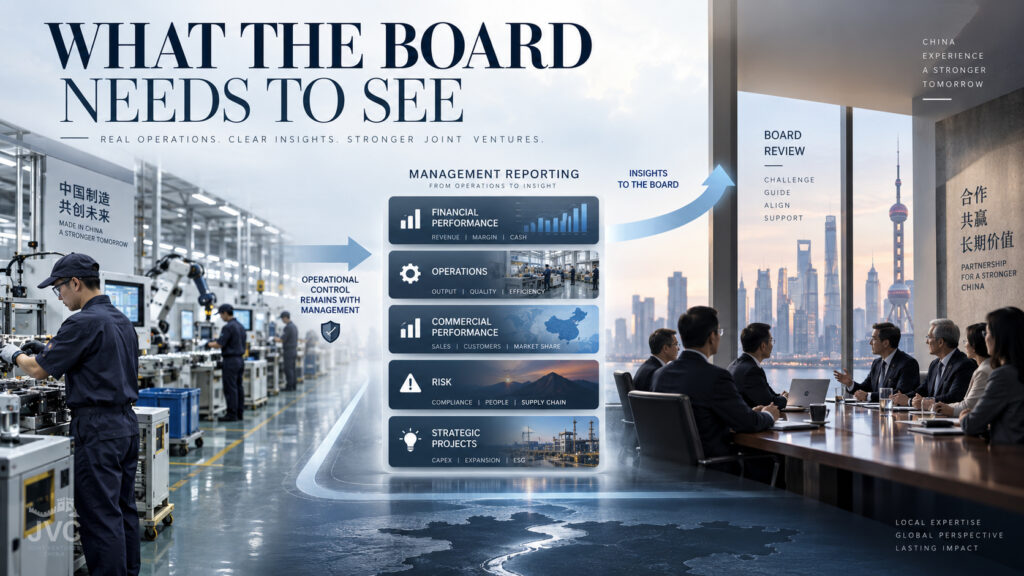
For most operating joint ventures, that means consistent reporting across several categories.
Financial Performance
Good management reporting should go beyond presenting an income statement.
Directors should be able to see revenue, gross margin, operating profit, cash position, receivables, inventory, and other significant measures relative to budget and prior periods.
Variance is often more important than the number itself.
If gross margin declines, directors should understand why. If receivables or inventory rise sharply, management should explain the cause.
A useful report provides enough context to understand what changed and why.
Operational Performance
For board oversight in a manufacturing joint venture, financial results alone are not enough.
Revenue and profit are lagging indicators. Many problems that eventually affect financial performance begin much earlier in operations.
Depending on the business, the board may need to see production output, capacity utilization, delivery, quality, scrap, productivity, downtime, customer complaints, or major supply constraints.
A plant manager may need dozens of measures to operate a factory. Directors need the smaller group that reveals whether the business is functioning as expected.
Commercial Performance
Sales reporting should extend beyond a single revenue number.
The board may need visibility into sales versus plan, major customers, new business development, pricing pressure, lost business, customer concentration, and meaningful market changes.
A company can meet its monthly revenue target while its underlying commercial position is deteriorating. Revenue may remain strong while pricing weakens, or current shipments may look healthy even as the sales pipeline declines.
Good management reporting gives directors some visibility into where the business is going, not only where it has been.
People and Organization
The board does not need to review every personnel change.
It does need visibility into organizational issues that could materially affect the business, including senior management turnover, difficulty filling critical positions, succession risk, significant restructuring, or capability gaps affecting the strategic plan.
This becomes particularly important when key positions sit close to the boundary between shareholder influence and company management.
Clear reporting lines and management accountability matter.
Risk and Compliance
Some matters belong in board reporting even when their immediate financial impact is limited.
Examples include significant quality failures, environmental or safety issues, tax matters, litigation, cybersecurity incidents, major customer disputes, regulatory concerns, intellectual property issues, or critical supplier risks.
The objective is not to elevate every operational problem to the board. It is to prevent material risk from remaining invisible until the consequences are already serious.
Strategic Projects and Capital Investment
Major investments also need continuing visibility.
Once a board approves a large project, oversight should not end with authorization.
Management should report progress against the assumptions behind the original decision, including budget, timing, milestones, expected benefits, significant risks, and material changes in scope.
Board oversight should continue after approval without requiring directors to manage the project themselves.
Good Management Reporting Focuses on Exceptions, Not Data Volume
One of the easiest mistakes in board reporting is to equate more information with better governance.
They are not the same.
A long presentation can contain enormous amounts of data while still failing to tell directors what they need to know.
The board should not have to search through twenty tables to discover that margins have fallen materially, a major customer complaint remains unresolved, or a capital project is months behind schedule.
Effective joint venture board reporting makes exceptions visible.
A director should be able to understand:
- what changed
- what is off plan
- why it changed
- what management is doing about it
- whether board involvement is required
The underlying detail should still be available when needed. But the primary report should distinguish ordinary operating variation from developments that deserve attention.
This is where management reporting becomes a governance tool rather than simply an administrative process.
The board is not trying to run the business through the report. It is trying to understand whether the business remains within the performance, risk, and authority boundaries that have been established.
Establish Reporting Thresholds Before Problems Occur
Many reporting disputes begin because no one has agreed on what management is required to escalate.
Consider a quality problem.
Does the board need to know about every customer complaint?
Probably not.
Should directors learn promptly about a defect that could trigger a major recall, regulatory issue, or loss of a strategic customer?
Almost certainly.
The difficult question is where the line sits between those situations.
That line should not be invented during the crisis.
The board and management can establish reporting thresholds in advance.
These might include:
- capital expenditures above a defined amount
- revenue or margin variances exceeding an agreed percentage
- customer losses above a certain annual value
- litigation or claims above a defined exposure
- significant regulatory notices
- major environmental or safety incidents
- quality failures affecting strategic customers
- unplanned production interruptions exceeding a specified duration
- senior management departures
- commitments outside approved authority
- major changes to approved investment projects
The exact thresholds will vary by company.
The principle does not.
Routine matters remain with management. Significant exceptions cross into board visibility according to rules that management already understands.
This strengthens management accountability while protecting both sides.
Management does not have to wonder whether every difficult decision requires board involvement. Directors do not have to worry that management will decide independently which bad news is important enough to mention.
The escalation framework has already established the boundary.
Reporting Cadence Matters as Much as Reporting Content
Even excellent information becomes less useful when it arrives too late.
A board that meets quarterly cannot rely exclusively on quarterly reporting if management is operating a fast-moving business.
By the time directors see a developing problem, the issue may already be several months old.
A more effective system usually uses several reporting rhythms.
Monthly reporting provides the recurring financial and operational picture.
Quarterly board meetings allow deeper discussion of strategy, investment, organization, risk, and significant performance issues.
Major exceptions should be reported when they occur rather than waiting for the next scheduled meeting.
Annual reviews can address the budget, strategic plan, major capital requirements, organizational capability, and longer-term priorities.
A predictable cadence can reduce unnecessary intervention because directors know they will receive the information they need reliably.
Stay Ahead of China JV Governance Problems
Good governance usually breaks down long before a board realizes it has lost visibility.
Subscribe to Joint Ventures China for practical insights on board oversight, management authority, shareholder alignment, and the operating realities that determine whether a China joint venture actually works.
Equal Information Access Matters in China Joint Venture Governance
China joint venture governance becomes fragile when different groups of directors operate with materially different information.
One shareholder may have employees working inside the venture or frequent access to the general manager while foreign directors rely primarily on formal reporting.
Those relationships may be entirely legitimate. For China joint venture governance, the important question is whether material information ultimately reaches the full board consistently.
If one group regularly learns about significant issues earlier than another, the board stops operating from a common factual foundation. Suspicion grows, and management becomes caught between competing expectations.
A stronger system establishes a formal information baseline that all directors receive.
Individual shareholders may still maintain legitimate additional reporting relationships, subject to the company’s governance and confidentiality rules. But material board-level information should not depend on which director happens to have the closest relationship with management.
Information imbalance can become influence imbalance long before it develops into an open governance dispute.
Management Accountability Starts With Clear Expectations
It is easy for a board to say management should provide better information.
It is harder to define what “better” means.
Management accountability requires clarity.
What information is required?
When must it be provided?
In what format?
Against which targets?
Which KPIs remain consistent from period to period?
Which developments require immediate escalation?
Who is responsible for preparing the report?
If those questions have never been answered, directors and management may both believe they are behaving reasonably while operating from very different expectations.
The board may believe management is withholding information. Management may believe directors continually change what they want to see.
That tension is avoidable.
The board should define the reporting framework. Management should own the process of producing accurate, timely, and useful information within that framework.
Once expectations are clear, accountability becomes much more objective.
The discussion changes from:
“Why didn’t you tell us about this?”
to:
“This exceeded the agreed threshold and should have been reported.”
That is a healthier governance conversation.
What Poor Board Reporting Looks Like
Weak reporting systems often reveal themselves through recurring patterns.
Board materials arrive immediately before the meeting. Reports contain numbers but little explanation. KPIs change frequently, making trends difficult to compare.
Management spends most of the meeting presenting routine information rather than discussing issues that require director attention. Negative developments appear only after directors ask the right question.
Directors repeatedly request the same data because it never becomes part of the standard reporting process.
At one extreme, every operating problem is escalated because management does not know where its authority ends. At the other, nothing is escalated because management assumes the board only wants information at formal meetings.
Repeated uncertainty around authority and escalation can also contribute to the conditions that eventually produce China joint venture deadlock.
None of these problems is solved simply by adding another spreadsheet.
The reporting architecture itself needs to improve.
A Board Report Should Lead to Discussion, Not Replace It
The reporting package is not the board meeting.
Its purpose is to prepare directors for the discussion.
Routine performance information should ideally be understood before the meeting begins. Board time can then focus on exceptions, decisions, risk, strategic choices, and issues where management genuinely needs guidance.
This is particularly important for international boards.
If a large portion of the meeting is spent translating or explaining basic operating data, there is little time left for governance.
The written materials therefore need to do more of the explanatory work before directors enter the room.
This also places responsibility on directors.
Good board oversight requires directors to review the information, identify important questions, and distinguish between asking for clarification and attempting to manage the issue themselves.
Reporting Should Evolve as the Joint Venture Evolves
A reporting system should not remain static forever.
A new joint venture may require close visibility into cash, startup costs, customer qualification, equipment commissioning, hiring, and capacity development.
A mature venture may place more emphasis on margin, productivity, market share, new product development, working capital, or strategic investment.
Rapid growth may require more attention to capacity and cash. A downturn may shift the focus toward cost, inventory, receivables, and customer risk.
The board should periodically ask whether its reporting still reflects the issues that matter most, while keeping core measures stable enough to show trends over time.
The Goal Is Visibility Without Interference
A strong general manager needs enough authority to run the company.
A strong board needs enough visibility to understand how that authority is being exercised.
Those principles do not conflict.
They depend on each other.
When the board has poor visibility, directors naturally seek more involvement. They ask more questions, request more approvals, create additional information channels, and move deeper into operating decisions because they do not trust the reporting system around them.
When management feels every decision will be second-guessed, it becomes more cautious about exercising authority.
Eventually, a governance problem becomes a management problem.
Effective joint venture board reporting interrupts that cycle.
It gives directors enough information to understand performance without requiring them to participate in every decision. It gives management clarity about what must be reported and what remains within its authority. It establishes escalation rules before disagreements occur and gives shareholders a common factual foundation from which to evaluate the business.
The strongest China joint venture boards are not the boards that involve themselves in the greatest number of decisions.
They are the boards that know what management is doing, understand where performance is departing from plan, and know when an issue has crossed from management responsibility into board responsibility.
That is what effective board oversight should accomplish. Good reporting is part of the governance system itself.
Frequently Asked Questions
What should be included in joint venture board reporting?
Joint venture board reporting should normally include financial performance, operating KPIs, commercial performance, major organizational issues, material risks, and progress on significant strategic or capital projects. The most useful reports also explain important variances, emerging issues, and whether board action is required.
What is the difference between board oversight and management responsibility?
Board oversight focuses on strategy, performance, risk, major investments, management accountability, and matters reserved for board decision. Management responsibility covers the day-to-day decisions required to operate the business within the authority and limits established by the board and shareholders.
How often should management report to the board?
The appropriate cadence depends on the business, but many operating companies benefit from monthly financial and operational reporting, deeper quarterly board reviews, and immediate reporting of material exceptions. Significant issues should not be delayed simply because the next formal meeting has not yet occurred.
What KPIs should a China joint venture board monitor?
The right KPIs depend on the business. Common measures include revenue, margin, profit, cash, receivables, inventory, sales versus budget, production performance, delivery, quality, productivity, major customer issues, and progress on important investments. The board should focus on measures that reveal whether the company is performing according to plan rather than attempting to monitor every operating metric.
How can foreign directors maintain visibility into a China joint venture?
Foreign directors should establish a consistent management reporting system with agreed KPIs, reporting schedules, variance explanations, and escalation thresholds. Formal board-level information should be available consistently to all directors so that oversight does not depend primarily on informal access to management.
Practical China JV Governance Starts With Clear Boundaries
The most effective joint ventures do not rely on constant intervention to remain under control.
They establish clear authority, reliable information, and agreed escalation rules.
Joint Ventures China explores these issues from the perspective of executives who have worked inside the operating system, not simply observed it from outside.
Subscribe for future articles on China joint venture governance, management, boards, and the practical realities of operating between shareholders.
Enjoying this Insight?
Get weekly real-world insights on Chinese business culture, joint ventures, and China manufacturing.

About the Author — Kevin Burton
Kevin Burton is the General Manager of a China joint venture company manufacturing advanced fiberglass materials for industrial thermal protection systems and EV safety applications. He writes about Chinese business culture, joint venture governance, and how Western leadership assumptions often collide with China’s execution-driven operating systems.
Editorial Transparency
These articles are based on my professional experience leading manufacturing operations and joint ventures in China. I use AI as an editorial assistant to help organize ideas, improve clarity, and review drafts. Every article is personally reviewed, edited, and approved by me, and the opinions and conclusions expressed are my own.