

A joint venture can have a clear ownership structure and still have an unclear operating structure.
The shareholders may know exactly who owns 50 percent, who appoints which directors, and who nominated the general manager. Yet when an important issue appears, a harder question often emerges: who actually has the authority to decide?
Management may see it as normal operations. A director may believe board approval is required. One shareholder may want shareholder consent. The discussion quickly moves away from the decision itself and toward something more fundamental: joint venture decision rights.
Effective joint venture decision rights do not require shareholders to approve more decisions. They require the company to understand where management authority ends, where board authority begins, and which matters are important enough to return to the shareholders.
Every approval right carries an operating cost. Too little oversight exposes shareholders to decisions they never intended management to make independently. Too much turns normal management into a continuous approval process. Good governance defines clearly when a management decision becomes a governance decision.
Joint Venture Decision Rights Define Who Actually Runs the Company
Ownership tells you who owns the company, but it does not always tell you who controls a China joint venture in practice. Joint venture decision rights tell you how the company is formally expected to operate.
Two companies with identical 50/50 ownership structures can function very differently. One may give its general manager meaningful freedom within an approved budget and strategy. Another may require board approval for contracts, hiring, capital expenditures, pricing, and routine operating changes.
A useful way to think about joint venture decision rights is through four layers: statutory shareholder authority, negotiated reserved matters, board authority, and delegated management authority. Problems begin when those layers blur together.
If every significant operating decision is treated as a shareholder matter, management becomes little more than an administrator. If major strategic commitments can be made entirely within management, the board and shareholders may discover that their oversight exists mostly on paper.
The strength of joint venture decision rights comes from defining the boundaries before a difficult decision arrives.
Start With the Legal Structure Before Negotiating Reserved Matters
A China joint venture does not begin with a blank sheet of paper.
Under China’s current Company Law framework, shareholders retain authority over fundamental matters such as amendments to the Articles of Association, registered capital changes, mergers, divisions, dissolution, and changes in corporate form. The board has defined responsibilities for major business and investment decisions.
The 2023 revision of the Company Law, effective July 1, 2024, also changed the way general manager authority is structured. Rather than relying on the prior statutory list of general manager powers, management authority can be defined through the Articles of Association and board authorization.
For foreign-invested JVs, this became especially important after the Foreign Investment Law transition period ended on December 31, 2024, requiring legacy Sino-foreign ventures to align with the current Company Law framework.
The law is only the starting point. Shareholders commonly negotiate additional reserved matters covering budgets, major capital expenditures, borrowing, guarantees, related-party transactions, acquisitions, disposals, and strategic changes.
Statutory approval requirements and negotiated reserved matters are not the same thing. Joint venture decision rights should make that distinction visible rather than burying both inside one approval list.
Reserved Matters Should Protect the Investment, Not Run the Company
Reserved matters protect shareholders against decisions that could materially alter the economics, risk, ownership, or strategic direction of their investment.
If a JV wants to borrow substantially, enter a new business, dispose of a major asset, transact with an affiliate, or materially depart from strategy, shareholders may reasonably want a direct voice.
The problem begins when the same concept is extended too far. A long reserved matters list can look like strong governance during negotiations. Then the company starts operating. A contract needs approval. An equipment purchase needs approval. A senior hire needs approval. A pricing exception needs approval. A customer commitment needs approval.
Individually, each control may seem reasonable. Together, they can create a business in which management carries responsibility for results while lacking the authority to produce them.
The purpose of reserved matters should therefore be to protect shareholders from decisions that materially affect their investment, not to give shareholders another opportunity to manage ordinary decisions differently than management would.
Well-designed joint venture decision rights preserve that distinction. Joint venture decision rights work best when reserved matters remain exceptional rather than routine.
The Decision Rights Ladder
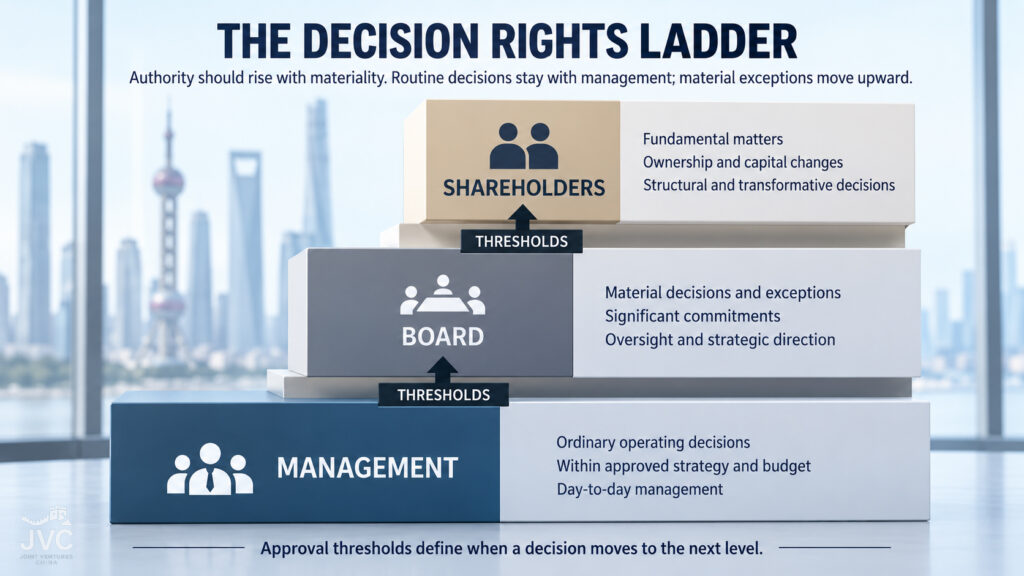
One practical way to design joint venture decision rights is to think of authority as a ladder.
At the first level is management. Management controls ordinary operating decisions that remain within the approved strategy, business plan, budget, policies, and delegated authority.
At the second level is the board. The board becomes involved when a decision is sufficiently material, departs from approved boundaries, changes risk, or represents a significant strategic commitment.
At the third level are the shareholders. Shareholder approval is reserved for fundamental ownership, capital, structural, or strategically transformative matters, together with additional reserved matters the shareholders have deliberately negotiated.
The principle is simple: the higher a decision moves, the more material it should be to the shareholders’ investment.
Without clear joint venture decision rights, decisions move upward defensively. Management asks the board to avoid overstepping, and directors ask shareholders to avoid later challenges.
Over time, escalation becomes normal. Joint venture decision rights should make the default path clear before anyone is under pressure.
What Management Should Be Able to Decide Without Board Approval
Management needs enough authority to run the company.
The exact scope varies by industry, size, and risk, but it should cover routine purchasing, production scheduling, ordinary contracts, approved hiring, budgeted spending, inventory, maintenance, and normal commercial decisions.
The important principle is not that every one of these activities must always belong to management. It is that the boundaries should be explicit.
Suppose the annual budget includes RMB 5 million for a manufacturing improvement program. Management should know how much of that approved amount it can execute without returning to the board for every purchase.
If headcount and salary bands are approved, management should know whether filling an approved engineering position requires another governance approval. If pricing policies establish acceptable margins and commercial terms, the sales organization should know which exceptions require escalation.
This is why the authority of the joint venture general manager matters so much. Responsibility without clearly delegated authority creates a position that looks powerful on an organization chart but remains dependent on directors or shareholders.
The practical test of joint venture decision rights is whether management knows what it can actually decide.
Board Approval Requirements: What Should Go to the Board?
Board approval requirements should focus on decisions that are genuinely material to the company but do not necessarily rise to the level of fundamental shareholder action.
Depending on the JV, these may include major unbudgeted capital expenditures, substantial contracts, borrowing or guarantees, major business-plan deviations, key executive appointments, material litigation, and significant asset purchases or disposals.
But the category alone rarely tells us whether something should require board approval.
Replacing a production machine for RMB 300,000 under an approved capital plan is very different from committing RMB 30 million to a major manufacturing expansion. Both are capital expenditures, but they should not necessarily follow the same approval process.
Likewise, a routine annual supply agreement with a long-standing vendor is different from a five-year exclusive sourcing arrangement that changes the company’s cost structure and strategic flexibility.
Board approval requirements should capture materiality and exception, not merely categories of activity. That is where joint venture decision rights become practical rather than theoretical.
Approval Thresholds Matter More Than Long Approval Lists
Governance documents often say that “material contracts” require board approval. The problem appears when someone has to decide what “material” means.
Is a RMB 500,000 contract material? What about RMB 5 million? Does it matter whether the expenditure was already included in the annual budget? Does a three-year customer commitment require approval because of its duration even if the annual value is modest?
Good approval thresholds answer those questions before they become disputes.
Approval thresholds can use absolute value, budget status, a percentage of revenue or assets, contract duration, or risk. Guarantees, related-party transactions, unusual financing, important intellectual property transfers, or commitments outside the approved business scope may require approval regardless of value. Strong systems often combine several methods.
Approval thresholds should also address cumulative exposure. A RMB 5 million limit should not be avoided by splitting a RMB 10 million commitment into smaller agreements. Related transactions may need to be aggregated over a defined period.
The quality of joint venture decision rights depends less on the length of the reserved matters list than on how clearly these boundaries are defined.
“Major expenditure” is open to interpretation. “Unbudgeted capital expenditure above RMB 2 million” is much harder to misunderstand.
Stay Current on China Joint Venture Governance
If you are responsible for a China JV, governance problems rarely arrive one at a time. They usually appear where authority, reporting, incentives, and operating practice overlap.
Subscribe for practical articles on China joint venture governance, management accountability, board effectiveness, and the issues that emerge after the agreements are signed.
Board Approval and Shareholder Approval Are Not the Same Thing
Another common governance mistake is treating board approval and shareholder approval as interchangeable.
Directors govern through the board, although understanding how a China joint venture board actually works requires looking beyond the formal meeting itself. Shareholders exercise ownership rights through the shareholders’ meeting. Some decisions belong with shareholders because the law or governing documents place them there. Other major business decisions properly belong to the board.
An unnecessarily shareholder-heavy structure can gradually weaken the board. If every meaningful business decision immediately returns to the shareholders, directors can become little more than an intermediate approval layer.
There is also a difference in perspective. Shareholders naturally consider the interests of their respective parent companies. Directors have duties to the JV itself. Those perspectives may overlap. A board also should not assume authority over matters legally or contractually reserved to shareholders.
Good China joint venture governance therefore requires more than identifying important decisions. It requires assigning them to the correct level. Clear joint venture decision rights make that distinction much easier to operate.
The Annual Budget Should Expand Management Authority, Not Reduce It
The annual budget is one of the most useful tools for defining decision authority.
When a board or shareholders approve a budget, they are doing more than accepting a financial forecast. They are approving assumptions about revenue, spending, headcount, capital investment, working capital, and business priorities.
That approval should create operating space for management.
Suppose the board approves RMB 10 million of capital expenditure for a defined expansion project. If management must return for approval with every related purchase order, the original approval has created little operating authority.
Transaction-level approval thresholds may still be necessary because circumstances change and individual commitments can introduce new risks. But the annual plan should mean something. A budget should authorize management to operate within agreed boundaries, not require every underlying decision to be approved again.
This is where joint venture decision rights and joint venture board reporting should work together. Management receives authority inside the approved plan while directors retain visibility into actual spending, forecast changes, major commitments, and emerging exceptions.
Visibility and approval are not the same thing. Joint venture decision rights preserve that distinction: a board may need to know about a decision without needing to make it.
When Good Governance Turns Into Operating Paralysis
Governance protections rarely look unreasonable one at a time. The problem appears when they accumulate.
Imagine a JV where major contracts require unanimous approval. Approval thresholds were established when the business was one-quarter of its current size. Budgeted expenditures still need separate approval. Senior hiring returns to shareholders. Some decisions need both board and shareholder consent. Terms such as “material” and “significant” are undefined, and approval requests have no required response time.
Each control can be defended individually. Together, they can make the company difficult to operate. Management escalates more decisions, directors move into operational issues, and shareholders begin communicating directly with managers. Formal governance and informal influence start to overlap.
Eventually, a disagreement over what should have been an operating decision can become a shareholder dispute.
This is one path toward China joint venture deadlock. Deadlock is often treated as a problem that begins when shareholders stop agreeing. In reality, the conditions for deadlock can be created much earlier by joint venture decision rights that move too many decisions upward.
The best time to address that problem is before the disagreement occurs.
Build a Decision Rights Matrix Before You Need One
A practical decision rights matrix can remove much of this ambiguity. It should identify the decision, responsible authority, approval threshold, voting requirement where applicable, and what must be reported afterward.
| Decision | Management | Board | Shareholders | Threshold or Condition |
|---|---|---|---|---|
| Routine purchasing | Yes | Within budget and delegated limit | ||
| Budgeted capital expenditure | Yes below threshold | Yes above threshold | Based on delegated limit | |
| Unbudgeted capital expenditure | Yes | Possibly | Defined RMB threshold | |
| Major borrowing | Yes | Possibly | Based on value and governing documents | |
| Routine hiring | Yes | Within approved headcount and salary bands | ||
| General manager appointment | Yes | If specifically reserved | Governing documents | |
| Major related-party transaction | Yes | Possibly | Risk or value threshold | |
| Registered capital change | Yes | Statutory shareholder matter | ||
| Merger or dissolution | Yes | Statutory shareholder matter |
The exact values will differ between a RMB 50 million business and a RMB 5 billion business. Copying another company’s thresholds rarely solves the problem.
The important question is not whether RMB 1 million or RMB 5 million is the correct threshold. It is whether everyone knows which threshold applies before the decision arrives. That clarity is the practical value of joint venture decision rights.
A good matrix also clarifies whether a decision needs a board majority, supermajority, unanimous consent, or shareholder approval. Those mechanics should sit beside the authority boundary.
Joint venture decision rights should evolve with the business. A threshold that was material at RMB 100 million of revenue may become restrictive at RMB 500 million.
A China Joint Venture Needs More Than a Decision Rights Document
Authority does not become real simply because it appears in an agreement, Articles of Association, board resolution, or delegation matrix. The operating company has to behave the same way.
A matrix may let management enter ordinary supplier contracts up to a defined amount while the contract workflow still requires a director’s approval. The general manager may have spending authority while banking controls require a shareholder-appointed executive to approve nearly every payment. The board may authorize hiring within approved headcount while HR still routes ordinary hires back to a shareholder.
The formal authority exists. The operating authority does not.
This is particularly important in China because practical authority is often reinforced through company seals and chops, bank authorization, contract-signing processes, ERP workflows, procurement controls, HR systems, and financial approval procedures.
If those systems do not match the governance structure, employees will follow the controls they encounter every day, not the theoretical authority described in a board resolution.
This is where joint venture decision rights either become operational or remain conceptual. The company’s systems should answer the same question as its governance documents: who is authorized to act, under what circumstances, and at what threshold?
Reporting Completes the Decision Rights System
Delegation works best when the board has confidence that it will remain informed.
That is why joint venture board reporting and joint venture decision rights should be designed together.
Management receives authority to operate. Approval thresholds define when management must stop and escalate. Reporting gives the board visibility into what happened within those boundaries. Exception reporting identifies where the business is moving outside the approved plan.
Together, those elements create a much stronger system than approval rights alone.
Without adequate reporting, directors often respond to uncertainty by demanding more approvals. Without management authority, the business cannot operate efficiently. Without clear approval thresholds, nobody knows when escalation is required.
Strong joint venture decision rights therefore depend on a complete operating system of delegation, thresholds, reporting, and escalation.
The Best Decision Rights System Makes Most Decisions Easy
The real test of joint venture decision rights is not how detailed the governance documents appear. It is what happens when the company needs to make a decision.
Does management know whether it can proceed? Does the board know when an issue belongs with it? Do shareholders know which decisions remain genuinely reserved to them? Are approval thresholds clear enough that people do not debate materiality every time something unusual happens?
A well-governed JV should not have to rediscover its governance structure every time a meaningful decision arises.
Management should have enough authority to execute, the board enough to govern, and shareholders enough protection over decisions that materially affect their investment. Reporting should connect all three.
The best joint venture decision rights make ordinary decisions easier because they keep them at the right level and move true exceptions upward quickly.
Good governance is not measured by how many decisions shareholders control, but by whether important decisions receive the right oversight while the company remains capable of operating.
Frequently Asked Questions
What are decision rights in a joint venture?
Joint venture decision rights define which decisions can be made by management, which require board approval, and which must be approved by shareholders. Clear joint venture decision rights assign authority before a specific issue arises.
What are reserved matters in a joint venture?
Reserved matters are decisions that cannot be made through ordinary management authority and instead require a specified level of board or shareholder consent. Some are reserved by law, while additional reserved matters can be created through the JV’s governing arrangements.
Which decisions should require board approval?
Board approval requirements normally focus on material business decisions, major exceptions to approved plans, significant investments, senior management matters, substantial borrowing, and changes in risk or strategic direction. The right board approval requirements depend on the company’s size, industry, and risk profile.
What is the difference between board approval and shareholder approval?
Board approval involves directors acting through the board. Shareholder approval involves owners exercising rights through the shareholders’ meeting. Clear joint venture decision rights keep the layers distinct.
How should a joint venture set approval thresholds?
Approval thresholds should reflect the company’s size, risk, operating model, and budget. They can use transaction value, budget status, revenue or asset percentages, contract duration, cumulative exposure, or strategic risk.
Can too many reserved matters create joint venture deadlock?
Yes. Too many heightened approvals can push ordinary disagreements upward to the shareholders. Clear joint venture decision rights reduce that risk by keeping normal decisions at the appropriate level.
Enjoying this Insight?
Get weekly real-world insights on Chinese business culture, joint ventures, and China manufacturing.

About the Author — Kevin Burton
Kevin Burton is the General Manager of a China joint venture company manufacturing advanced fiberglass materials for industrial thermal protection systems and EV safety applications. He writes about Chinese business culture, joint venture governance, and how Western leadership assumptions often collide with China’s execution-driven operating systems.
Editorial Transparency
These articles are based on my professional experience leading manufacturing operations and joint ventures in China. I use AI as an editorial assistant to help organize ideas, improve clarity, and review drafts. Every article is personally reviewed, edited, and approved by me, and the opinions and conclusions expressed are my own.