

A joint venture may depend on one of its shareholders for essential materials, components, or services. That arrangement can be a considerable advantage, providing reliable capacity, technical knowledge, and infrastructure that would be difficult to establish independently. It also creates a particular management challenge: the company negotiating the supply terms is partly owned by the company setting them. When prices or conditions change, management must evaluate the commercial consequences while preserving a relationship that matters to the business.
In my work managing a China joint venture, I have come to regard that overlap as an important operating responsibility. Related party transactions in joint ventures require enough information to assess pricing, enough authority to question the terms, and a clear process for addressing competing interests. This article examines the JV as the customer purchasing from a shareholder or its affiliates, and how management can keep that arrangement commercially accountable as the business develops.
Why partner supply can be a genuine advantage
The supply relationship may be one reason the partners formed the venture. A local shareholder might have established manufacturing capacity, specialist materials knowledge, or access to facilities that accelerate the JV’s development. A foreign shareholder might supply technology, components, or technical services. Either can contribute capabilities the venture would otherwise have to purchase, develop, or finance separately. Related party suppliers can therefore make the business more competitive, especially during its early stages.
These advantages should be evaluated with the same care as the costs. Reliable deliveries can reduce inventory requirements, technical support can improve yield, and proximity can shorten the response to production problems. An independent supplier offering a lower unit price may provide less of that support. Management should understand the value of the whole arrangement before proposing changes, including which benefits are contractual commitments and which depend on goodwill or individual relationships.
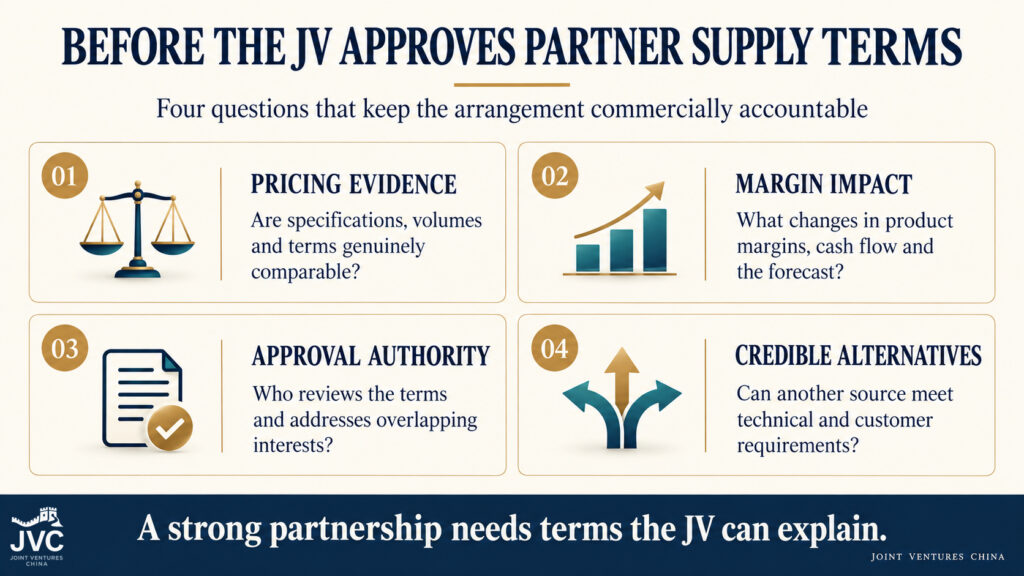
My starting point is that related party transactions in joint ventures should remain commercially explainable as the business develops. What made sense at formation may need adjustment after volumes grow, market prices change, or new suppliers become available. Periodic review gives the partners an opportunity to preserve the arrangement’s strengths while addressing terms that no longer fit the business. Shared ownership should make that discussion possible, although it does not make it automatic.
When supplier economics and JV economics diverge
A shareholder supplying the JV operates its own business. It may face higher input costs, capacity constraints, or pressure to improve margins. The venture, meanwhile, must sell finished products into a market where customers may resist increases or have access to lower-cost competitors. Each business can have a reasonable commercial position while reaching a different conclusion about what the supply price should be. Related party pricing becomes difficult when those two positions are treated as though they must always coincide.
There is also an ownership effect. The supplying shareholder receives the full benefit of its supplier margin, while participating in the JV’s earnings according to its equity interest. Other shareholders participate in the reduction in JV profit without necessarily sharing the supplier’s gain. That difference can create procurement conflicts of interest even when everyone supports the venture’s long-term success. It warrants an explicit discussion of the economics rather than an assumption that ownership keeps every incentive aligned.
Management needs to distinguish a genuine market increase from a change in how value is divided between the supplier and the JV. Rising costs may justify an increase, but the explanation should address its size, timing, and commercial basis. Equally, weak JV margins do not automatically entitle the company to subsidized supply. A sound review of related party transactions in China allows both businesses to present their constraints while keeping the venture’s competitive position visible.
This discussion needs particular care when a shareholder representative has responsibility for both businesses. That person may understand the economics better than anyone else, but their knowledge does not eliminate the competing responsibilities. The company should make the roles explicit and give each business a channel to present its position. Otherwise, management can find itself negotiating with someone who is simultaneously able to influence how the JV evaluates management’s performance.
Make the effect on profitability visible
Consider a simplified hypothetical example. A JV buys an input for RMB 10 per kilogram and uses 0.8 kilograms for each unit of finished product. If the supplier raises the price to RMB 14, material cost increases by RMB 3.20 per finished unit. At an unchanged selling price of RMB 40, gross margin falls by eight percentage points, assuming all other costs remain unchanged. Across 100,000 units, the additional material cost is RMB 320,000.
That calculation does not establish whether the increase is fair. It establishes what the increase means for the operating company. Related party pricing should be presented alongside the effect on product margins, customer commitments, cash requirements, and the annual forecast. Directors can then see whether the JV can recover the cost through selling prices, absorb it temporarily, or needs a different commercial response. Without that connection, the supplier’s explanation and the JV’s financial consequences remain separate conversations.
Related party suppliers may be able to offer transitional terms, volume commitments, or a phased adjustment. These are commercial proposals that need defined quantities, effective dates, and an end point. Management should also consider what happens after temporary support expires. A bridge arrangement can help the JV adapt, but repeated concessions without a credible recovery plan can conceal a business model that needs more substantial attention from the shareholders.
The model should include the timing of customer price recovery. If management can raise selling prices only at the next contract renewal, the intervening loss belongs in the forecast. A temporary reduction in profit can be acceptable where the recovery path is credible and funded. It becomes a different decision when the customer market cannot support the revised cost structure. In that case, the board needs to examine product selection, capacity use, and the underlying business plan.
Evaluate related party pricing with meaningful comparisons
A statement that the price reflects the market is useful only when management understands which market and which transaction it reflects. Materials that share a general description can differ in specification, performance, consistency, packaging, and availability. Volumes, payment terms, freight, and delivery commitments also affect the comparison. Related party pricing needs evidence that accounts for those differences, otherwise the board may be comparing an actual qualified supply arrangement with an indicative quote that could never support production.
For related party transactions in China, an external technical reference is the State Taxation Administration’s guidance on comparability analysis and transfer pricing methods. Its analysis considers product characteristics, contractual terms, functions, risks, and economic conditions. These factors offer a useful reminder that a price comparison requires context. The tax analysis and the commercial assessment of whether the arrangement serves the JV are separate judgments.
Management should document the source and date of each benchmark, the differences from the current arrangement, and the adjustments needed to compare them. If no credible alternative exists, that limitation belongs in the analysis. Related party suppliers should also be assessed against their actual performance, including rejection rates, delivery reliability, and the cost of disruption. A lower price accompanied by poor yield can be more expensive in production, while exceptional service should be supported by evidence rather than assumed because of the relationship.
A pricing mechanism needs rules that work in practice
Agreeing on market-based or cost-plus pricing is only the beginning. A market-based arrangement needs an identified reference, a review frequency, and a way to handle differences in grade or contract volume. A cost-plus arrangement needs agreement on allowable costs, allocation methods, and the margin applied. Related party pricing becomes difficult to verify when overhead is included without explanation or the cost base changes in ways the JV cannot examine.
The agreement should also address how increases are communicated and when they take effect. A purchasing team cannot plan reliably if prices change after customer orders have been accepted or after materials have been delivered. Reasonable notice, a documented explanation, and a defined review process help management assess the consequences before committing the business. This is especially important where related party suppliers provide inputs for products with long quotation periods or customer contracts that restrict price adjustments.
Hong Kong Lawyer’s discussion of contractual safeguards for related-party transactions examines pricing mechanisms, review opportunities, and the management of dependency in private JVs. The supply agreement should provide enough detail for management to review its terms. Related party transactions in joint ventures are easier to manage when the partners agree in advance what evidence is available and how disagreements about terms will be resolved.
An agreement can also define whether market declines flow through to the JV under the same process as increases. If an adjustment mechanism works in only one direction, its economics deserve further discussion. Review periods should fit the volatility of the input and the venture’s customer commitments. The company should understand whether the formula offers genuine predictability or simply delays a cost change until the next renewal, when the accumulated increase may be harder to absorb.
Give management authority to assess the supplier
The general manager is accountable for the company’s performance and needs the authority to investigate costs that affect it. Purchasing should be able to obtain benchmarks, request supporting information, and propose improvements within the approved governance framework. Procurement conflicts of interest become harder to manage when employees believe that asking a commercial question about a shareholder supplier could be interpreted as disloyalty to the partner.
This requires an explicit understanding among the shareholders about management’s role. A request for evidence or an alternative quotation should be treated as part of responsible management. The supplier should have a clear commercial contact, and the JV team should know which decisions it can negotiate and which require approval. I discuss that operating boundary in the general manager’s authority in China joint venture management.
Directors can support the process by directing supplier concerns through the agreed management channel. Informal instructions from a shareholder organization can otherwise reopen purchasing decisions or undermine negotiations already underway. Related party suppliers deserve professional engagement, including clear specifications and reasonable forecasts. Management needs the same professional latitude to raise concerns and recommend changes, with accountability for the quality of its analysis and the consequences of its decisions.
Address procurement conflicts of interest before approval
An annual budget may include expected purchases from a shareholder, but that should not leave the scope of approval unclear. Management and directors need to know whether approval covers a named supplier, a pricing formula, a maximum commitment, or simply a spending forecast. Material changes should follow the applicable approval process. Procurement conflicts of interest are easier to address when the company identifies the overlapping interests before a proposal reaches the board.
The appropriate process depends on applicable law, the company’s documents, and the transaction. Counsel should establish any disclosure, abstention, or approval requirements. Operationally, I would want all relevant decision-makers to receive the commercial basis, the financial effect, and the realistic alternatives. Related party transactions in China should not be presented as routine merely because the supplier has been associated with the venture for many years.
The company also needs a proportionate system. Once a properly reviewed framework agreement is approved, routine orders within its terms can follow delegated authority. Changes to the pricing basis, substantial commitments, or other defined exceptions can trigger further review. This is the practical application of joint venture decision rights and approval boundaries: protect the venture while allowing management to keep purchasing the materials production requires.
Urgent purchases need an agreed route as well. A plant should not discover its approval process during a threatened interruption. The board can establish limited emergency authority, with clear spending limits and subsequent reporting, while counsel confirms the process is permissible. Such authority should address continuity without allowing a temporary exception to establish permanent commercial terms. The decision record should explain why the purchase was necessary and what further review is required.
Alternative sourcing must be technically and commercially credible
The ability to consider an alternative supplier changes the quality of a commercial discussion, but an alternative must be usable. A different input may require production trials, engineering validation, customer approval, or changes to inventory. Management should estimate qualification costs, the time required, and the risk of interruption before presenting a cheaper quotation as a ready replacement. Related party suppliers should be compared with feasible alternatives rather than theoretical ones.
The opposite problem deserves equal attention. A qualification requirement can become an indefinite explanation for never examining another source. The JV should know who can authorize trials, what evidence is required, and how a proposed alternative will be assessed. Procurement conflicts of interest can appear when shareholder influence prevents that evaluation from beginning, even though management has identified a legitimate commercial reason to explore it.
Where a second source is feasible, a limited qualification program may improve resilience without changing the main supply relationship. Where it is not feasible, management should document the dependency and consider inventory, notice periods, capacity commitments, or contingency arrangements. Related party transactions in joint ventures need a realistic account of what the business can do if the supplier changes its terms or fails to deliver. A contractual right to buy elsewhere has limited operating value if no substitute can be qualified in time.
Qualification spending should be judged against both expected savings and continuity value. A backup source may never receive substantial orders yet still reduce the consequences of an outage. Management should explain that purpose openly to related party suppliers so a resilience exercise is not misread as a decision to remove the partner. The eventual sourcing recommendation should reflect production evidence, customer requirements, and the costs of maintaining the alternative.
Supply dependency can extend beyond raw materials
A shareholder may also provide premises, utilities, shared equipment, maintenance, or environmental services. These arrangements can create efficiencies, but they can also make the JV dependent on decisions outside its own organization. Management should map which services are essential, how charges are determined, and who controls continuity. Evaluating related party suppliers one contract at a time can miss the combined effect of several dependencies concentrated with the same shareholder.
For shared services, the basis of allocation matters as much as the headline rate. Management should understand whether charges reflect consumption, capacity reserved, floor area, or another agreed measure. If a cost increases, the explanation should identify whether the underlying rate changed or the JV’s allocated share increased. Related party pricing becomes difficult to assess when several different costs are combined into a single charge with little supporting detail.
The agreements should describe service responsibilities, maintenance expectations, and the response to an interruption. If the JV cannot control the restoration of a critical service, that limitation should appear in its operating risk assessment. A supplier relationship supported by several shared services can be commercially attractive while still requiring stronger contingency planning. Related party suppliers should be evaluated according to the consequences of failure as well as the benefits of normal operation.
Board reporting should show the commercial effect
The board needs enough information to understand whether shareholder supply continues to support the business. Useful reporting identifies material purchases, changes in terms, and their effect on the forecast. It should explain the benchmark used, the supplier’s performance, and any significant dependency. Related party pricing belongs in the board discussion when it materially changes the JV’s earnings outlook, rather than disappearing inside an unexplained cost variance.
Management can make that discussion more useful by separating the supplier’s price effect from changes in volume, product mix, yield, and other costs. The board can then distinguish a procurement issue from a production problem or a weak commercial strategy. Directors should also see what management has already negotiated and which decisions still require their involvement. I develop that distinction further in joint venture board reporting for effective oversight.
Visibility alone does not resolve procurement conflicts of interest, but it gives the company a shared factual starting point. The report should identify the next decision, the responsible person, and the date by which action is needed. If an unresolved supplier issue begins blocking necessary operating decisions, the warning signs discussed in China joint venture deadlock become relevant. Escalation should occur while the business still has workable options.
Keep the supply relationship commercially accountable
Related party transactions in joint ventures can remain valuable for many years when the partners keep their commercial assumptions open to review. Where the partner supplies the JV, that means periodically reassessing the purchasing terms, supplier performance, and dependencies that affect the venture’s competitiveness. The supplier needs reasonable forecasts, timely payment, and a fair return for what it provides. The JV needs dependable performance and terms it can explain to its customers, management, and shareholders. Both businesses benefit from a process that makes those expectations visible before pressure builds.
My view is that the most useful test is whether management can explain why the current arrangement remains appropriate. That explanation should connect related party pricing to comparable evidence and show how the JV is managing its dependencies. It should also identify what would trigger reconsideration. An arrangement that cannot be examined becomes difficult to defend, even where the original rationale was sound and the relationship remains constructive.
For leaders managing related party transactions in China, the responsibility is to protect the venture’s ability to make informed commercial decisions while preserving the capabilities its partners contribute. That requires enough information to assess the terms, enough authority to raise concerns, and an agreed process for reaching a decision. Partner supply works best when everyone can see how it continues to serve the business they jointly own.
The commercial questions change when the supply relationship runs in the other direction and the JV sells products to a shareholder or its affiliates. In the next article, I will examine how selling prices, payment terms, customer concentration, and access to other customers affect the venture’s ability to retain a fair return from the business it generates.
Frequently Asked Questions
Can a joint venture buy materials from one of its shareholders?
Yes, subject to applicable legal and governance requirements. Related party suppliers may provide capabilities central to the venture’s business model. The important management question is whether the arrangement remains commercially justified, with clear supply terms, appropriate approval, and enough information to assess pricing and performance over time.
How should a JV assess prices charged by related party suppliers?
Related party pricing should be evaluated using comparable specifications, purchase volumes, payment terms, and delivery commitments. Management should also consider quality, production yield, and technical support. A lower quotation is meaningful only if the alternative supplier can meet the JV’s requirements at a credible total cost.
Who should approve purchases from a shareholder or its affiliates?
Approval depends on applicable law, the company’s governance documents, and the transaction’s significance. Counsel should confirm any disclosure or voting requirements. To manage procurement conflicts of interest, the approval process should identify overlapping interests and give decision-makers the commercial evidence, financial impact, and realistic alternatives.
Can the JV qualify an alternative supplier when its partner supplies the material?
That depends on its agreements, approval boundaries, and technical requirements. Management should establish whether it can obtain quotations and authorize qualification trials. For related party transactions in joint ventures, a credible alternative requires evidence of production suitability, customer acceptance where necessary, and the cost and timing of switching.
Enjoying this Insight?
Get weekly real-world insights on Chinese business culture, joint ventures, and China manufacturing.

About the Author — Kevin Burton
Kevin Burton is the General Manager of a China joint venture company manufacturing advanced fiberglass materials for industrial thermal protection systems and EV safety applications. He writes about Chinese business culture, joint venture governance, and how Western leadership assumptions often collide with China’s execution-driven operating systems.
Editorial Transparency
These articles are based on my professional experience leading manufacturing operations and joint ventures in China. I use AI as an editorial assistant to help organize ideas, improve clarity, and review drafts. Every article is personally reviewed, edited, and approved by me, and the opinions and conclusions expressed are my own.